
SpaceX launched eight replacement satellites for Globalstar aboard a Falcon 9 rocket from Cape Canaveral, adding fresh capacity to a low Earth orbit network that supports emergency messaging, remote communications and industrial tracking.
The Globalstar 2R Launch 1 mission comes at a pivotal moment for the satellite operator as Amazon moves ahead with its roughly $11.6 billion acquisition of Globalstar. The proposed deal would give Amazon access to an established satellite constellation, ground infrastructure and internationally authorised spectrum as it builds out future direct-to-device services.
Globalstar satellites head to orbit aboard Falcon 9
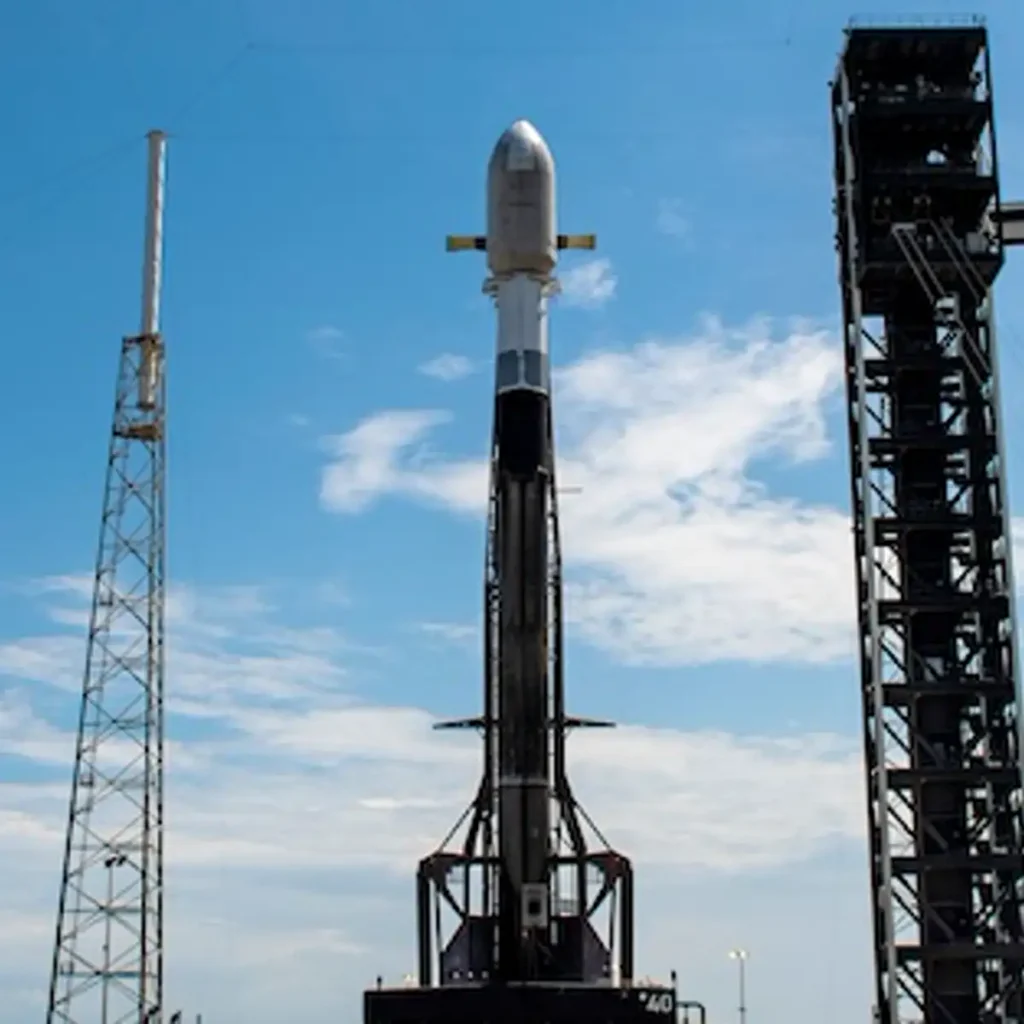
The Falcon 9 mission was scheduled to lift off from Space Launch Complex 40 at Cape Canaveral Space Force Station at 9:12 p.m. EDT on August 15, or 1:12 a.m. UTC and 6:42 a.m. IST on August 16.
- Mission: Globalstar 2R Launch 1
- Payload: Eight replacement satellites
- Launch site: Cape Canaveral Space Force Station
- Falcon 9 booster: B1090, flying for the 14th time
- Weather outlook: 90% favourable
- Deployment: Beginning more than 56 minutes after liftoff and continuing for less than 10 minutes
Weather conditions were largely favourable, although cumulus and anvil clouds remained the main concerns around the launch window. Weak surface winds and high pressure over the Gulf were expected to push isolated showers and thunderstorms inland, leaving lingering cloud cover as the bigger potential issue for launch safety rules.
Booster B1090 was set to return to Landing Zone 40 near the launch complex less than eight minutes after liftoff. A successful touchdown would represent another recovery of a flight-proven Falcon 9 first stage and add to SpaceX’s rapidly growing number of booster landings.
The return-to-launch-site approach differs from the offshore recovery profile used during a recent SpaceX Starlink mission from California. Both recovery methods are central to SpaceX’s reusable rocket strategy, allowing first stages to be inspected, refurbished and flown again.
The Globalstar mission had originally been targeted for May 17 before being delayed to provide additional time for satellite preparations. The eight spacecraft form part of a broader replacement programme covering 17 satellites, with options for another nine.
MDA Space is serving as the prime contractor under an agreement initially valued at $327 million, while Rocket Lab developed the spacecraft buses. Reaching orbit is only the first step: controllers must establish contact with each spacecraft, verify power and communications, test onboard systems and prepare the satellites for operational service.
The replacements are important because Globalstar already supports a wide range of services, from SPOT emergency products and remote asset monitoring to mobile satellite communications and commercial Internet of Things applications.
Globalstar’s network also provides satellite connectivity used by supported Apple devices for services including Emergency SOS, Messages, Find My and roadside assistance when conventional cellular or Wi-Fi coverage is unavailable.
SpaceX Rocket Hits the Moon as NASA Identifies New Crater
SpaceX Stock Rises as 911.5 Million Shares Unlock — Is It a Buy Near $100?
Amazon’s $11.6 billion Globalstar deal raises the stakes
The launch carries added significance because Globalstar could soon become part of Amazon’s expanding satellite business. Amazon announced its agreement to acquire the company in April 2026, a transaction that would bring Globalstar’s satellites, terrestrial infrastructure, technical expertise and spectrum assets under the Amazon umbrella.
Those assets could accelerate Amazon’s ambitions beyond conventional satellite broadband. The shareholder terms and initial market reaction are detailed in this report on Amazon’s $11.6 billion Globalstar acquisition.
The transaction is expected to close in 2027, subject to regulatory approvals and other satellite-related conditions. Globalstar’s existing constellation and replacement spacecraft are expected to complement Amazon Leo’s broadband network as Amazon develops a direct-to-device system capable of reaching ordinary mobile devices outside terrestrial coverage.
Amazon is targeting 2028 for deployment of its next-generation direct-to-device network. The technology is intended to extend voice, messaging and data connectivity into areas where conventional mobile networks are unavailable, placing Amazon in an increasingly competitive satellite-to-phone market alongside companies including SpaceX and AST SpaceMobile.
Maintaining existing customers will remain important during that transition. Amazon and Apple have agreed to preserve satellite connectivity for supported iPhone and Apple Watch models, ensuring that the services already relying on Globalstar’s network are not simply displaced by Amazon’s longer-term plans.
Regulatory work surrounding the acquisition is also progressing. Globalstar said the US antitrust waiting period expired in July, while reviews involving the Federal Communications Commission and authorities outside the United States were continuing.
With the acquisition pending, Globalstar has said it does not plan to hold additional earnings calls or update forward-looking guidance. The company reported second-quarter revenue of $64.8 million alongside record commercial IoT subscriber activations.
SpaceX’s launch schedule was particularly busy around the Globalstar mission. Just 38 minutes after the Cape Canaveral flight, another Falcon 9 was scheduled to depart from Vandenberg Space Force Base in California carrying the classified USSF-366 payload for the United States Space Force.
The second Falcon 9 used a different first-stage booster, flying for the 18th time after previously supporting missions including NROL-126, Transporter-12, SPHEREx, NROL-57 and 13 Starlink launches. Instead of returning to land, the booster targeted SpaceX’s Of Course I Still Love You drone ship in the Pacific.
Residents across parts of Santa Barbara, San Luis Obispo and Ventura counties were advised that sonic booms could be heard depending on atmospheric and local conditions. The USSF-366 flight plan called for stage separation roughly two and a half minutes after launch, followed by a booster landing about eight minutes and 24 seconds after liftoff.
Although the missions were scheduled close together, they were entirely separate operations. Globalstar 2R Launch 1 flew from Florida with eight commercial replacement satellites and an onshore booster recovery, while USSF-366 departed California with a classified military payload and an offshore landing attempt.
For Globalstar’s customers, the immediate significance of the launch is reliability. Satellites have finite operating lives, making timely replacements essential to maintaining coverage and capacity as older spacecraft approach retirement.
For Amazon, however, the same satellites could eventually serve a much broader purpose. If the acquisition closes as planned, Globalstar’s operational network could provide Amazon with a ready-made bridge between today’s satellite messaging and IoT services and a future in which smartphones and other mobile devices remain connected far beyond the reach of terrestrial networks.

Make Swikblog your go-to source on Google for reliable updates, smart insights, and daily trends.