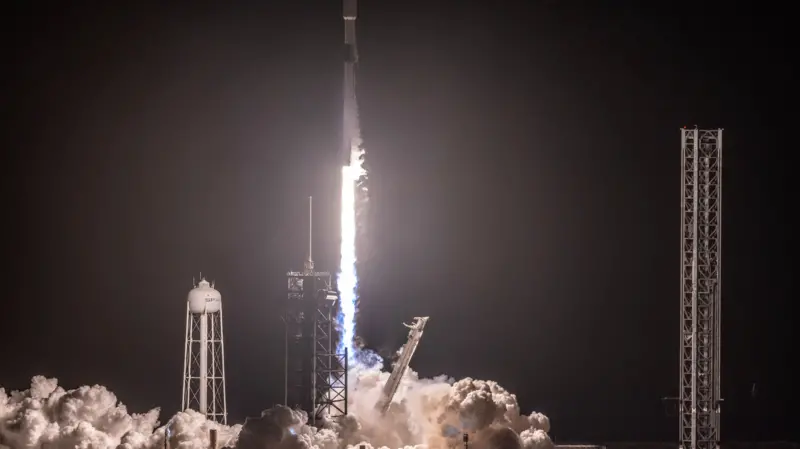

A discarded SpaceX Falcon 9 upper stage has struck the Moon near the Einstein and Bell craters, with scientists detecting chemical signals consistent with the predicted collision.
The four-tonne object, catalogued as 2025-010D, reached the lunar surface at approximately 06:35 UTC on August 5, 2026. It was travelling at about 2.43km per second, equivalent to 8,700km/h or 5,400mph.
No observatory is known to have captured a clear photograph or video of the collision. The strongest evidence came from observations using the European Southern Observatory’s Very Large Telescope in Chile, which detected sodium and lithium shortly after the predicted impact time.
Researchers believe the sodium came from lunar material thrown above the surface, while the lithium was probably associated with the rocket. Combined with the stage’s precisely calculated trajectory, the observations provide convincing evidence that it hit the Moon as predicted.
South Korea’s Danuri lunar orbiter has also photographed the area before and after the collision. The Korea AeroSpace Administration said the observations revealed changes around the expected impact site and indications of material dispersed across the surface.
Falcon 9 Moon impact details
- Object: Spent Falcon 9 upper stage
- Designation: 2025-010D
- Estimated mass: Approximately 4,000kg
- Impact time: About 06:35 UTC on August 5, 2026
- Speed: Approximately 8,700km/h, or 5,400mph
- Impact area: Near the Einstein and Bell craters
- Estimated energy: Nearly three tonnes of TNT
- NASA crater estimate: About 18 metres wide and 3.7 metres deep
- Danger to Earth: None
The Falcon 9 launched from Kennedy Space Center on January 15, 2025, carrying Firefly Aerospace’s Blue Ghost Mission 1 and ispace’s Resilience lunar lander.
Blue Ghost landed successfully in Mare Crisium on March 2, carrying 10 NASA science and technology instruments. Resilience reached lunar orbit but was lost during its landing attempt on June 6, 2025.
The object that hit the Moon was the expendable upper stage, not the reusable first-stage booster commonly seen returning to a landing zone or drone ship. The operation of the separate stages can be seen in this account of a Falcon 9 launch visible across the California sky.
After deploying the spacecraft, the upper stage remained in an unstable, highly elongated orbit. Solar activity and the gravitational influence of Earth, the Moon and the Sun gradually changed its path until it was placed on a collision course.
Independent astronomers identified the trajectory using publicly available tracking data. NASA’s Center for Near Earth Object Studies later calculated that the stage had a 100% probability of hitting the Moon.
The Moon has almost no atmosphere, so the rocket did not burn up or slow significantly before impact. NASA estimated that the collision would create a crater approximately 60 feet, or 18 metres, wide and 12 feet, or 3.7 metres, deep. Those dimensions remain predictions until orbital images are fully analysed.
The impact site was on illuminated terrain close to the lunar limb, making the event difficult to observe from Earth. Any flash would have been brief and faint against the bright surface.
NASA outlined its tracking work and safety assessment in an official statement about the Falcon 9 lunar impact.
What happens after the Moon collision?
Scientists will compare Danuri’s observations with photographs from NASA’s Lunar Reconnaissance Orbiter and the ShadowCam instrument aboard the Korean spacecraft. The images should reveal the crater’s exact position, dimensions and surrounding debris pattern.
The event offers an unusual scientific opportunity because researchers knew the object’s approximate mass, structure, speed and trajectory. Natural meteoroids strike the Moon regularly, but their characteristics are rarely known in such detail before impact.
NASA said an object carrying similar energy hits the Moon about once every six days. The collision posed no threat to Earth and could not change the Moon’s orbit, affect tides or send dangerous debris towards the planet.
NASA also said lunar impacts can be an accepted disposal method when they are planned and accurately tracked. The longer-term concern is preventing uncontrolled rocket stages from threatening landers, satellites, equipment or future astronauts.
The growing competition to develop new Moon missions makes reliable tracking and planned disposal routes increasingly important. Data from this collision could improve impact models and help agencies manage future hardware travelling between Earth and the Moon.

Make Swikblog your go-to source on Google for reliable updates, smart insights, and daily trends.