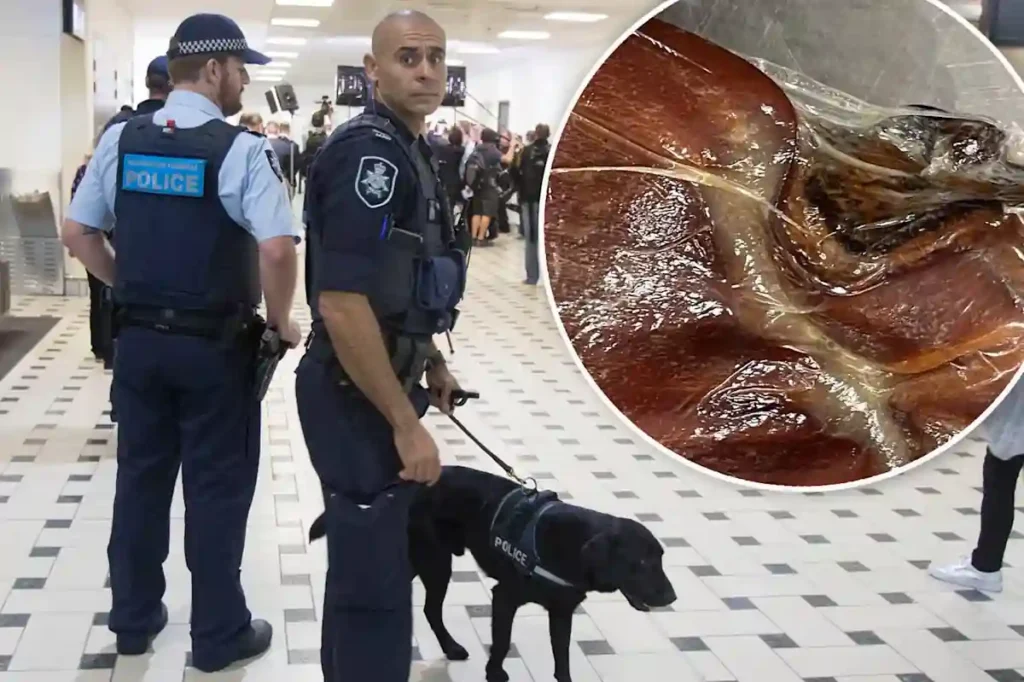

A traveller arriving at Brisbane Airport from Ukraine was fined $3,960 after biosecurity officers found an undeclared ham hock in their luggage, prompting a fresh warning about Australia’s strict rules for food and animal products.
The interception occurred in February 2026. The Department of Agriculture, Fisheries and Forestry later publicised the case to remind international passengers that even cooked, packaged or culturally significant food must be declared when it falls within a biosecurity risk category.
Officers confiscated and destroyed the ham hock. The passenger received an infringement notice equal to 12 Commonwealth penalty units, worth $3,960 at the time. Following an increase in the value of a penalty unit on July 1, an equivalent infringement is now $4,368.
The penalty was issued because the meat was not declared, not because authorities confirmed that it carried a disease. Australia applies controls before a threat becomes established, with officers considering a product’s origin, ingredients, preparation and packaging.
Pork and other meat products can provide a pathway for animal diseases that could affect livestock. An outbreak in Australia could disrupt farms, food production, regional employment and agricultural exports, which explains why officers treat a single food item as more than an airport inconvenience.
The case differs from an interception in which a passenger declares an item but it is refused entry. A separate Australian airport seizure involving a declared alligator skin demonstrated that disclosure does not guarantee admission, but it gives officers an opportunity to assess and manage the risk.
What passengers must declare when entering Australia
Travellers must declare specified food, plant material and animal products. These can include fresh, dried, frozen, cooked, smoked or preserved meat; poultry and seafood; dairy and egg products; fruit and vegetables; seeds, nuts, grains, herbs and spices.
Declarations may also be required for traditional medicines, wooden articles, animal skins, feathers, bones, shells and equipment used around farms or animals. Food taken from an aircraft or cruise ship should not be overlooked.
The requirement can apply to commercially packaged, homemade, cooked or frozen products, including small quantities carried as gifts. Packaging alone does not prove that an item is allowed into Australia.
Declaring a product does not automatically result in a fine. A biosecurity officer may permit it, order treatment, require it to be exported at the traveller’s expense or direct that it be surrendered for destruction. Passengers can also place uncertain goods in designated disposal bins before inspection.
Import conditions can change and may vary according to the product and its country of origin. The safest option is to check the current requirements before travelling and declare anything uncertain on arrival.
Baggage may be examined even when a passenger declares no goods. Screening can involve X-rays, detector dogs, physical inspection and questioning by an officer.
Man Fined $31,000 for Mailing 65 Lizards from WA to NSW: What Happened
Australian Restaurant Hit With $24,000 Fine Over Illegal Seafood Deal
Visit the homepage for the latest Australia news, consumer updates and breaking stories
Current fines and the scale of airport interceptions
At current rates, an airport infringement can begin at two penalty units, or $728. Failure to declare goods known to carry a high biosecurity risk can attract six units worth $2,184 or 12 units worth $4,368.
Concealing conditionally non-prohibited goods can result in a 20-unit notice worth $7,280. The official airport infringement guidance provides the current amounts, payment periods and potential consequences of not paying.
Two-unit notices generally need to be paid before leaving the airport unless the traveller requests more time. Notices involving six, 12 or 20 units generally have a 28-day payment period. Unpaid notices can lead to civil penalty proceedings.
Serious illegal importation is treated separately from an ordinary passenger infringement. Individuals convicted under the Biosecurity Act 2015 can face up to 10 years in prison and fines of up to $1.6 million. Some breaches may also result in visa cancellation for non-citizens who have not completed immigration clearance.
The Brisbane discovery was one of hundreds of thousands of border interventions. In 2025, biosecurity officers intercepted more than 359,000 travellers at Australian airports and confiscated almost 64 tonnes of meat products.
Detector dogs found more than 40,000 high-risk items across airports, seaports and international mail centres during the year. The figures show why declarations are treated as a central part of protecting Australian agriculture, wildlife and the environment.
Before travelling, passengers should check every suitcase, carry-on bag and gift, retain original food packaging and ensure relatives have not packed food without telling them. Travellers should also review their documents before departure, particularly after passport rules disrupted some Australian international journeys.
The practical message from the Brisbane case is simple: declare uncertain goods or dispose of them before inspection. At current rates, failing to disclose a high-risk food item can cost $4,368—far more than the value of the product inside the suitcase.

Make Swikblog your go-to source on Google for reliable updates, smart insights, and daily trends.