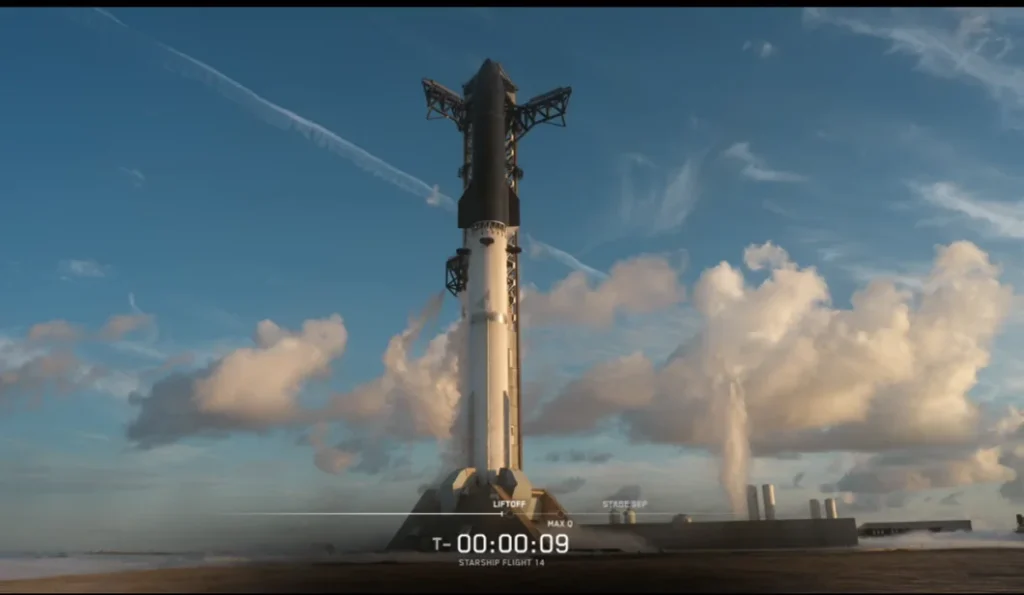

Starship Flight 14 reached orbit on Monday, September 28, but the achievement came with two decisions that changed the course of the mission. One of the spacecraft’s six engines shut down during ascent, forcing controllers to assess whether it was safe to attempt orbit. After Starship deployed its satellites, SpaceX chose to bring it down hours earlier than planned.
The uncrewed rocket lifted off from Starbase, Texas, at about 8:50 a.m. ET. Its Super Heavy booster separated roughly two minutes into the flight, leaving the upper-stage Starship to continue towards space under its own power. Shortly after separation, one of Starship’s Raptor engines shut down, according to News9’s account of the flight.
Starship did not immediately need that engine to enter orbit. ABC News reported that the engine lost during ascent was not required for the orbital insertion burn. The shutdown still mattered because getting into orbit was only one part of the test. Once there, Starship would need to fire an engine again to leave orbit and return over a cleared stretch of ocean.
The decision before the orbital burn
SpaceX had designed Flight 14 with a choice at this exact stage. After its main ascent burn, Starship would initially follow a suborbital path that brought it back towards Earth without another engine firing. Controllers would command a separate burn to put it into orbit only if checks showed the vehicle could later perform a controlled deorbit.
On its Flight 14 mission page, SpaceX said the orbital burn would proceed only after its team confirmed “sufficient redundancy on hardware critical to doing the subsequent deorbit burn.” Its orbital flight explanation says the checks cover Raptor engine health as well as power, communications, flight computers, navigation, propellant tanks, pressure control and the systems that keep the spacecraft pointed correctly. More than 500 physical sensors provide measurements from across Starship.
News9 reported that controllers initially called off the attempt to enter orbit after the engine shutdown, then decided minutes later to proceed. SpaceX has not released a detailed account of that exchange or identified which engine failed. The distinction is important: the reported pause was a decision about whether to make the orbital burn, not an abort of the launch itself.
About 25 minutes after liftoff, Starship performed the insertion burn and entered Earth orbit for the first time. That result was different from its previous 13 test flights, which followed suborbital routes by design. Shortly afterwards, Starship began deploying 26 Starlink V3 satellites intended for use in SpaceX’s internet network. The first-orbit milestone was confirmed, but the rest of Flight 14 was still unfolding.
Why SpaceX ended the flight early
The original plan called for roughly six trips around Earth at an altitude of about 275 kilometres, followed by a deorbit burn and splashdown in the Pacific Ocean west of Chile nearly 10 hours after launch. SpaceX instead said its flight team would deorbit Starship to a pre-cleared area of the Pacific after about three hours. ABC News reported that the new splashdown area was north of Hawaii.
SpaceX has not publicly explained why it selected that earlier return. The engine shutdown may prompt questions about the decision, but the available statements do not establish a connection between the two. Flight 14 had planned checkpoints at which controllers could shorten the mission after reviewing the spacecraft’s condition.
That leaves a more complicated picture than a simple success-or-failure headline. Starship overcame an engine shutdown to reach orbit and deploy satellites. It did not follow the planned nearly 10-hour flight. The cause of the engine shutdown, the reason for the early deorbit decision and the result of Starship’s return will determine what SpaceX learned from the test.

Make Swikblog your go-to source on Google for reliable updates, smart insights, and daily trends.