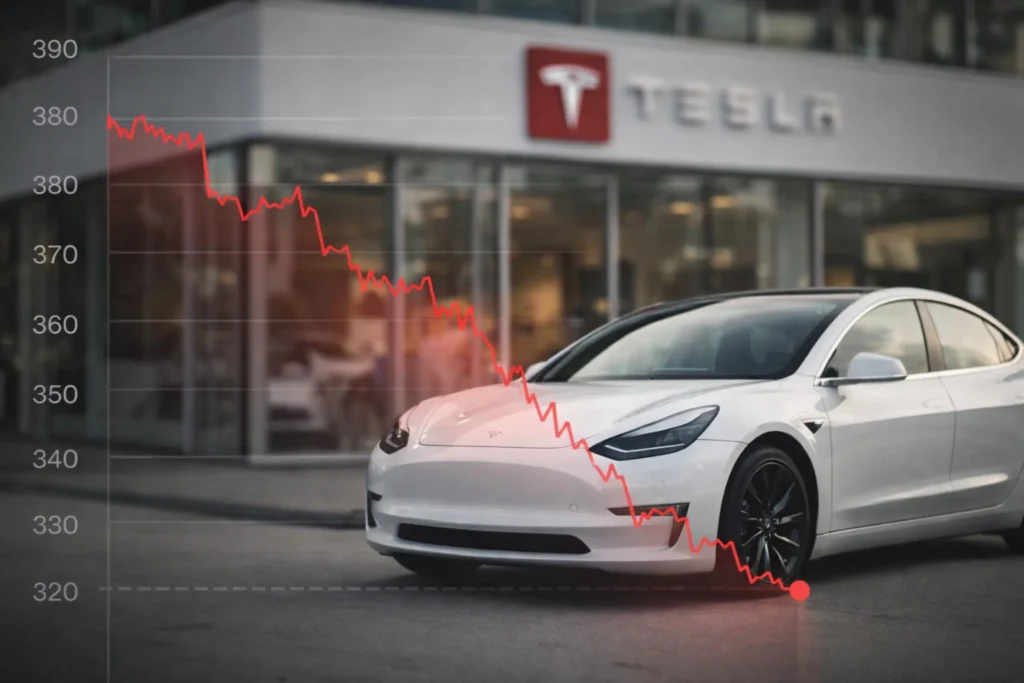

Tesla (NASDAQ: TSLA) stock slipped to $384.60, down 1.88% in Thursday trading, as investors booked profits following a sharp 7.6% rally in the previous session driven by renewed optimism around Elon Musk’s next-generation AI5 chip. The pullback comes as the stock attempts to break an extended eight-week losing streak, highlighting a tug-of-war between short-term traders and long-term believers in Tesla’s artificial intelligence ambitions.
The recent surge in Tesla shares was largely attributed to Musk’s announcement that the company had completed the “tape-out” phase of its AI5 chip — a critical milestone marking the final stage of the chip’s design before manufacturing. According to Deepwater Asset Management’s Gene Munster, nearly 80% of the stock’s sharp move was tied directly to Musk’s post, underlining how sensitive Tesla shares remain to developments in its AI roadmap.
The AI5 chip is expected to deliver a significant leap in performance — potentially up to 5x improvement over previous generations — enabling advancements in full self-driving (FSD), robotaxi deployment, and Tesla’s Optimus humanoid robot program. In a market increasingly viewing Tesla as an AI and robotics company rather than just an electric vehicle maker, such developments carry outsized importance for valuation.
Delays, timelines, and execution challenges
Despite the excitement, the AI5 program has not been without setbacks. The chip has already faced delays of several years, raising questions about Tesla’s ability to execute on aggressive timelines. Analysts estimate that AI5 could begin rolling out by mid-2027, though Musk has not officially confirmed a production schedule.
At the same time, Tesla is pursuing an even more ambitious strategy — building its own semiconductor fabrication facility, known as “Terafab,” in Austin, Texas. The move would mark a dramatic shift toward vertical integration, potentially allowing Tesla to design and manufacture its own chips at scale.
However, the scale of this ambition is staggering. Bernstein analysts estimate the total cost of the Terafab project could range between $5 trillion and $13 trillion, a figure that dwarfs typical semiconductor investments and highlights the magnitude of the challenge. Even industry leaders like TSMC and Intel operate with significantly lower capital expenditures.
Adding urgency to the initiative, Bloomberg reported that Musk is pushing suppliers to move at “light speed,” demanding turnaround times in days rather than weeks. Tesla is reportedly willing to pay a premium to secure equipment and services faster, with suppliers including Applied Materials, Tokyo Electron, and Lam Research involved in early discussions.
Despite this aggressive push, sources indicate that meaningful chip production from the Terafab facility may not begin until around 2029, suggesting a long road ahead before the project contributes to Tesla’s bottom line.
Market reaction and investor sentiment
Thursday’s decline reflects a natural pause after a rapid price increase rather than a fundamental shift in sentiment. Tesla’s stock has been under pressure for weeks, and the recent rally provided an opportunity for traders to lock in gains. The move also highlights a broader pattern: Tesla shares often react sharply to forward-looking announcements but struggle to sustain momentum without near-term financial validation.
Investor sentiment remains divided. Bullish investors argue that Tesla’s AI initiatives could unlock entirely new revenue streams, transforming the company into a leader in autonomous mobility and robotics. They point to the potential of robotaxis, AI-driven services, and vertically integrated chip production as long-term catalysts that justify a premium valuation.
On the other hand, skeptics caution that many of these opportunities are still years away from commercialization. They highlight execution risks, rising capital requirements, and the uncertainty surrounding timelines as reasons for caution. The delay in AI5 development only reinforces concerns about whether Tesla can deliver on its most ambitious promises.
Financial focus shifts to upcoming earnings
With major AI announcements already influencing the stock, investor attention is now turning to Tesla’s upcoming earnings report scheduled for April 22. The results will provide critical insight into the company’s core business performance, including revenue growth, margins, and earnings.
Key figures such as total revenue, automotive margins, and earnings per share will be closely watched, particularly as Tesla navigates a competitive EV landscape marked by pricing pressure and shifting demand dynamics. Investors will also be looking for updates on capital expenditure plans, especially in relation to AI infrastructure and chip manufacturing.
The challenge for Tesla is clear: it must demonstrate that it can maintain strong financial performance while simultaneously investing heavily in long-term innovation. Striking that balance will be crucial in determining whether the stock can sustain its recent rebound.
Looking ahead, Tesla’s trajectory will likely depend on its ability to convert ambitious vision into tangible progress. The AI5 chip represents a significant step forward, but it is only one part of a much larger strategy that includes autonomy, robotics, and semiconductor manufacturing.
The timeline for these initiatives remains uncertain, and investors will be watching closely for concrete milestones. While Musk’s track record of pursuing bold, unconventional projects has earned him a loyal following, it has also introduced volatility into Tesla’s stock.
For now, the dip to $384.60 suggests that the market is taking a more measured approach after an initial wave of enthusiasm. The coming weeks — particularly the earnings report — will be critical in determining whether Tesla’s latest rally marks the beginning of a sustained recovery or just another short-lived spike.
For real-time updates and detailed market data, investors can track Tesla’s performance on Yahoo Finance.

Make Swikblog your go-to source on Google for reliable updates, smart insights, and daily trends.