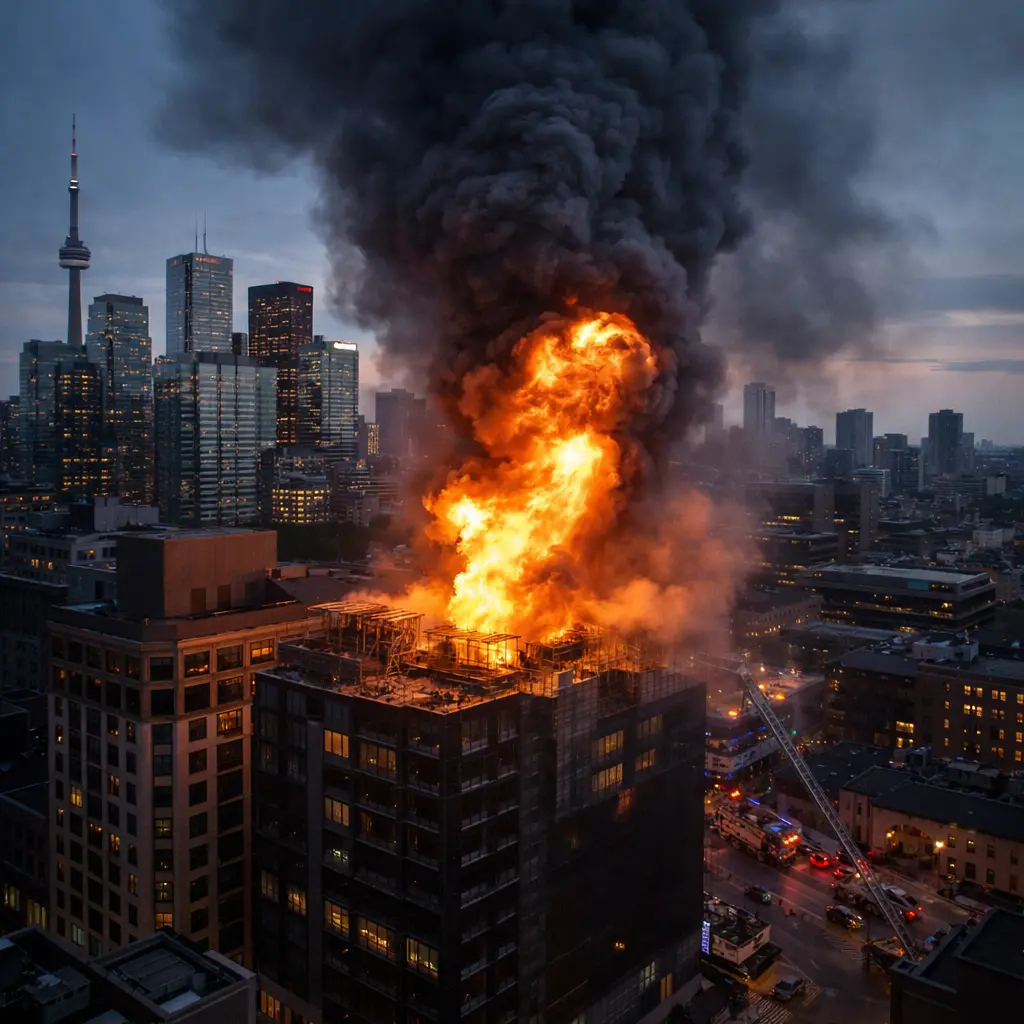

Downtown Toronto was rocked by a dramatic explosion and rooftop fire Friday evening after multiple propane cylinders burst on top of a commercial building under construction. The incident, which unfolded near Richmond Street West and John Street shortly after 6 p.m., sent thick black smoke billowing into the sky and triggered panic among nearby residents, workers, and restaurant-goers.
What initially appeared to be a rooftop fire quickly escalated into a high-risk emergency as loud explosions echoed across the downtown core. Witnesses described the blasts as “earth-shattering,” with some reporting that nearby buildings shook from the force. The situation intensified within minutes, turning a construction-site fire into one of the most alarming breaking news events in Toronto.
Explosion erupts as propane tanks burst on rooftop
According to Toronto Fire Services, crews were dispatched to 296 Richmond St. W. just after 6 p.m. and arrived within approximately 90 seconds. Upon arrival, firefighters encountered a heavy fire on the roof along with multiple explosions caused by ruptured propane cylinders.
Officials confirmed that up to three propane tanks exploded during the incident, sending flames shooting into the air. Dramatic aerial footage captured by a news helicopter showed a massive fireball erupting from the rooftop as crews battled the blaze below.
The building involved is a six-storey commercial structure currently under construction, which likely contributed to the rapid spread of the fire. Construction materials, exposed roofing, and fuel sources such as propane cylinders can significantly increase fire intensity in such environments.
Heavy flames, thick smoke and falling debris fears
As the fire intensified, thick black smoke could be seen from several blocks away, drawing attention across downtown Toronto. Police warned that debris could fall onto the streets below as explosions continued, prompting safety concerns for pedestrians and nearby businesses.
The fire was quickly upgraded to a two-alarm response, with crews taking positions from adjacent buildings to safely fight the flames. The presence of multiple propane cylinders made conditions extremely dangerous, as each explosion increased the risk for firefighters and the surrounding area.
Eyewitnesses in nearby restaurants described chaotic moments as the situation unfolded. One witness said the blasts were so powerful that windows rattled and the building shook, adding to the uncertainty and fear at the scene. Many initially did not understand what was happening until emergency vehicles flooded the area.
Rapid firefighter response prevents major disaster
Despite the intensity of the fire and explosions, Toronto Fire Services managed to gain control of the situation relatively quickly. Crews worked aggressively to contain the flames, protect remaining propane cylinders, and prevent the fire from spreading further.
Firefighters also conducted a full search of the building to ensure no one was trapped inside. Officials later confirmed that no injuries were reported, a remarkable outcome given the scale and danger of the incident.
“Crews protected the remaining cylinders and made strong progress even during the explosions,” fire officials said, highlighting the efficiency and coordination of the response.
By approximately 8:30 p.m., authorities confirmed that the fire had been extinguished and that roads and sidewalks in the area had reopened. Emergency crews remained on site to monitor for any remaining hot spots.
What caused the Toronto rooftop explosion
The exact cause of the fire remains under investigation. However, early indications suggest that construction activity on the roof will be a primary focus. Officials noted that there were no workers or members of the public on the rooftop at the time of the incident.
Investigators are expected to examine how the propane cylinders were stored and whether safety protocols were followed. In construction environments, improper handling or exposure of pressurized fuel tanks to heat can quickly lead to dangerous explosions.
While the origin of the fire is still unknown, the involvement of propane cylinders clearly played a central role in escalating the situation from a routine fire call to a major downtown emergency.
Why propane explosions are so dangerous
Propane tanks are commonly used on construction sites, but they can become highly volatile when exposed to extreme heat. As pressure builds inside the cylinder, it can rupture violently, causing explosions, fireballs, and flying debris.
This appears to be exactly what happened in downtown Toronto. Once the rooftop fire reached the propane cylinders, the situation escalated rapidly, producing multiple blasts and intense flames that made firefighting efforts significantly more challenging.
Experts often warn that proper storage, handling, and monitoring of such materials are critical, especially in dense urban areas where any explosion can impact surrounding buildings and public spaces.
Downtown disruption and public reaction
The incident caused temporary disruption in one of Toronto’s busiest areas. Roads were closed, pedestrians were diverted, and emergency vehicles dominated the scene as crews worked to contain the fire.
Social media quickly filled with videos showing the explosion, heavy smoke, and fire, amplifying public concern and drawing widespread attention to the incident. For many residents, the sight of flames erupting from a rooftop in the heart of downtown was both shocking and unsettling.
For ongoing updates and official reporting, coverage from CBC News and CP24 provided real-time details, eyewitness accounts, and aerial footage of the blaze.
safety concerns
While the fire has been extinguished and no injuries were reported, the incident raises important questions about construction site safety in densely populated urban areas. The combination of rooftop work, fuel storage, and nearby public spaces creates a high-risk environment if proper precautions are not followed.
Authorities will now focus on determining the cause of the fire and whether any safety violations contributed to the explosions. The findings could have implications for future construction regulations and enforcement in Toronto.
For now, the situation stands as a stark reminder of how quickly a localized rooftop fire can escalate into a major emergency. Thanks to the rapid response of firefighters, what could have been a catastrophic incident ended without casualties — a best-case outcome in a highly dangerous scenario.
Stay updated with more breaking stories in our Canada news section and latest Toronto updates.

Make Swikblog your go-to source on Google for reliable updates, smart insights, and daily trends.