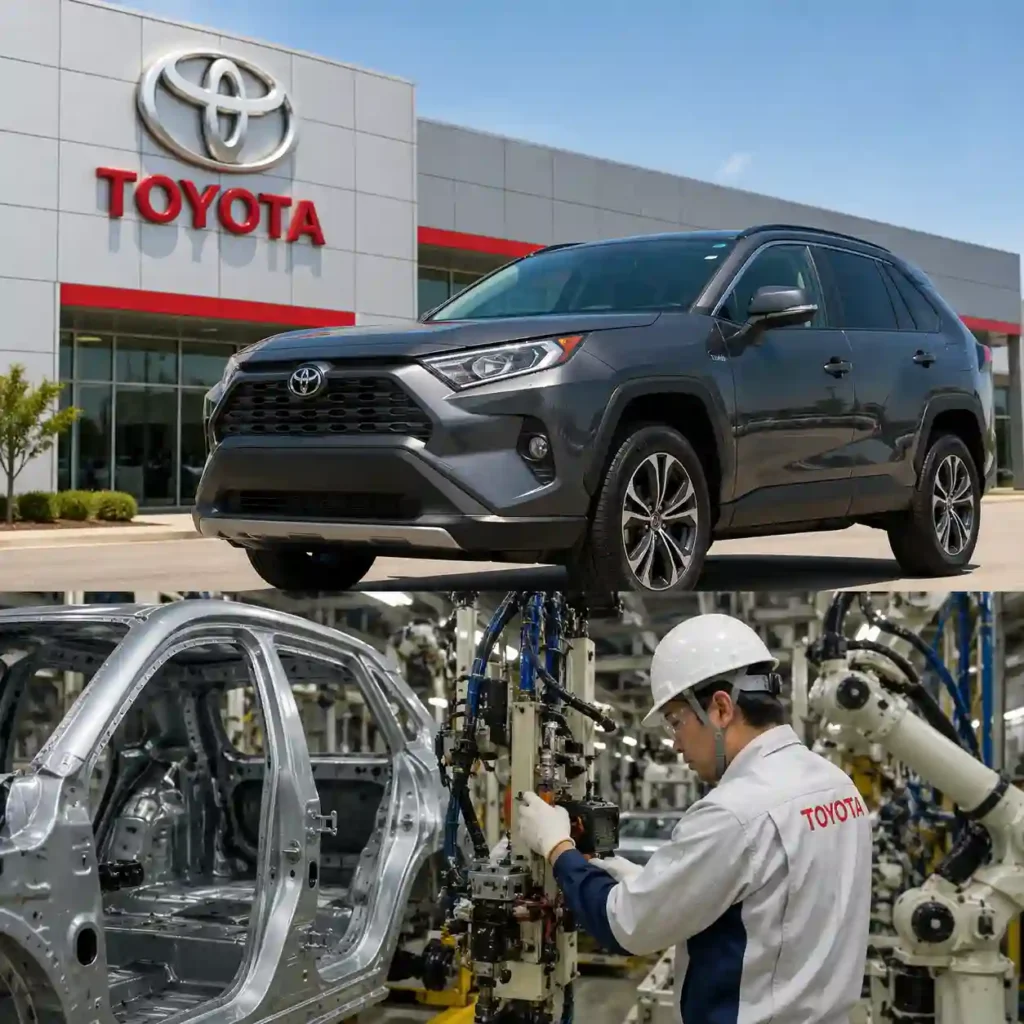

Toyota has issued a rare safety recall for just four 2025 RAV4 SUVs in the United States after a seat-related welding defect was identified during a supplier inspection. The recall is unusually small, but the safety concern behind it is significant: the driver-side seat may not be properly secured to the vehicle body.
According to recall information reported through the National Highway Traffic Safety Administration, the affected vehicles may have missing welds on the seat brackets that hold the driver-side seat rails in place. If those brackets are not bonded correctly to the body structure, the seat may not perform as intended in a crash, increasing the risk of injury.
The recall covers 2025 Toyota RAV4 units built between November 28 and December 1, 2025. That narrow production window is one reason the number of affected vehicles is so low. Toyota’s investigation found that only four vehicles from the suspect group were sold to customers in the U.S., while other vehicles built around the same period were either not sold in the country or were not part of the U.S. recall population.
Why only four RAV4 SUVs are affected
Most vehicle recalls involve hundreds, thousands, or even millions of cars, which is why this case stands out. A four-vehicle recall may sound minor, but recalls are not measured only by size. They are measured by risk. In this case, the issue involves the driver’s seat mounting points, a core safety area that must remain strong during sudden braking, impact, or a collision.
The defect was traced to the welding process used to attach the seat brackets to the vehicle body. The brackets are important because they support the rails that allow the driver’s seat to be installed and positioned securely. If required welds are missing, the seat may not be anchored with the strength Toyota designed into the vehicle.
The problem was not discovered after crashes, injuries, or customer complaints. Instead, it was caught during a routine supplier inspection. Inspectors found missing welds on the driver-side seat brackets and notified Toyota, which then launched a formal review to understand how the defect happened and which vehicles could be affected.
That investigation pointed to an unusual cause. Something had become attached to the welding robot, interfering with the robot’s ability to complete the welds properly. In a modern assembly environment, welding robots are programmed to repeat exact movements with high precision. But if an obstruction disrupts that process, even briefly, the robot may not make full contact with the intended area.
This is why Toyota narrowed the recall to such a small number of vehicles. By reviewing production records, dates, supplier findings, and market distribution, the company was able to identify the specific RAV4 SUVs that may have reached U.S. customers with the defect.
What owners should know
For most RAV4 owners, this recall does not point to a widespread problem with the SUV. The affected group is extremely limited, and Toyota’s ability to isolate the issue suggests the company had enough production traceability to avoid a broader recall. Still, the risk is serious for the four owners involved because seat mounting strength is directly linked to occupant protection.
A properly secured seat works together with the seat belt, airbags, and vehicle structure during a crash. If the seat moves unexpectedly because its mounting brackets are not fully welded, the driver may not remain in the intended position for the restraint systems to work correctly. That is why even a tiny recall can still require immediate action.
Toyota owners can check whether their vehicle is affected by using Toyota’s official recall lookup page or the NHTSA VIN tool. The Toyota recall portal allows owners to search by vehicle identification number and see open safety campaigns linked to their vehicle.
Affected owners should receive notification and will be asked to bring their SUV to a Toyota dealer. The dealer will inspect the seat bracket area and repair the issue if needed. As with safety recalls, the work should be performed free of charge.
The case also shows how small process failures can still matter in highly automated factories. Modern vehicles are built with robots, sensors, quality checks, supplier audits, and digital records, but no system is completely immune to disruption. A single piece of interference on a welding robot was enough to trigger a safety review because the affected part plays a critical role in crash protection.
For Toyota, the positive side is that the issue appears to have been caught through inspection rather than through a real-world failure. For customers, the lesson is simple: even if a recall sounds small, it should not be ignored. A four-vehicle recall may not shake the broader RAV4 lineup, but for the owners of those specific SUVs, the repair is important.
The 2025 RAV4 remains one of Toyota’s most important models, and this recall is best understood as a targeted safety action rather than a sign of a larger defect. What went wrong was not a design failure across the lineup, but a production-floor welding interruption that affected a very small batch of vehicles. The recall shows how closely automakers and suppliers monitor manufacturing quality—and why even four vehicles can be enough to trigger a formal safety campaign.
You may also like: Costco Pizza Kit Recall in Canada Over Mould Warning

Make Swikblog your go-to source on Google for reliable updates, smart insights, and daily trends.