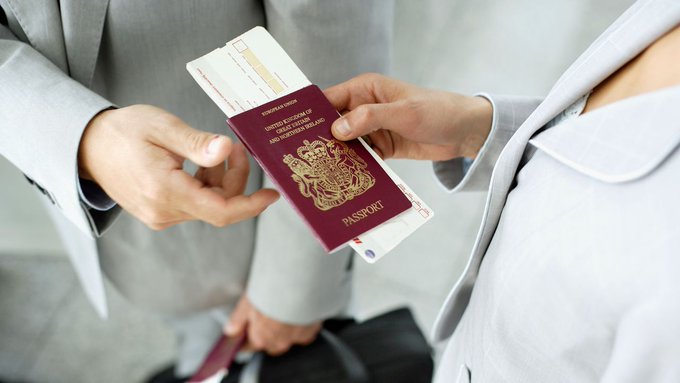

LONDON — UK airport passport checks are entering a new phase as the Home Office begins rolling out contactless eGates powered by facial recognition, allowing some passengers to clear the border without placing their passport on a scanner.
The rollout started at East Midlands Airport on October 6, 2026, initially for British citizens using British passports. Government testing found the new process could be up to 25% faster than conventional eGate checks, with a wider rollout planned across major UK airports by early 2027.
Passengers should not mistake the change for passport-free travel. A valid passport is still required, immigration and security checks remain in place, and Border Force officers can intervene whenever additional verification is needed.
Facial recognition replaces the passport scan at the gate
Traditional eGates usually require passengers to place their passport on a reader before looking into a camera. The upgraded system removes that first step for eligible travellers.
A live facial image is captured as the passenger approaches the gate. The system then compares the image with verified passport, immigration and travel information already available to Border Force.
If identity and border checks are completed successfully, the gate opens automatically. According to the Home Office’s official eGate guidance, passengers can still be asked to scan their passport or speak to an officer if the automated check cannot be completed.
British passport holders get first access
The first stage is limited to British citizens travelling on British passports at selected East Midlands Airport gates.
The government plans to extend contactless processing to other nationalities that are already eligible to use UK eGates. Existing eligibility includes British and Irish citizens and qualifying travellers from countries including the United States, Canada, Australia, New Zealand, Japan, Singapore, South Korea and EU member states.
Children aged eight and over can also use UK eGates when eligible, although travellers aged eight to 17 must be accompanied by an adult.
Heathrow and Gatwick are part of the rollout
The contactless system is scheduled to expand beyond East Midlands to airports including Heathrow, Gatwick, Manchester, Birmingham, Bristol, Cardiff, Edinburgh, Glasgow, London City, Luton, Newcastle and Stansted.
The Home Office expects contactless eGates to be available across UK airports by early 2027.
The technology could have its biggest impact at high-volume hubs such as Heathrow and Gatwick, where even small reductions in processing times can matter during busy international arrival periods. Recent Heathrow and Gatwick flight disruption has also highlighted how quickly pressure can build across Britain’s aviation network.
UK Train Fares Set to Rise 4.2% in 2027: What Passengers Could Pay
UK Airport Drop-Off Fees 2026: What Drivers and Passengers Need to Know
Passengers still need to carry a passport
The biggest point for travellers is simple: do not travel without your passport.
Contactless processing changes how eligible passengers present themselves at the border, not the requirement to hold valid travel documents. Border Force can still request a passport, direct passengers to a staffed desk or carry out additional checks.
Dual British nationals are also advised to enter Britain using a valid British passport or appropriate evidence of their right of abode.
The change is part of Britain’s digital border push
The eGate upgrade follows a wider shift toward digital border controls, including eVisas and Electronic Travel Authorisations. The ETA system allows the government to assess many visa-exempt travellers before they board transport to the UK.
Travellers planning a UK trip can also review how UK ETA requirements affect US and Canadian visitors.
The contactless technology was tested before the wider rollout, including through earlier work at Manchester Airport. The government says much of the expansion can be delivered through software upgrades to existing eGate infrastructure rather than replacing every gate.
Facial recognition raises privacy questions
The faster system has also renewed debate over biometric technology. Campaign group Together has raised concerns about the wider growth of facial recognition and government digital-identity systems, including GOV.UK One Login.
However, the airport eGate programme and GOV.UK One Login are separate systems. The Home Office describes contactless eGates specifically as border identity-verification technology, while critics argue that wider use of biometrics deserves stronger scrutiny.
For passengers, the immediate change is more practical: some arrivals will increasingly be able to walk up to an eGate, look at a camera and clear passport control faster. But passports remain mandatory, Border Force remains in control, and the rollout will happen gradually rather than at every gate overnight.

Make Swikblog your go-to source on Google for reliable updates, smart insights, and daily trends.