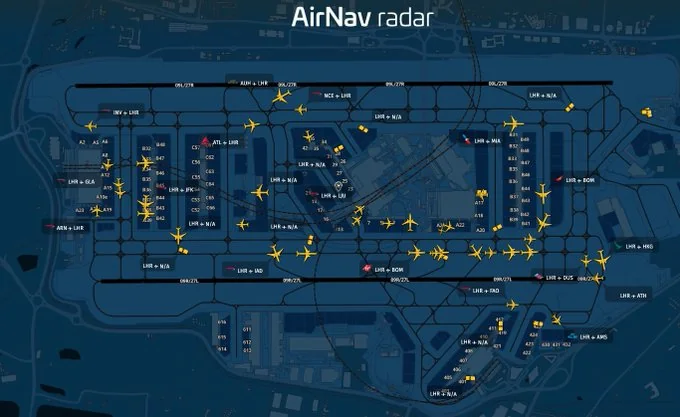

LONDON — Flights began departing again from Heathrow and Gatwick on Tuesday, September 8, after a technical fault involving UK air traffic control disrupted outbound operations, leaving passengers facing significant delays even after restrictions started to ease.
⚠️ Arrivals and departures are being heavily regulated at airports in the London EGTT FIR due to ATC equipment issues. Eurocontrol lists 2000 UTC as expected return to normal traffic. pic.twitter.com/LOkXMgo1NE
— Flightradar24 (@flightradar24) September 8, 2026
The disruption was linked to a technical issue affecting National Air Traffic Services (NATS). Engineers worked on the problem while controllers reduced departure capacity for safety, creating queues and delays across two of Britain’s busiest airports.
Although departures resumed, the disruption moved into a recovery phase rather than ending immediately. Airlines still had to work through delayed aircraft, revised departure slots, crews and missed connections.
What happened at Heathrow?
The major departure restriction at Heathrow was reported at about 12:48 p.m. local time. Aircraft preparing to leave were held while air traffic controllers operated with reduced capacity.
Flights subsequently began departing again. Reports indicated American Airlines flight AA55 to Chicago was among the aircraft to leave after restrictions eased, departing at around 1:35 p.m.
Some Heathrow departures had already accumulated delays of more than two hours, meaning passengers could continue experiencing disruption well after aircraft started moving.
Gatwick departures were also disrupted
Gatwick was affected by the same wider air traffic control problem, with outbound flights temporarily restricted before departures resumed.
Passengers should not interpret the restart as an immediate return to the published timetable. Aircraft held during the disruption need new slots and must be safely inserted into existing air traffic.
Were arrivals affected?
Heathrow said arriving flights were not affected in the same way as departures during the disruption. That meant aircraft could continue landing while outbound services waited for clearance.
Travelers can check Heathrow’s official live departure information and should confirm their individual flight with their airline before heading to the airport.
Other UK airports reported disruption
The effects were not limited to Heathrow and Gatwick. Stansted was also reported to have experienced disruption, while effects were reported involving Southend, Jersey and services using southern UK airspace.
The wider impact reflects how air traffic control differs from an airport-specific problem. A technical issue affecting the network can force controllers to reduce traffic across multiple airports even when individual runways remain open.
Heathrow bird strike was a separate incident
Heathrow had already experienced another disruption earlier Tuesday. At approximately 11:07 a.m., arrivals using runway 27R were briefly interrupted following a reported bird strike.
The runway was inspected and reportedly reopened at about 11:13 a.m.. The bird strike was a separate event and was not identified as the cause of the later NATS technical problem.
DHL Cargo Plane Fire: Aircraft Makes Emergency Landing at LAX
Anak Krakatau Eruption Disrupts Jakarta Airport Flights: Latest Update
Why delays can continue after departures restart
Air traffic controllers cannot release every waiting aircraft simultaneously when capacity returns. Delayed departures must be resequenced alongside arrivals and aircraft already travelling through surrounding airspace.
Airlines may also have aircraft out of position, passengers missing connections and crews approaching working-hour limits. A flight scheduled several hours after the initial fault can therefore still be delayed.
Unexpected aviation events can quickly affect wider airport schedules. In Miami, investigators recently recovered black boxes following an Amazon plane crash as authorities continued examining the incident.
A separate emergency response followed a plane crash at Montgomery-Gibbs Executive Airport in San Diego, where airport operations were temporarily affected.
What should Heathrow and Gatwick passengers do?
Passengers flying Tuesday should check their specific flight status through their airline’s app or official airport departure board before travelling. Those making connections should also confirm their onward flight and available connection time.
If a flight is substantially delayed or cancelled, passengers should retain booking information, airline messages and receipts for reasonable expenses.
UK passenger protections can require airlines to provide assistance during qualifying long delays, including refreshments and, when necessary, accommodation. Financial compensation is separate and depends on the circumstances, including whether the cause was within the airline’s control.
For passengers travelling later Tuesday, the key issue is now how quickly airlines and controllers can clear the accumulated backlog. Flights may be operating again at Heathrow and Gatwick, but individual departure times can remain significantly different from the original schedule.

Make Swikblog your go-to source on Google for reliable updates, smart insights, and daily trends.