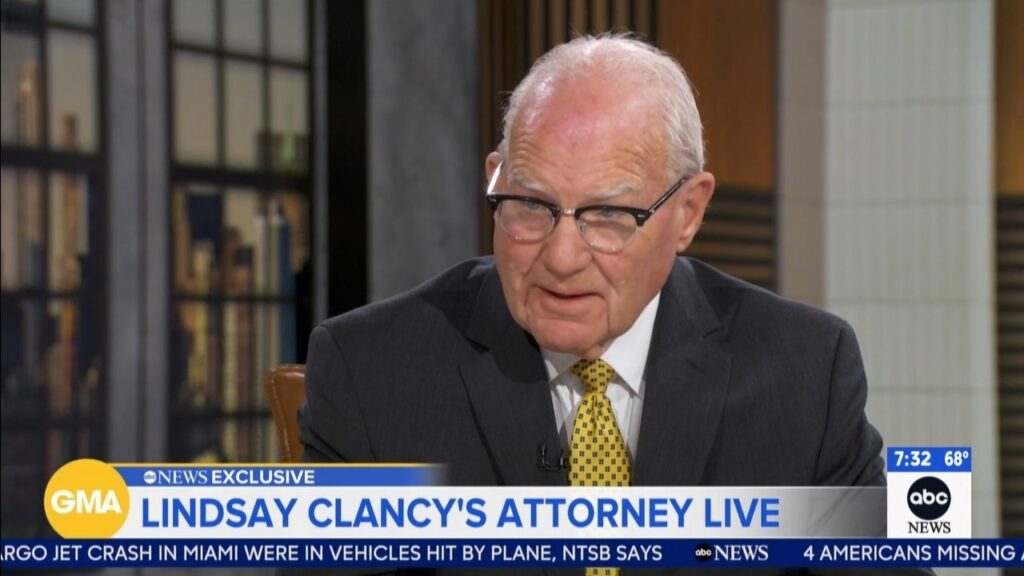

BROCKTON, Massachusetts — Lindsay Clancy’s defense attorney has publicly appealed to President Donald Trump for a pardon after her murder trial ended with a deadlocked jury, despite a significant legal obstacle: presidents cannot pardon state criminal charges.
EXCLUSIVE: Lindsay Clancy’s defense attorney, Kevin Reddington, discusses what comes next for Clancy and calls on President Trump to grant her a pardon. pic.twitter.com/86PqkSiHHt
— Good Morning America (@GMA) September 8, 2026
Attorney Kevin Reddington made the appeal during an interview with ABC’s “Good Morning America” on Tuesday, September 8. He said he hoped Trump would consider intervening in the case, which centers on the January 2023 deaths of Clancy’s three young children at the family’s Duxbury home.
Clancy has pleaded not guilty to three counts of murder and three counts of strangulation or suffocation. Her defense does not dispute that she caused the deaths of 5-year-old Cora, 3-year-old Dawson and 8-month-old Callan, but argues that she was not criminally responsible because she was experiencing severe postpartum mental illness.
Prosecutors have maintained that Clancy understood her actions and deliberately planned the killings. The sharply different accounts were at the center of a six-week trial in Plymouth County Superior Court.
Why Trump cannot pardon Lindsay Clancy
Although Reddington directed his plea to Trump, the president’s constitutional clemency power applies to federal offenses—not crimes prosecuted under state law. Clancy’s charges were brought by Massachusetts authorities, placing them outside presidential pardon authority.
The U.S. Department of Justice’s presidential pardon guidance explicitly states that a president cannot pardon a state criminal offense. Any formal state clemency route would instead fall under Massachusetts law and involve the governor and the Governor’s Council.
Reddington’s statement therefore appears to be a public appeal for attention or support rather than a legally available way for Trump to terminate the prosecution.
Trump commented on the case after the mistrial, describing the deaths as a terrible tragedy and indicating that further legal proceedings were likely. He did not announce any plan to intervene.
During the television interview, Reddington again described Clancy as someone who had been suffering and said he hoped to reach an agreement with Plymouth County District Attorney Timothy Cruz.
He also addressed criticism of his comments following the trial, including his attack on the lone holdout juror and his claim that the defense had overwhelmed the prosecution’s case.
Reddington acknowledged that he could have chosen his words more carefully while continuing to defend the case presented by Clancy’s legal team.
What happens after the Lindsay Clancy mistrial?
Judge William Sullivan declared a mistrial on September 4 after the 12-person jury reported that it could not reach unanimous verdicts. Jurors had deliberated for more than 38 hours across seven days and were reportedly divided 11-1.
A mistrial is not an acquittal and does not dismiss the charges. As explained in Swikblog’s earlier report on what the Lindsay Clancy mistrial means and what happens next, prosecutors may seek a second trial, negotiate a resolution with the defense or make another decision about how to proceed.
The defense is also expected to pursue post-trial legal options. Reddington has discussed asking the judge to enter a finding that Clancy was not criminally responsible, though such a move faces a high legal threshold following a hung jury.
District Attorney Cruz has not publicly committed to a retrial. After the mistrial, his office emphasized that the case concerned justice for Cora, Dawson and Callan.
A court status hearing is scheduled for September 29, when prosecutors and defense attorneys could provide further information about the case’s next phase.
Clancy remains under psychiatric care at Tewksbury State Hospital. If prosecutors retry the case, another jury would again be asked to decide whether the Commonwealth proved beyond a reasonable doubt that she was criminally responsible at the time of the children’s deaths.
The proceedings have also renewed a national discussion about postpartum depression, postpartum psychosis and gaps in maternal mental-health care. Those broader issues remain separate from the specific legal question the jury could not resolve: whether Clancy met Massachusetts’ standard for criminal responsibility.
This is a developing story and will be updated as additional court information becomes available.

Make Swikblog your go-to source on Google for reliable updates, smart insights, and daily trends.