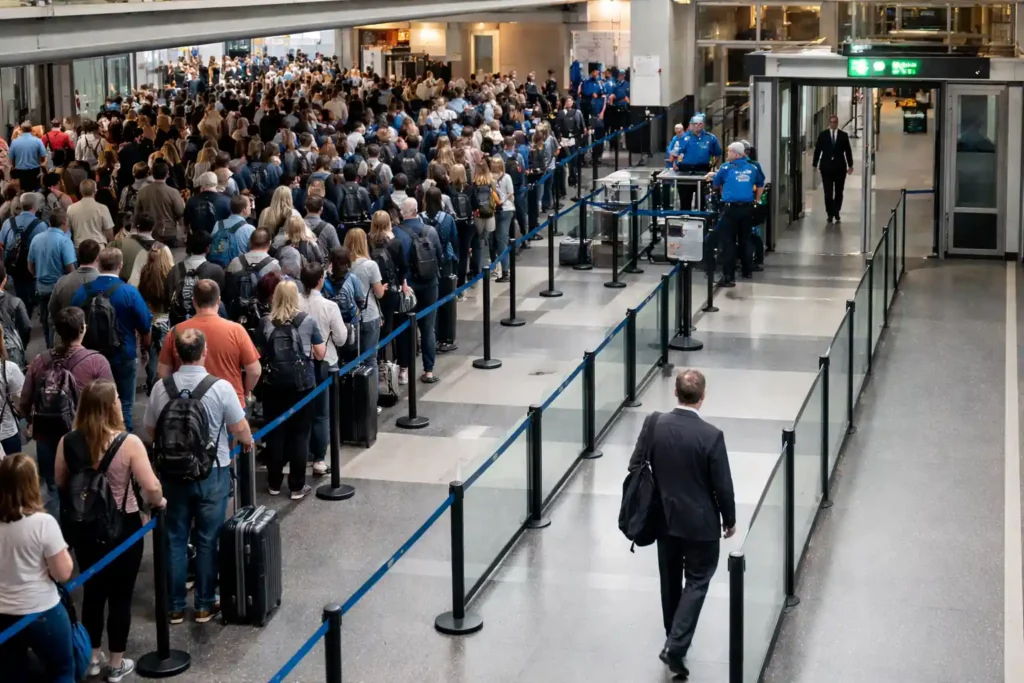

Airport security delays are worsening across the United States, with some major hubs reporting wait times exceeding two hours. But a surprising contrast has emerged — 20 US airports are operating with almost no delays, with some reporting security lines under three minutes.
The difference lies in who runs the checkpoints. While most airports rely on the Transportation Security Administration (TSA), these 20 locations use private contractors under a federal program — and the results are becoming impossible to ignore.
Shutdown impact hits TSA airports hard
The ongoing government shutdown has left TSA workers unpaid for over a month, triggering widespread absences. At major airports like Atlanta’s Hartsfield-Jackson and Houston’s George Bush Intercontinental, more than one-third of TSA staff failed to report to work, causing massive delays.
This staffing shortage has created unpredictable and often extreme wait times, forcing travelers to arrive hours earlier than usual just to clear security.
Private airports operating normally
In contrast, airports using private security contractors have avoided disruption entirely. These companies continue to pay employees during the shutdown, keeping staffing levels stable.
Industry experts note that these airports are essentially “oblivious to the shutdown,” with operations running as normal while others struggle.
Some operators have even highlighted their efficiency publicly, claiming security wait times under three minutes during peak periods.
According to reporting cited by CNN, this stark difference is now drawing attention across the aviation sector.
Same security rules, different operations
Despite being privately run, these checkpoints are not less secure. All contractors operate under strict federal oversight and must follow the exact same TSA screening procedures and training standards.
The key operational advantage comes from flexibility. Private firms can:
• Control hiring and staffing levels
• Set wages and incentives
• Continue payroll regardless of government funding issues
However, companies also take on financial risk, covering payroll costs themselves until the government resumes payments.
Not a fast solution for struggling airports
Switching to private screening is not an immediate fix. Airports must go through a lengthy process that includes TSA approval, contract bidding, and implementation.
The transition can take up to a year or more, meaning airports currently facing long lines cannot quickly adopt this model.
Larger airports are also less likely to switch due to operational complexity and a “if it isn’t broken, don’t fix it” mindset during normal conditions.
Ongoing debate over privatization
The model remains controversial. Supporters argue private contractors can deliver better efficiency, improved detection rates, and higher employee satisfaction.
Critics, including TSA unions, warn that contracts often go to the lowest bidder, potentially prioritizing cost over safety and leading to workforce instability.
Security experts increasingly describe the system as a hybrid approach — a partnership where federal standards remain intact, but operations gain private-sector flexibility.
Airports with faster security today
The 20 airports currently using private screening include major locations such as:
San Francisco International Airport
Kansas City International Airport
Orlando Sanford International Airport
Sarasota-Bradenton International Airport
Greater Rochester International Airport
Along with several smaller regional airports across the country, particularly in Montana.
The contrast in passenger experience is becoming increasingly visible. While some travelers are stuck in lines stretching for hours, others are clearing security in minutes — highlighting a growing divide in how airport security operates across the US.

Make Swikblog your go-to source on Google for reliable updates, smart insights, and daily trends.