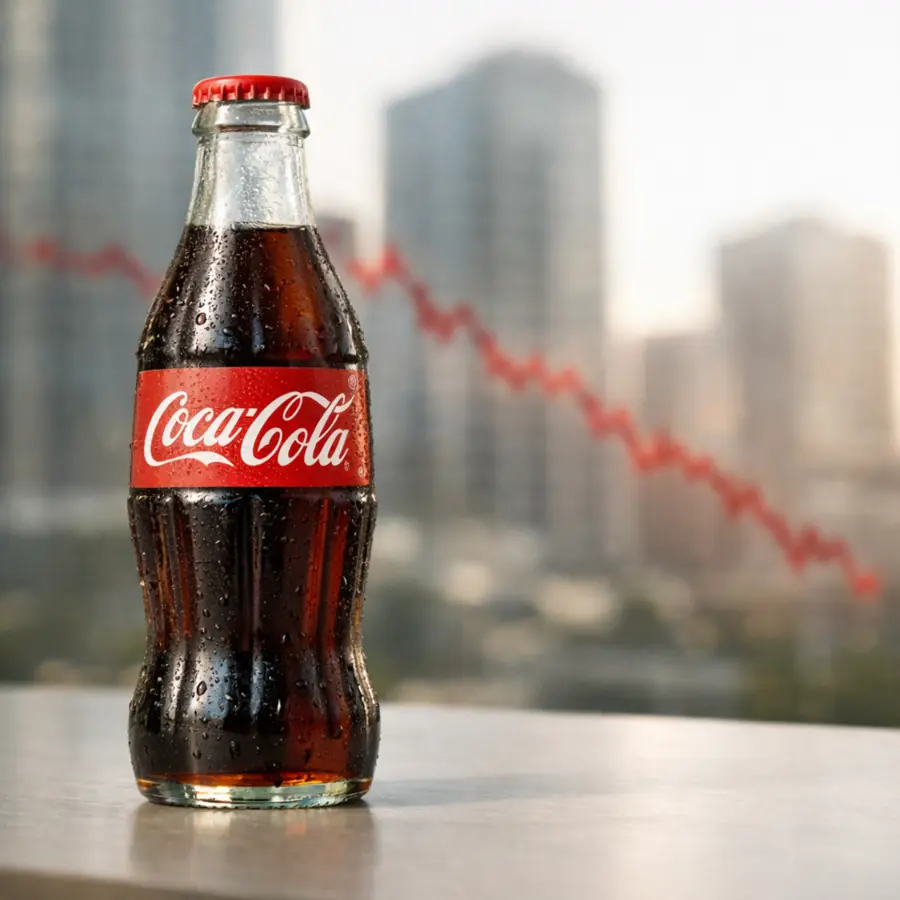

Coca-Cola (NYSE: KO) has slipped back into focus after closing at $74.75, a pullback that leaves the stock noticeably below its late-February high even as Warren Buffett’s Berkshire Hathaway continues to sit on one of the market’s most famous long-term positions. The short-term dip has added fresh tension to the KO story: on one side is a defensive blue-chip name with unmatched dividend credibility, and on the other is a stock that no longer gets a free pass from investors who want both safety and stronger upside.
That split is exactly what makes Coca-Cola one of the most watched consumer stocks right now. The company still offers the qualities long-term investors have trusted for decades: a globally dominant brand, deep pricing power, resilient demand across markets, and a dividend record that remains among the strongest in the S&P 500. Yet the recent slide has also reopened the valuation debate, especially as money continues to rotate in and out of defensive names depending on rate expectations and broader market appetite for growth.
Buffett’s Coca-Cola position still anchors the bull case
The biggest part of the Coca-Cola investment story is still Berkshire Hathaway. Buffett’s company disclosed a stake of 400 million shares in Coca-Cola worth roughly $27.9 billion at the end of the fourth quarter. That number matters because it shows there has been no change in conviction. Berkshire has owned Coke for decades, and the position remains one of the clearest examples of Buffett’s preference for durable brands with predictable cash generation.
Buffett has long argued that Coca-Cola’s edge is not built on hype or fast-changing technology cycles, but on habit, brand equity, and a distribution machine that is extremely hard to replicate. In older shareholder commentary, he framed Coca-Cola as a business with demand that could still be understood years into the future, a rare quality in public markets. That idea still resonates because the basic thesis has not really changed: consumers may alter formats, flavors, and health preferences, but Coca-Cola’s scale allows it to adapt while staying embedded in global beverage demand.
There is also a practical reason Buffett’s support keeps attracting attention. Berkshire’s dividend income from Coca-Cola has compounded dramatically over time. What started as a much smaller annual payout decades ago became a massive stream of cash for Berkshire, reinforcing the argument that patient ownership of high-quality dividend growers can produce extraordinary long-term results without constant trading.
The dividend machine remains Coca-Cola’s strongest selling point
Coca-Cola’s status as a dividend heavyweight is not based on reputation alone. The company approved its 63rd consecutive annual dividend increase, lifting its quarterly payout to $0.51 per share. That kind of consistency is rare, and it remains the main reason many investors are willing to tolerate periods of slower stock-price momentum.
For income-focused portfolios, KO still checks the boxes that matter most. The business throws off substantial cash, management has shown commitment to returning capital, and the company’s operating profile is steady enough to support dividend growth even when the broader market becomes volatile. That is why Coca-Cola continues to be treated as a “sleep well at night” holding rather than a momentum trade.
The more interesting question is whether that dividend strength alone is enough to drive renewed buying at current levels. For some investors, the answer is yes, especially if they believe the recent pullback has made the stock more attractive. For others, the stock still sits in a tougher middle ground: dependable, but not cheap enough to ignore the opportunity cost of faster-growing sectors.
Recent business results show resilience, not explosion
Coca-Cola’s latest annual numbers did not tell a story of runaway growth, but they did reinforce the company’s stability. In its most recent full-year report, Coca-Cola said 2025 net revenues rose 2%, while organic revenue grew 5%. Comparable earnings per share for the year reached $3.00, and the company also highlighted strong cash generation. Those figures are not the kind that typically ignite speculative excitement, but they do support the view that the core business is still working as intended.
That matters because Coca-Cola is not meant to be judged like an early-stage growth stock. Investors usually buy KO for consistency, global reach, and margin resilience, not for sudden bursts of expansion. Even so, market pricing still reacts when expectations get stretched. After touching a 52-week high near $82.00 in late February, the stock’s retreat to the mid-70s shows how quickly sentiment can soften when a defensive name looks fully valued.
There is a case to be made that the current weakness reflects exactly that reset. The stock is not collapsing because the business is breaking. It is slipping because investors are reassessing what they are willing to pay for dependability in a market that continues to reward more aggressive themes whenever risk appetite improves.
Why the stock still appeals even after the drop
Even with that backdrop, Coca-Cola continues to hold an edge that many companies cannot match. Its portfolio extends far beyond the flagship soda brand, its products are sold in more than 200 countries and territories, and its distribution strength gives it room to protect shelf space and pass through price increases better than smaller rivals. That combination helps explain why the company remains so relevant in both inflationary and slower-growth environments.
For investors looking through a long-term lens, the recent move down to $74.75 may not look like a warning sign at all. It may simply look like the latest reminder that even elite dividend names rarely move in straight lines. A stock can be temporarily out of favor while the business underneath remains highly intact.
That is the real tension around KO today. The near-term chart has weakened, but the long-term case still leans on brand durability, cash flow, dividend growth, and Buffett’s enduring vote of confidence. For readers tracking the company’s most recent operating performance, Coca-Cola’s latest full-year results offer the clearest snapshot of how management is balancing growth, margins, and shareholder returns.
At this point, Coca-Cola does not need to become a fast-growth story to remain relevant. It only needs to keep doing what it has done for years: defend its moat, grow the payout, and prove that a temporarily weaker stock price is not the same thing as a weaker business. That is why the recent dip has not erased the bull case. It has simply made the debate around valuation, income, and patience more interesting again.
You May Also Like

Make Swikblog your go-to source on Google for reliable updates, smart insights, and daily trends.