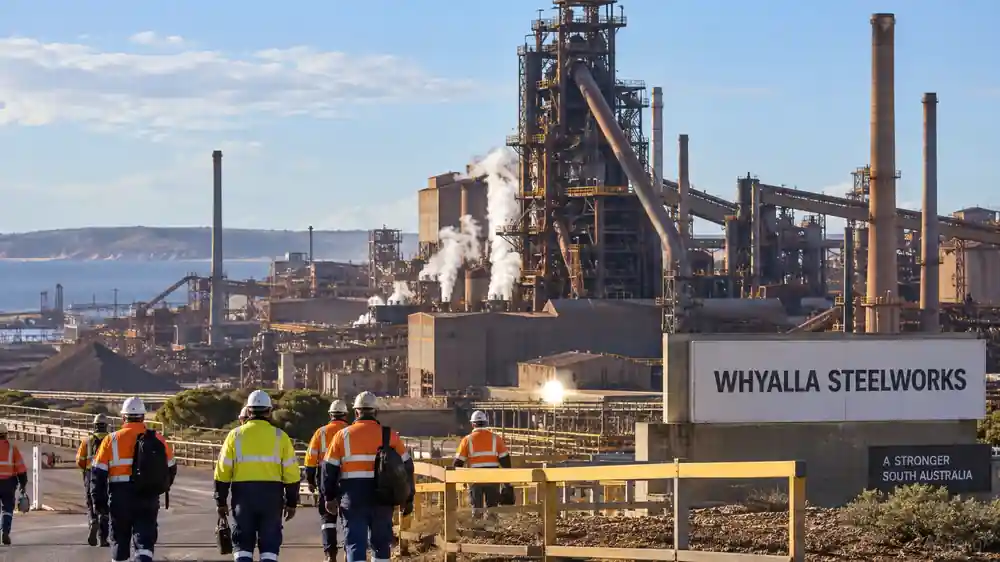

About 500 workers at Whyalla Steelworks are expected to lose their jobs after a decision to permanently shut down the site’s blast furnace, delivering a major employment blow to the South Australian industrial city.
More than 100 contractors working at the site are also expected to be affected. Employees were informed of the decision on Monday morning after months of unsuccessful attempts to return the ageing furnace to operation.
The shutdown matters beyond the immediate job losses. Whyalla is one of Australia’s key steelmaking centres, and the decision comes while administrators and governments are still working to secure a buyer and determine the plant’s long-term industrial future.
About 500 workers and more than 100 contractors affected
The workforce reduction will affect roughly 500 employees as well as more than 100 contractors connected to the steelworks.
For Whyalla, the impact could extend beyond those directly employed at the plant. Local suppliers, trades, service businesses and households are closely linked to activity at one of the Upper Spencer Gulf’s most important industrial employers.
The announcement adds to a difficult period for Australian workers facing large corporate restructures. KPMG Australia is cutting hundreds of staff and partner positions, although Whyalla’s situation is distinct because of the steelworks’ importance to a regional economy.
Blast furnace has been offline since April
The blast furnace has not operated since April. Workers and administrators made repeated efforts to restart it, but those attempts failed to restore reliable production.
The coal-fired furnace performed a critical step in traditional steelmaking by converting iron ore into molten pig iron, which was then processed into steel. Permanently taking it out of service therefore removes a central part of Whyalla’s existing production system.
The equipment dates back to the 1960s and has not undergone a substantial upgrade since 2004. Its age and condition had already raised questions about how long it could remain viable.
Restart efforts could not provide a long-term solution
The furnace had suffered shutdown problems before the latest outage, and concern about its reliability increased after it went offline in April.
Several workers were injured during restart work in July, underscoring the challenges involved in restoring ageing industrial equipment.
Even if another restart attempt had succeeded, the furnace was not viewed as a permanent solution. Plans for Whyalla’s future have increasingly centred on replacing older coal-dependent infrastructure with newer steelmaking technology.
Steelworks remains under administration
The latest decision comes about 19 months after the South Australian government placed OneSteel Manufacturing, the company that owns and operates the steelworks and associated mines, into administration on February 19, 2025.
KordaMentha was appointed administrator and has since been working to stabilise operations while pursuing options that include the sale of the business.
The ownership process remains crucial because any new operator will inherit both a strategically important steelmaking site and the substantial task of modernising its infrastructure.
Australian-owned M Resources and India’s Jindal Steel have been among the bidders involved in the sale process. Governments have been working with administrators as they seek a long-term owner capable of investing in the plant.
Whyalla remains strategically important to Australian steel
The steelworks is one of only two primary steelworks in Australia and is the country’s only domestic producer of long steel products such as structural sections and rail.
Its output supports infrastructure including railways, bridges, transmission projects, schools, hospitals and other construction.
That strategic role is one reason the federal and South Australian governments have committed substantial public support. The official Whyalla Support program says $100 million has been committed for immediate assistance to affected workers and businesses, while up to $1.9 billion is earmarked for investment in the future of the steelworks.
Omnicom to Reduce Workforce by 15,000 in Major 2026 Restructuring
Volkswagen Approves 50,000 More Job Cuts as Restructuring Expands
Future steelmaking is expected to use different technology
The long-term vision for Whyalla involves moving towards lower-emissions production using direct reduced iron and electric arc furnace technology rather than relying on the ageing blast furnace.
This transition could preserve steelmaking in the city while substantially changing how the plant operates. However, future investment does not remove the immediate problem facing workers whose current roles are disappearing.
Large Australian employers are restructuring for very different reasons across several industries. Coles has also been reshaping hundreds of corporate roles, highlighting the broader employment uncertainty facing workers during major business transformations.
Alternative employment becomes an immediate priority
South Australian Premier Peter Malinauskas is expected to provide further details about assistance for displaced workers, including potential employment opportunities with other major employers.
BHP is among the companies expected to be discussed as a possible source of alternative jobs for some affected employees.
The challenge will be matching steelworkers, engineers, maintenance specialists, tradespeople and other employees with suitable roles while the steelworks moves through its ownership and technology transition.
Contractors will also require attention. More than 100 are expected to be affected alongside the approximately 500 direct workers, broadening the economic consequences of the shutdown.
Sale and redevelopment will shape Whyalla’s next phase
The permanent blast furnace closure effectively ends efforts to restore Whyalla’s traditional production system and increases pressure on administrators and governments to complete the transition to new ownership and replacement technology.
For workers and the wider community, the timing is critical. A modernised steelworks could retain an important industrial role for Whyalla, but employment support is needed now, before any future facilities are ready to replace the jobs tied to the old furnace.
Attention will therefore remain on the government’s worker-support measures, possible employment opportunities with other companies and progress towards securing a buyer capable of delivering the next generation of steelmaking in Whyalla.

Make Swikblog your go-to source on Google for reliable updates, smart insights, and daily trends.