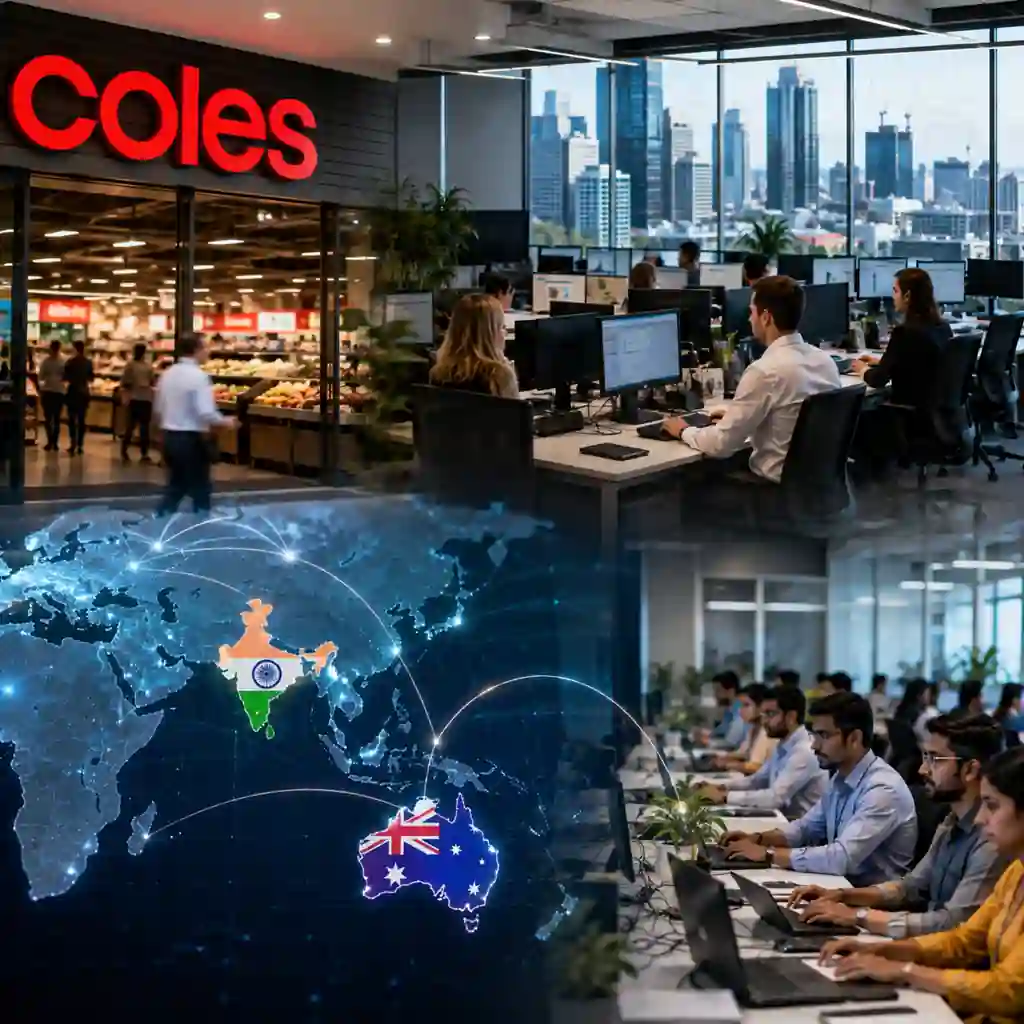

Coles is moving several hundred Australian corporate roles into an expanded outsourcing arrangement with Accenture, with much of the work expected to be performed in India as the supermarket group cuts costs and accelerates investment in technology and artificial intelligence.
The August 7, 2026 announcement affects corporate functions including technology, finance, human resources, marketing and other back-office operations. Coles has confirmed several hundred redundancies, while some media reports have suggested the wider outsourcing program could involve around 1,000 roles. Coles has not confirmed 1,000 job losses.
The retailer employs about 115,000 people across Australia, with its corporate workforce reported at around 5,000. Importantly, supermarket store employees are not included in this outsourcing program.
What Coles is changing under the Accenture deal
The changes form part of an expanded multi-year partnership with global consulting and technology company Accenture. Coles says some corporate work will move to Accenture overseas, while other functions will be handled by Accenture teams in Australia.
The Australian Financial Review reported details of the Coles outsourcing plan, including the expected transfer of hundreds of office-based roles to India.
Chief executive Leah Weckert told employees that maintaining cost leadership was important in an increasingly competitive retail market. Coles has also linked the partnership to modernising technology, accessing global specialist skills and accelerating its use of AI.
Which Coles employees are affected?
The restructuring focuses on white-collar and back-office roles across marketing, finance, HR and technology. Coles has not published a complete list of affected positions, so the final impact on individual teams will become clearer during consultation.
Store workers are not affected by this announcement, and Coles has not linked the Accenture partnership to widespread supermarket closures.
The company says it will try to redeploy affected employees where possible, while providing reskilling opportunities and pathways into other positions. Workers who cannot be redeployed may face redundancy.
Why are jobs moving to India?
India has become a major global centre for software development, finance operations, data analytics, AI, customer support and business-process services. Multinational companies can access large pools of specialist workers while often operating at lower costs than maintaining equivalent teams entirely in Australia.
Accenture already operates extensive delivery operations in India, making the country an established location for supporting international clients. Reports surrounding the Coles announcement indicate Accenture had begun advertising positions in Mumbai connected with the program.
Is AI replacing Coles workers?
AI is part of Coles’ strategy, but the announcement should not be interpreted as hundreds of employees being directly replaced by artificial intelligence.
The company is combining several changes: outsourcing selected functions, moving some work offshore, modernising technology and increasing its use of AI and automation.
Similar changes are occurring elsewhere in corporate Australia. Commonwealth Bank’s AI-related workforce restructuring highlights how large employers are redesigning office work as automation changes staffing requirements and the skills businesses need.
Australian companies are expanding offshore workforces
Coles is part of a wider Australian corporate trend. Qantas has been considering outsourcing parts of its marketing, finance, HR and other back-office functions under its reported Project IQ initiative, although the airline had not reached a formal agreement when those plans were reported.
Telstra has also undergone substantial restructuring, with up to 650 additional jobs flagged for possible removal in early 2026 following more than 2,300 role reductions reported during 2025.
Endeavour Group, which operates Dan Murphy’s and BWS, disclosed about $58 million in costs associated with establishing a centralised business-services function, including back-office outsourcing, restructuring and consulting expenses.
Australia’s banks have already built large offshore operations. NAB’s Australian job cuts alongside expanding hiring in India and Vietnam provide another example of businesses combining domestic restructuring with larger global delivery teams.
Officeworks has also moved office-support and customer-service functions to India and the Philippines, while Kmart and Target employ hundreds of workers in Bengaluru.
Volkswagen Job Cuts 2026: Why the Automaker Is Reducing Roles and Restructuring Operations
Diageo Job Cuts 2026: What the Workforce Reductions Mean for the Drinks Giant
Visit the homepage for the latest business news, job cuts and corporate updates
Will the changes make groceries cheaper?
Coles says reducing back-office costs will help it continue delivering value to customers, but shoppers should not expect outsourcing to automatically produce lower grocery prices.
Food prices are influenced by supplier costs, wages, transport, energy, agricultural conditions, competition and promotional decisions. Lower corporate expenses may give Coles more capacity to invest in prices, stores or technology, but no specific grocery-price reduction has been announced as part of the outsourcing deal.
Affected employees are expected to go through consultation as Coles determines which responsibilities remain inside the company, which move to Accenture in Australia and which are transferred overseas.
The final redundancy number may therefore change as redeployment opportunities are assessed. For investors, the key question will be whether the program produces sustainable savings without disrupting operations, losing important expertise or creating expensive transition problems.
For Australian workers, the Coles decision shows how white-collar employment is being reshaped by three forces at once: outsourcing, global workforces and AI-enabled automation. The confirmed position remains that several hundred corporate jobs are affected, many functions will move to Accenture teams in India, supermarket workers are not part of the program, and Coles is positioning the restructuring as both a cost-saving measure and a longer-term technology transformation.

Make Swikblog your go-to source on Google for reliable updates, smart insights, and daily trends.