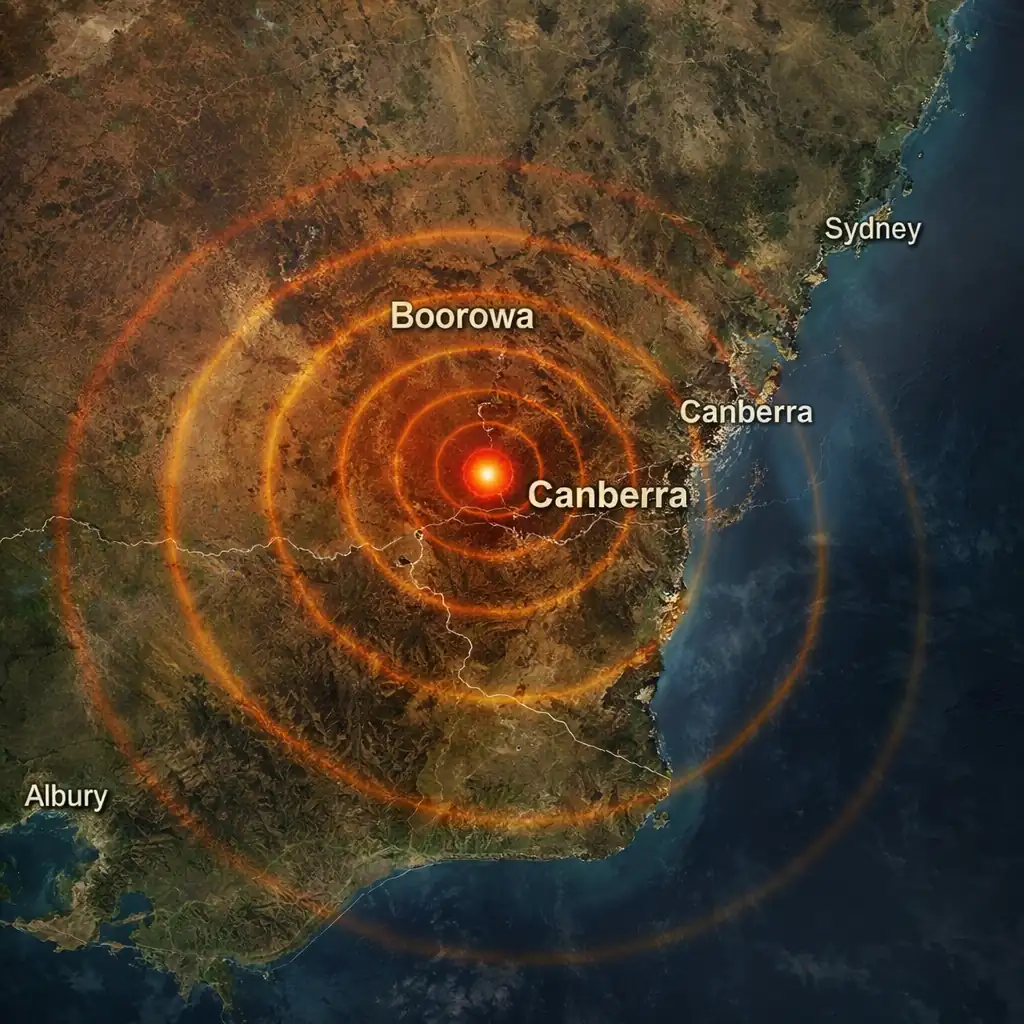

A 4.4 magnitude earthquake near Canberra shook parts of New South Wales and the ACT on Wednesday evening, with thousands of residents reporting the tremor across a wide stretch of southeastern Australia. The quake, which struck near Boorowa at a depth of about 12 kilometres, was felt in Canberra and beyond, reaching places such as Sydney, Batemans Bay, Gosford, Albury, and Goulburn. For many locals, it was the kind of sudden event that instantly turns an ordinary evening into a breaking news moment.
According to early reports, more than 5,000 people said they felt the shaking, making it one of the most widely noticed seismic events in the region in recent years. While there were no immediate reports of major damage, the tremor quickly became a major talking point because earthquakes of this size are uncommon enough in the area to spark concern, curiosity, and a rush for updates. Readers looking for official seismic data can check the latest updates from Geoscience Australia.
Why this 4.4 magnitude earthquake got so much attention
Earthquakes are not unheard of in Australia, but they are far less common than in countries located on major tectonic plate boundaries. That is one reason why even a moderate quake can generate intense public reaction. In this case, the earthquake happened close enough to populated areas that it was widely felt inside homes, apartments, and offices.
Residents described the experience in vivid terms, with some saying it felt like a train rumbling past the house. That kind of description is often what makes a story spread fast online. It gives readers a real sense of what happened on the ground, especially for those who did not feel the shaking themselves. The combination of a sizable tremor, a large affected area, and dramatic firsthand reactions helped push this event into the national spotlight.
Where the quake was felt across NSW and the ACT
The earthquake’s epicentre was reported near Boorowa, roughly 100 kilometres north of Canberra. Despite that regional location, the shaking was felt across a surprisingly broad area. Reports came in from Canberra, large parts of regional NSW, and even areas much farther away, including Sydney. That wide reach added to the sense that this was not just a local event but a regional one.
For people in the ACT, the tremor was especially unsettling because Canberra is not a city where earthquake preparedness is part of everyday life. In NSW, the same applied to many communities that may have experienced only minor seismic activity before. A moderate quake can feel much stronger when it occurs in a place where residents are not used to the ground moving beneath them.
Could there be damage after a 4.4 magnitude quake
At this stage, authorities have not reported major destruction, which is reassuring. Still, experts often note that earthquakes around this size can sometimes cause minor damage. That can include small cracks in plaster, objects falling from shelves, or light cosmetic damage to buildings. In most cases, the impact depends on local ground conditions, building quality, and how close a property is to the epicentre.
Even when no serious structural damage occurs, events like this tend to leave a strong impression on residents. A sudden jolt, rattling windows, and the noise that comes with the movement can create anxiety long after the shaking stops. That is why many people continue checking for news, aftershock updates, and safety advice in the hours following the event.
Aftershocks may follow the main tremor
One of the key concerns after an earthquake is whether aftershocks will follow. Seismologists say smaller aftershocks are possible after a quake of this kind. These are usually weaker than the main event, but they can still be felt by nearby residents. Aftershocks are a normal part of the process as stress adjusts in the earth’s crust after the initial rupture.
For households in affected parts of NSW and the ACT, the best response is usually to stay calm, inspect the home for any obvious issues, and follow official advice if new information is released. People wanting broader preparedness guidance can also review earthquake safety tips from the NSW State Emergency Service.
How rare is an earthquake like this near Canberra
While not unprecedented, a quake of this strength is significant for the region. Historical records show that earthquakes above magnitude four have occurred in the broader area before, but they remain infrequent enough to stand out. That is why this tremor is being described as one of the strongest felt in decades across this part of the country.
The event also serves as a reminder that Australia does experience measurable seismic activity, even if it does not receive the same global attention as earthquake-prone countries elsewhere. Because these events are less common, public reaction is often stronger, online search interest jumps quickly, and stories like this gain traction across Google News and Discover.
What this means for residents now
For now, the main takeaway is that the 4.4 magnitude earthquake near Canberra was widely felt but has not led to confirmed major damage. That makes it a serious but manageable event rather than a disaster-level emergency. Even so, it has clearly captured public attention because of how broadly it was felt and how unusual it seemed to many residents.
As more details emerge, interest is likely to stay high, especially if there are aftershocks or updated statements from geological authorities. For people across NSW and the ACT, this tremor was a sharp reminder that even regions not known for major seismic risk can still experience sudden earth movement. And for thousands who felt it firsthand, this was not just another headline. It was a real and memorable jolt that shook homes, conversations, and the evening news cycle all at once.

Make Swikblog your go-to source on Google for reliable updates, smart insights, and daily trends.