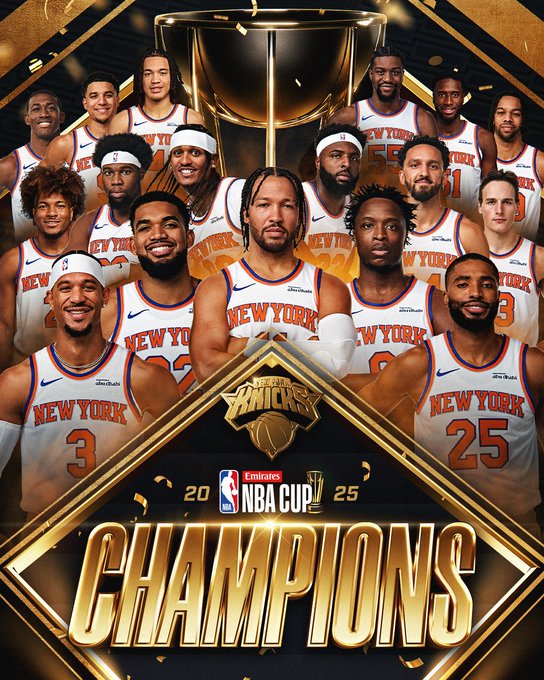
The confetti didn’t fall until the very end, but the story of the 2025 Emirates NBA Cup final can be told in one decisive burst: a fourth-quarter surge that turned a tense, seesaw night into a statement trophy for the New York Knicks. In Las Vegas, with the league’s in-season title on the line, New York closed hard to beat the San Antonio Spurs 124–113 — and did it the way championship teams tend to do it: with stops, second efforts, and a calm that held even when the margins were thin.
For three quarters, it looked like the kind of game that could swing on a single whistle, a single run, a single star shot that changed the air in the building. The Spurs kept their pace, kept their spacing, and kept finding answers — enough to carry a slight edge deep into the third and keep the Knicks from ever settling into cruise control. At halftime it was tight. Late in the third, San Antonio had enough momentum to make it feel like New York would need something extra to take the trophy.
That “extra” arrived all at once.
The fourth quarter opened with the Knicks trailing and the arena still unsure which way the night would break. Then New York found its rhythm: a quick scoring pop that forced the Spurs to chase, followed by a stretch of possessions where the Knicks simply refused to let the ball belong to anyone else. A miss didn’t end a trip. A stop didn’t guarantee San Antonio a run-out. Loose rebounds became Knicks rebounds. Second-chance points became a theme — and then a problem the Spurs couldn’t solve fast enough.
OG Anunoby’s scoring set a tone all night, and when New York needed points to keep the pressure on, the Knicks kept getting them from the places that travel: tough finishes, timely jumpers, and the kind of points that come after the “first” defensive possession is already supposed to be over. Jalen Brunson, as steady as he’s been all tournament, controlled the game’s temperature — pushing when the lane opened, pulling it back when the moment asked for patience, and keeping the Knicks’ offense organized when the Spurs tried to speed it up.
But the defining edge wasn’t just one player’s shot-making. It was the grind inside. Mitchell Robinson owned the kind of minutes that don’t always show up in highlight edits but decide trophies: offensive rebounds that reset possessions, tap-outs that turned chaos into order, and rim protection that made the Spurs think twice on drives they’d attacked earlier. In a final where both teams had stretches of pretty basketball, New York’s ugliest points — the ones earned on the glass — were often the most valuable.
Related: Queen Naija’s National Anthem Moment at the NBA Cup Final
That’s how the game broke: the Knicks piled up extra possessions, the Spurs ran out of clean finishes, and the fourth quarter stopped being a debate. New York outscored San Antonio 35–19 in the final period, and once the Knicks got their noses in front, they didn’t blink. The ball moved. The defense tightened. The rebounding became relentless. Every Spurs miss started to feel heavier.
San Antonio had its own bright spots. Dylan Harper provided punch and poise, and Victor Wembanyama — still the gravitational center of every half-court possession when he’s on the floor — flashed the kind of two-way influence that makes opponents adjust their shots before they even take them. The Spurs were not overawed by the stage. They were, for long stretches, the team dictating the speed. What changed was the ending: when New York turned the final quarter into a fight for every inch, the Knicks had more answers, more bodies, and more control.
In-season tournaments live and die on whether they feel real — whether the intensity is more than marketing and whether players treat it like something to win instead of something to get through. This one felt real by the end. You could see it in how hard the Knicks celebrated, in how quickly the Spurs looked like a team already filing this away as a lesson, and in how the game’s most important plays were the ones that usually show up in playoff basketball: the rebound that shouldn’t be yours but is, the stop that turns into a run, the veteran decision that keeps a lead from becoming panic.
Brunson was rewarded for that steadiness with tournament MVP honors, and the numbers back it up: he was productive without forcing it, and commanding without hijacking it. Anunoby led the scoring on the night, and the Knicks’ supporting cast swung the margins in the minutes that mattered most — the kind of collective lift that separates “a good team having a good night” from a team that can finish the job under bright lights.
There’s also a real-world edge to winning the NBA Cup: the league’s prize pool means meaningful bonus money for the players — especially for those not on max deals. For New York, it’s both a tangible reward and a symbolic one: a trophy that says this group can win a high-stakes game on neutral ground against a talented opponent that wouldn’t go away.
What happens next is the part Knicks fans will care about most. The NBA Cup doesn’t hand out playoff seeding, and it doesn’t guarantee anything in April. But it can change how a season feels. It can sharpen habits. It can confirm identities. For the Knicks, the identity looked clear in that fourth quarter: defend, rebound, trust the ball, and let pressure do the work.
One quarter. One surge. One cup — and a reminder that when New York decides the last 12 minutes belong to them, the night can end with confetti.
Read more: For the official recap and box score details, see coverage from the ESPN game page and the Associated Press match report.
You may also like: More Sports on Swikblog

Make Swikblog your go-to source on Google for reliable updates, smart insights, and daily trends.