
By Swikriti • Updated today
Microsoft shares were firmer today, climbing toward $410 as investors digested a fresh industry partnership in copper mining and another round of bullish commentary from long-term holders and Wall Street. With AI spending still one of the market’s defining themes, the headline catalyst is notable for what it represents: Microsoft’s tools moving deeper into heavy industry, where even small efficiency gains can translate into meaningful cost savings, safety improvements, and better asset utilization.
In early trading, MSFT hovered around $410 after a sharp open that lifted the stock above the prior close near $405. The move came alongside an announcement out of Chile that puts Microsoft closer to one of the world’s most strategically important supply chains: copper, a metal at the center of electrification, power grids, and data-center buildouts.
Codelco partnership adds an industrial AI catalyst
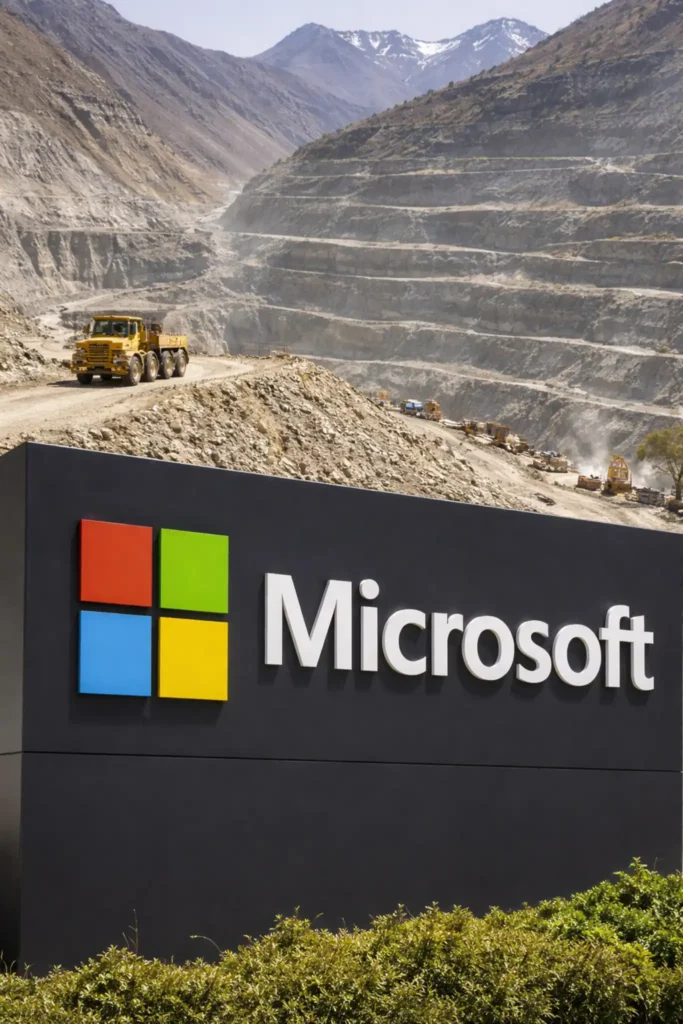
Chile’s state-owned Codelco, the world’s largest copper producer, said it has signed a memorandum of understanding with Microsoft to evaluate joint initiatives spanning artificial intelligence, advanced analytics, automation, and digital security. The framework is designed to move beyond a single pilot and into a structured evaluation period with measurable execution steps.
Under the agreement, the initial term runs for 18 months and includes joint governance for strategic and operational tracking. The scope is broad but tightly aligned with the levers that matter most in mining: intensive operational data use, AI-assisted decision-making, autonomous operations, automation of critical processes, and strengthened cybersecurity. Both sides also expect to participate in early testing of new solutions, with an emphasis on sharing international experiences that could accelerate deployment and shorten the learning curve.
What stands out is the structure: an 18-month window with joint oversight suggests this is built to produce real operational outcomes, not just a headline. The stated focus areas—autonomy, process automation, and cybersecurity—are the same ones miners prioritize when labor constraints, safety standards, and commodity cycles collide.
Leadership signals: data scale and safer operations
Codelco CEO Rubén Alvarado framed the partnership as a way to keep the miner ahead of a rapidly digitizing sector, pointing to the need to process and interpret large volumes of operational data as mines become more complex and capital-intensive. On Microsoft’s side, Latin America president Tito Arciniega emphasized AI’s potential to drive safer, more efficient, and more sustainable operations, with a clear focus on people, productivity, and long-term value for both company and country.
For Microsoft investors, this messaging matters because it reinforces a core positioning theme: AI as a practical layer that improves decision quality and workflow reliability in the real economy. Industrial deployments can be sticky—once a system improves throughput, reduces downtime, or tightens security, it becomes difficult to rip out. That dynamic can support durable cloud consumption, ongoing analytics usage, and a pipeline of modernization projects that extend across years rather than quarters.
Resilience narrative: multiple profit engines working together
Separately, a recent investor letter from Bretton Capital Management’s Bretton Fund highlighted Microsoft as a resilient compounder supported by diversified business lines. The fund pointed to Microsoft’s breadth—productivity software, cloud computing, AI, gaming, and Windows—as a structure that can keep cash generation steadier across market cycles. In the letter’s discussion of performance, Microsoft was described as having delivered strong stock returns alongside earnings-per-share growth, reinforcing the idea that this is not a single-product story.
That same letter also captured the mood of many disciplined long-term investors right now: the market’s AI enthusiasm can swing between excitement and concern, yet the view expressed was that conditions were not necessarily in “bubble” territory, even if valuations appear modestly elevated. The implication is that trimming speculative excess can make sense while still holding the durable platforms that monetize AI across productivity, cloud, and enterprise workflows.
Wall Street momentum: $675 target underscores bullish case
Adding to the optimism, Truist reiterated a Buy rating while raising its price target to $675, keeping Microsoft in the category of mega-cap names where analysts believe fundamentals can support a higher medium-term valuation. Whether the stock ultimately tracks that trajectory will depend on the pace of cloud growth, margins across software and infrastructure, and the degree to which AI services translate into sustained revenue expansion rather than one-off bursts of demand.
Still, the combination of an industrial AI partnership and a refreshed bullish target works well for sentiment: it blends a tangible “real economy” implementation path with the broader investment narrative that Microsoft’s platform breadth can keep the company resilient through economic crosscurrents.
What the market is watching next
Near term, traders will likely focus on how quickly Microsoft’s industrial AI efforts turn into repeatable deployments, especially as enterprises push for automation that lowers costs and improves reliability. On the Codelco side, investors will be listening for early signals that AI and analytics can reduce bottlenecks, lift recovery rates, improve maintenance planning, or enhance workforce safety. In mining, even incremental improvements can matter—particularly when scale is measured in millions of tons and operational decisions ripple across complex systems.
For Microsoft, the bigger takeaway is strategic: extending AI and cloud services into capital-heavy industries broadens the addressable market beyond offices, developers, and traditional IT backbones. If these pilots mature into standardized solutions, it strengthens Microsoft’s positioning as a provider of enterprise-grade AI systems that can operate in demanding environments where security, uptime, and governance are non-negotiable.
For readers interested in the underlying technology stack that powers many enterprise AI deployments, Microsoft’s overview of Azure AI services provides context on the types of tools businesses can use for analytics, automation, and secure AI workflows.
You May Also Like

Make Swikblog your go-to source on Google for reliable updates, smart insights, and daily trends.