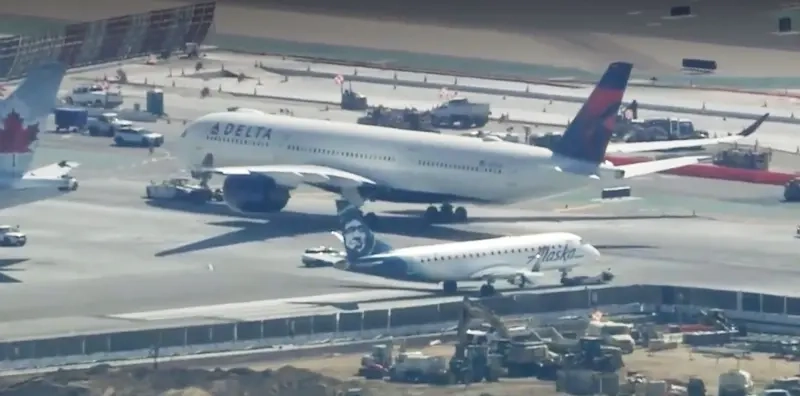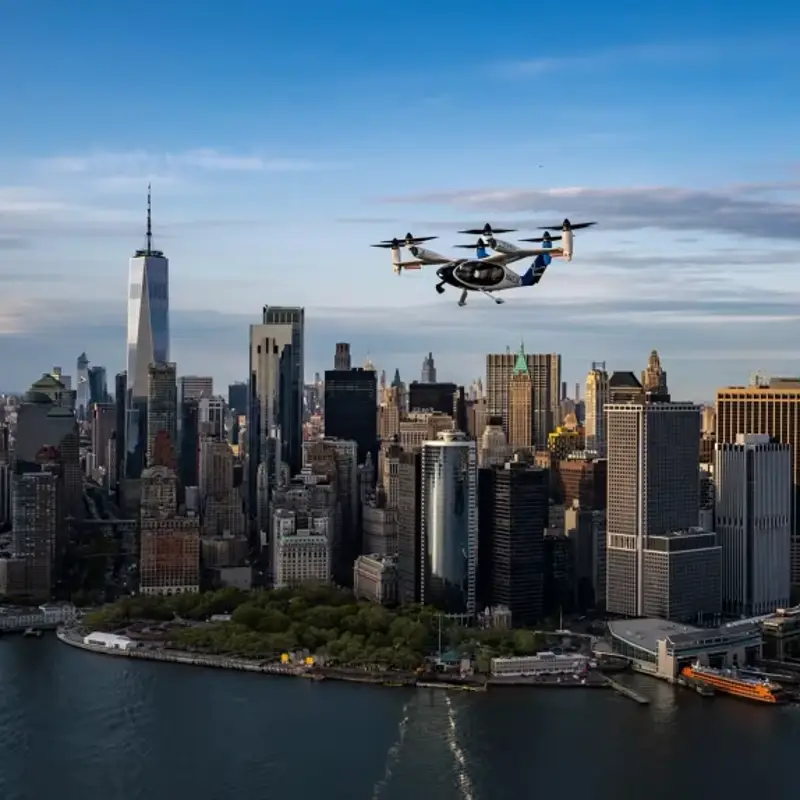

New York’s long-running airport traffic problem has a new challenger: the electric air taxi. Joby Aviation has completed New York City’s first point-to-point electric vertical takeoff and landing demonstration flights, linking John F. Kennedy International Airport with Manhattan heliport locations and showing how a journey that often takes well over an hour by road could one day be reduced to roughly 10 minutes in the air.
The flight is important because it was not just another aviation showcase. It tested an aircraft on a real airport-to-city route, using existing heliport infrastructure in one of the busiest urban regions in the world. For passengers who know the uncertainty of reaching JFK from Manhattan, the appeal is obvious. A delay on the road can mean a missed flight, an expensive reschedule or a stressful start to a trip. A short electric air link could turn that unpredictable commute into a scheduled premium transfer.
Joby’s aircraft belongs to a new class known as eVTOL, short for electric vertical takeoff and landing. It lifts off vertically like a helicopter, then uses tilting propellers to move forward more efficiently. The aircraft is designed to carry five people, including one pilot. Unlike a conventional helicopter, it is powered by batteries, which means zero operating emissions and lower noise levels during flight. Those two factors are central to Joby’s pitch, especially in dense cities where helicopter noise has long been a public concern.
The New York campaign included flights tied to a 10-day eVTOL integration effort, with operations involving JFK and Manhattan’s existing heliport network. That detail matters because early air taxi services are unlikely to begin with brand-new “flying car stations” across every neighborhood. The first practical routes will probably use places that already handle vertical aviation, such as airport zones and city heliports. In New York, that makes airport transfers one of the clearest early business cases.
The route also gives Joby a market where speed has real value. A car trip between Manhattan and JFK can range from manageable to painful depending on traffic, time of day and weather. Public transit may be cheaper, but it is not always convenient for travelers carrying luggage or trying to reach a terminal quickly. By contrast, a sub-10-minute air transfer would target travelers who are willing to pay for certainty as much as speed.
Regulation remains the biggest factor separating test flights from public service. Joby’s aircraft is moving through the Federal Aviation Administration’s certification process, a detailed approval pathway covering aircraft design, safety, testing, production and operational readiness. The FAA has also created rules for “powered-lift” aircraft, the category that includes eVTOL vehicles. Readers can review the agency’s work on advanced aviation and safety oversight through the Federal Aviation Administration.
The flights also connect to a broader U.S. push to test advanced air mobility in real conditions. In March, the U.S. Department of Transportation and the FAA selected eight projects under the eVTOL Integration Pilot Program, covering passenger flights, regional transport, cargo, emergency response, autonomous operations and other use cases. The official U.S. Department of Transportation has said data from these projects will help shape future rules for scaling the technology safely.
Joby is working with several public partners as part of this wider effort, including the Port Authority of New York and New Jersey, along with transportation agencies in Texas, Utah, Florida and North Carolina. The Port Authority’s role is especially important in New York because it operates the region’s major airports, including JFK. Without airport operators, local officials and airspace regulators aligned, electric air taxis cannot move beyond impressive demonstrations.
Joby also has a commercial advantage that many aviation start-ups lack: it is building the customer pathway as well as the aircraft. The company owns Blade’s passenger business, a helicopter ride-share operation that already serves premium airport and city routes. That gives Joby access to existing route knowledge, landing infrastructure and customers who are already familiar with paying for faster air transfers. Over time, those helicopter routes could become natural candidates for quieter electric service.
The company’s relationships with Delta Air Lines and Uber add another layer to the strategy. Delta gives Joby a possible airline integration path, where an air taxi ride could become part of a broader airport journey. Uber gives the concept a familiar booking environment. Instead of treating air taxis like private aviation, Joby wants them to feel closer to a high-end ride-hailing option that can be booked through platforms people already use.
There are still practical limits. Early air taxi rides are expected to be expensive compared with regular ground transport, and the first customers will likely be business travelers, premium leisure passengers and people who place a high value on time. Costs may fall as aircraft production scales and routes become more efficient, but affordability will determine whether air taxis become a niche luxury or a wider transport option.
Infrastructure is another challenge. Cities will need safe takeoff and landing sites, charging systems, passenger handling areas and clear rules for flight paths. Even if electric aircraft are quieter than helicopters, communities will want answers about frequency, safety, noise and who benefits from the service. In a city as crowded and politically sensitive as New York, public trust may matter almost as much as technical performance.
Safety will be the defining issue. Demonstration flights can prove that an aircraft works, but commercial aviation requires a much higher standard. Batteries must perform reliably, flight systems must handle failures, pilots must be trained for a new aircraft category, and operators must coordinate with air traffic control in busy skies. That is why FAA certification is not simply a paperwork exercise; it is the central gatekeeper for whether this industry can move from vision to routine service.
The environmental argument is also more nuanced than a simple “electric equals green” claim. Joby’s aircraft produces no emissions during operation, which could make it cleaner than helicopter services on similar routes. However, the full climate impact depends on electricity sources, battery manufacturing, aircraft lifespan and whether flights replace car journeys or create additional premium travel demand. The strongest case will be on routes where electric aircraft replace noisier, fuel-burning helicopters or reduce high-value congested road trips.
For New York, the latest flights show that the air taxi conversation is becoming more practical. The focus is shifting from whether electric aircraft can fly to whether they can be certified, integrated, priced and accepted by the public. Manhattan-to-JFK is a powerful test route because it combines traffic frustration, airport urgency and existing aviation infrastructure in one market.
Joby’s demonstration does not mean electric air taxis are ready for everyday passengers today. But it does show that one of the most talked-about ideas in future mobility is moving into real city operations. If regulators approve the aircraft and operators can solve cost, infrastructure and community concerns, the airport commute may be one of the first places where electric air taxis become visible to the public.
You may like: American Airlines $1.14B Bond Sale Signals Pressure From Aircraft and Fuel Costs

Make Swikblog your go-to source on Google for reliable updates, smart insights, and daily trends.