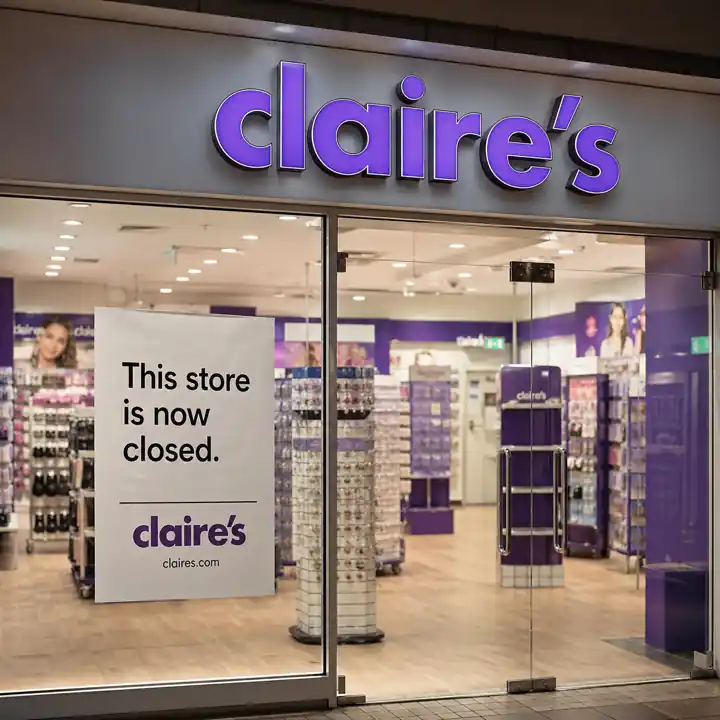

Claire’s has disappeared from UK and Irish high streets after administrators confirmed the closure of 154 standalone shops, leaving about 1,300 workers facing redundancy. The move ends a familiar chapter for a retailer that was once woven into weekend shopping trips, school-holiday visits and first-time ear-piercing appointments.
The shutdown took effect on April 27 and applies only to Claire’s standalone stores in the UK and Ireland. Its concession counters, including those operating inside larger retailers, are not part of the immediate closure, and the company’s wider European business is also continuing to trade.
The collapse is more than another store-closure story. It shows how quickly a brand built around impulse buying can lose ground when shoppers change habits, rivals move faster online and the cost of running physical shops keeps rising.
Why Claire’s Struggled to Survive on the High Street
Claire’s first built its UK presence in the 1990s, offering inexpensive jewellery, hair accessories, bags, novelty gifts and ear-piercing services. For years, the model worked because the stores were easy to spot, affordable to browse and closely tied to teenage fashion culture.
But the same identity that once made Claire’s popular later became harder to modernise. Younger shoppers increasingly discover trends through TikTok, Instagram and online marketplaces rather than town-centre stores. Accessories that once felt fresh in a shopping centre can now look dated when trends change daily on social media.
Low-cost digital competitors made that pressure worse. Platforms such as Shein, Temu and TikTok Shop can push trend-led products quickly and cheaply, often turning viral moments into sales within days. That speed is difficult for a traditional chain with leases, staffing costs and store stock to match.
Claire’s was also squeezed by physical rivals. Primark, Superdrug and other value-led retailers have expanded into fashion accessories while offering customers a wider reason to visit. For many shoppers, a separate trip to an accessories-only store became less necessary.
The company’s owner, Modella Capital, had already warned that trading had weakened sharply, particularly around the key Christmas period. Administrators were later appointed after rescue efforts failed, with the business unable to find a profitable route forward in its current form.
Rising employment costs, inflation and fragile consumer confidence added another layer of difficulty. Retailers with large store estates are especially exposed when sales soften because rent, wages, utilities and business costs continue even as footfall declines.
According to BBC News, administrators confirmed that all Claire’s standalone stores in the UK and Ireland had ceased trading, while concessions and European stores were not affected by the same move.
A Retail Warning Beyond Claire’s
The loss of 1,300 jobs is the most immediate consequence, but the wider impact will be felt across shopping centres and town centres where Claire’s stores were long-standing tenants. Empty retail units are becoming a visible sign of the high street’s struggle to adjust to new spending patterns.
Claire’s still has brand recognition, but recognition alone is no longer enough. Successful retailers now need sharper pricing, faster product cycles, a stronger digital presence and a store experience that gives customers a reason to visit in person.
The company’s remaining concessions may offer a clue to what survives. Smaller formats inside larger stores carry lower risk than standalone shops and can still reach customers without the full burden of a separate high street lease. That model could keep parts of the Claire’s name alive even as its traditional store network disappears.
The collapse also reflects a broader shift in youth spending. Teenagers and younger shoppers now divide their money between beauty, fashion, food, drinks, entertainment and online trends. Accessories are still popular, but they compete in a crowded attention economy where price, speed and social relevance matter more than store nostalgia.
For rivals, Claire’s exit may create short-term opportunities. Competitors selling jewellery, hair accessories and ear-piercing services could pick up demand in areas where Claire’s was previously dominant. But the same market forces that hurt Claire’s remain in place for everyone else.
The lesson for legacy retailers is clear: a well-known name can help bring shoppers through the door, but it cannot compensate for a slow response to changing behaviour. Retail brands must continually refresh their offer, understand where younger customers spend time and avoid relying too heavily on formats that worked in the past.
Claire’s closure will feel nostalgic for many former customers, but for the retail industry it is a practical warning. The high street is not disappearing, but it is becoming less forgiving. Brands that fail to adapt quickly risk finding that familiarity is not enough to survive.
Read more retail and business coverage on Swikblog.

Make Swikblog your go-to source on Google for reliable updates, smart insights, and daily trends.