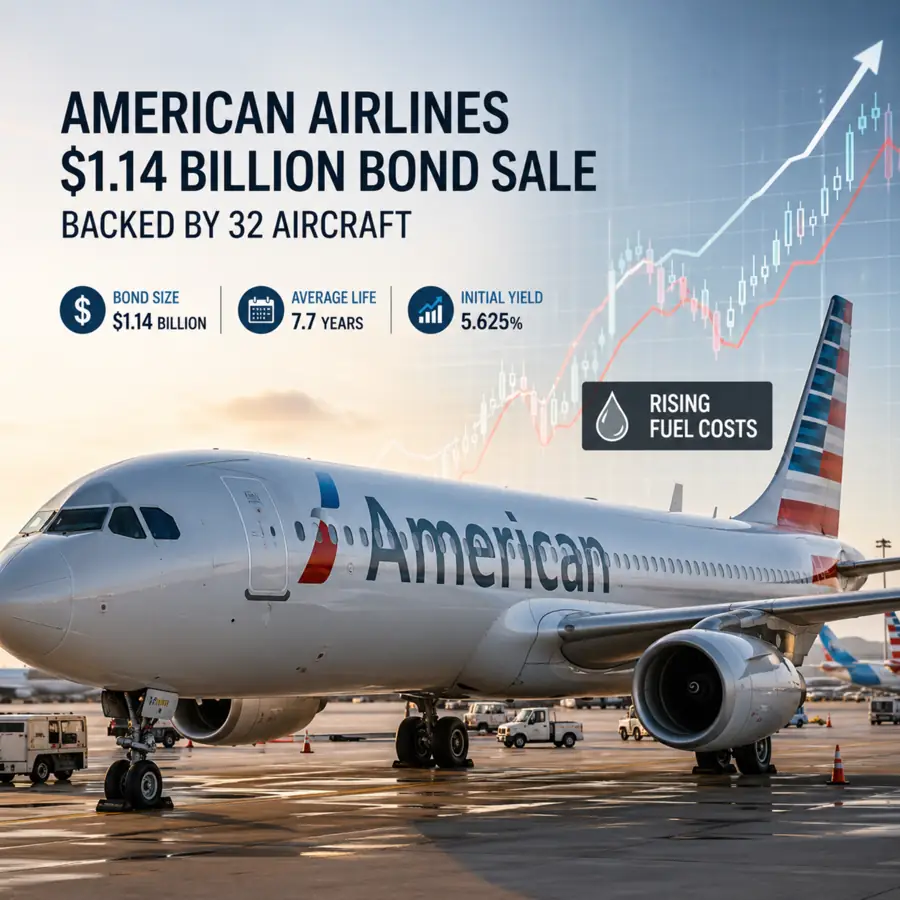

American Airlines is raising $1.14 billion in aircraft-backed bonds, giving the carrier fresh financing at a time when higher fuel costs are putting pressure on its 2026 earnings outlook.
The bond sale is tied to 32 new and existing American Airlines planes. Shares of American Airlines Group Inc. fell 2.19% on Monday as investors weighed the company’s latest financing move against a tougher cost environment for the airline industry.
A $1.14 billion aircraft-backed bond deal
The securities are being sold as enhanced equipment trust certificates, commonly known as EETCs. In simple terms, EETCs are bonds backed by aircraft, allowing airlines to raise money using planes as collateral.
For American Airlines, the structure matters because the company itself is rated below investment grade. S&P Global Ratings has American Airlines at B+, four steps below investment grade, but the longer-term bonds in this deal are expected to receive an A rating from S&P. Fitch Ratings is expected to rate them one notch lower.
That gap between the company rating and the bond rating shows why EETCs remain an important financing route for airlines. They can help carriers access investors who may not normally buy traditional junk-rated corporate debt.
The offering is split into two parts. The larger portion is a $905.04 million longer-dated tranche with an average life of about 7.7 years. Initial pricing discussions put the yield around 5.625%.
That is higher than a similar American Airlines EETC sale in October, when the carrier issued $883.63 million of notes with a weighted average life of 8.7 years at a 4.9% yield. The higher yield suggests investors are demanding more compensation than they did just a few months ago.
Fuel costs are reshaping the earnings picture
The debt sale comes as American Airlines faces a more difficult fuel backdrop. Fuel is usually one of an airline’s largest expenses, and rising oil prices can quickly squeeze margins even when travel demand remains steady.
American recently lowered its full-year earnings target and said it could end 2026 with a loss as it absorbs around $4 billion in additional fuel costs. That warning has made the company’s balance sheet and financing strategy more important for investors tracking AAL stock.
The latest transaction is being led by American Airlines Investor Relations alongside major bookrunners Goldman Sachs, MUFG and Morgan Stanley.
For equity investors, the story is mixed. The bond market’s willingness to finance American’s aircraft shows that lenders still see value in the company’s fleet and collateral base. But the higher borrowing cost, weaker earnings outlook and fuel-price pressure explain why the stock remains under pressure.
American Airlines now has to manage two challenges at once: keeping liquidity available while protecting profitability in a more expensive operating environment. The company’s latest bond sale does not remove those risks, but it gives the airline another source of funding as the industry watches fuel prices closely.
In another major shake-up across the property sector, Real Brokerage’s $880 million RE/MAX acquisition creating a 180,000-agent giant highlights how consolidation is accelerating globally.

Make Swikblog your go-to source on Google for reliable updates, smart insights, and daily trends.