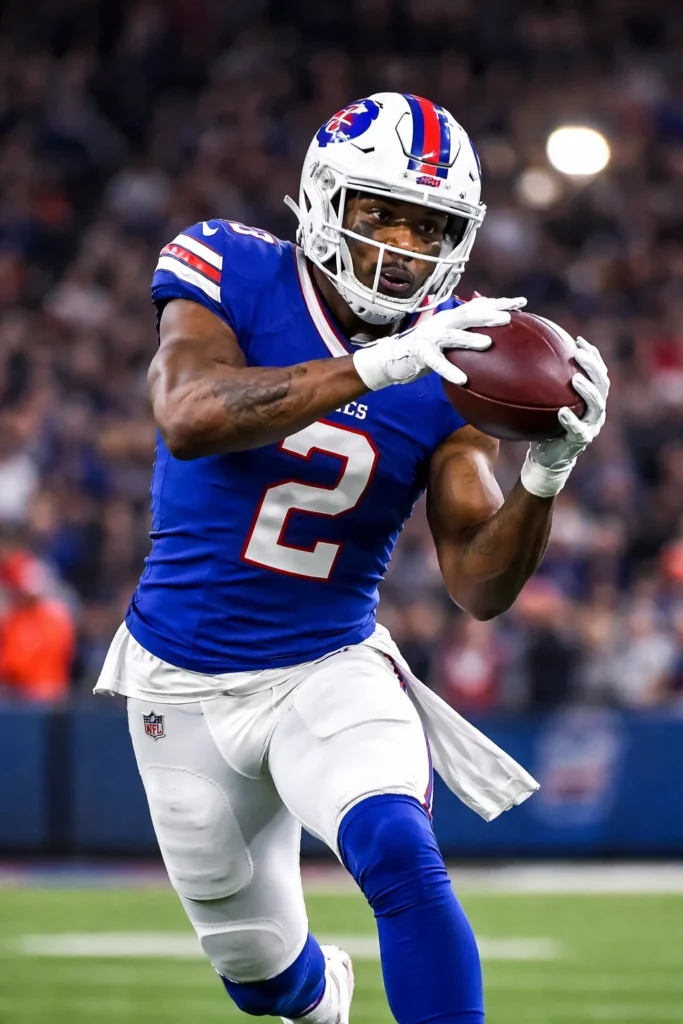

DJ Moore is on the move — and Buffalo is betting big on a true WR1 moment for Josh Allen. The Chicago Bears have agreed to send the veteran wide receiver to the Buffalo Bills, a deal that adds a proven playmaker to an offense that has been searching for a dependable top target since the Stefon Diggs era ended. The trade is expected to be completed once the new league year opens, but the message is already loud: Buffalo wants more explosiveness, more reliability on money downs, and a receiver who can win outside the numbers.
For the Bills, Moore arrives with a reputation built on tough yards and contested catches, plus the ability to turn short throws into chunk gains. For the Bears, the move signals a clear reshaping of the passing game around a different timeline and a different structure — a reset that likely prioritizes flexibility, draft capital, and a new identity under a new staff direction.
Buffalo adds a true top target for Josh Allen
Buffalo’s offense has rarely lacked for creativity or quarterback talent, but the roster has been missing a consistent, high-volume outside receiver. Moore fills that role immediately. He’s not a gadget piece and not a situational specialist. He’s the type of receiver who can take press coverage, win on slants, digs, comebacks, and crossers, and still threaten vertically when safeties creep up.
That matters for Allen because it changes the geometry of the field. Defenses can’t simply crowd the intermediate windows and dare Buffalo to win one-on-one on the perimeter. With Moore as a credible boundary winner, the Bills can stretch coverages horizontally and vertically, creating cleaner throwing lanes for Allen and more room for the run game to breathe.
Contract and money: a long-term commitment
Moore’s arrival is not a rental feel. He is under contract through the 2029 season, with a $23.5 million base salary scheduled for 2026. That’s the kind of number teams reserve for cornerstone pieces, and it underlines Buffalo’s plan: stabilize the receiver room with a proven No. 1 option rather than hoping a committee approach holds up against elite AFC defenses.
For Buffalo’s front office, the calculus is straightforward. Allen’s prime is right now. The roster construction has to match that reality, even if it means absorbing premium receiver money to prevent the offense from becoming too tight-window dependent.
Moore’s recent production and the Chicago chapter
Last season, Moore finished with 50 receptions, 682 yards, and six touchdowns. Across three seasons with Chicago, he totaled 244 catches for 3,012 yards and 20 touchdowns. Those are serious numbers in a stretch where the Bears cycled through offensive approaches and passing-game rhythms that didn’t always maximize receiver output.
Even with career-low marks in catches and yardage last year while appearing in every game, Moore’s tape still shows the traits teams pay for: strength through contact, sharp breaks when the route demands it, and a willingness to operate in traffic. Buffalo doesn’t need him to be a highlight-reel sprinter every snap. It needs him to be the steady force that keeps drives alive and punishes single coverage.
The Joe Brady connection that could speed up the fit
There’s also a built-in familiarity with Bills head coach Joe Brady, who coached Moore in Carolina. During that earlier stretch, Moore posted consecutive 1,000-yard seasons, including 1,193 receiving yards in 2020 and 1,157 in 2021. That history doesn’t guarantee instant chemistry in a new city, but it does suggest Buffalo is acquiring a receiver whose strengths are already understood by the staff designing the weekly plan.
With Allen’s arm talent, Buffalo can lean into layered concepts that force defenses to declare coverage earlier. Moore can be the primary read on intermediate routes that punish zone spacing, and he can also be the trusted option on third down when the play breaks and the quarterback needs a receiver who stays strong at the catch point.
Timing: the deal lands right before free agency opens
The trade lands as the league calendar accelerates toward free agency. Teams are locking in cap plans, adjusting rosters, and positioning for the legal negotiating window. Buffalo moving early signals urgency — and it also reduces the pressure to chase a top receiver at the highest possible price in a crowded market.
Chicago, meanwhile, gains flexibility and a clean slate. Moving a major receiver contract can open doors for a different allocation of resources, whether that means investing in protection, adding speed, or reshaping the skill-position depth chart with more cost-controlled pieces.
What this changes on Sundays
For Buffalo, the most immediate difference is how defenses respond. Moore’s presence can force more safety help to the outside, which can create easier looks for slot targets and backs in space. In the red zone, he offers a strong-bodied option who can win quickly at the line or fight through tight coverage when the field shrinks.
For Chicago, the passing game now pivots toward a new pecking order. It’s a move that can look jarring because Moore has been the recognizable, dependable name in the room — but trades like this often mark the start of a deeper reshuffle, especially as teams recalibrate timelines and cap priorities.
For more on the agreement and timing around the new league year, see ESPN’s reporting on the DJ Moore trade.
You May Also Like

Make Swikblog your go-to source on Google for reliable updates, smart insights, and daily trends.