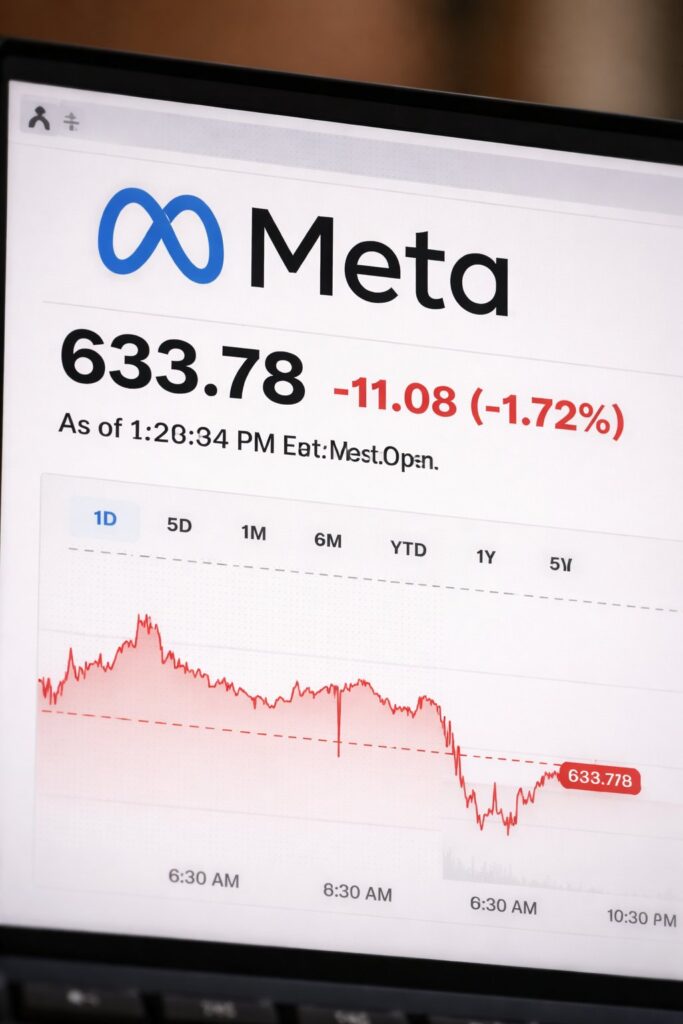

Meta Platforms (NASDAQ: META) was in focus during Monday’s session after the stock fell to $633.78, down 1.72%, as investors balanced the company’s powerful long-term growth narrative against its massive AI spending plans and near-term valuation questions.
Even with the pullback, Meta remains one of the most closely watched names in the market. The company continues to sit at the center of several of Wall Street’s biggest themes, including artificial intelligence, digital advertising, platform monetization, and large-cap technology leadership. Recent investor attention has also been fueled by fresh discussion around Meta’s earnings outlook, forward revenue growth, and the scale of its planned infrastructure investments.
For investors following the latest move, the decline does not necessarily change the broader thesis around the social media giant. Instead, it highlights the tension that often appears when a mega-cap technology company posts strong fundamentals while also committing tens of billions of dollars toward future growth initiatives that may take time to fully translate into financial returns.
META stock remains tied to AI optimism and execution risk
Meta’s long-term bull case is increasingly linked to the company’s ability to use artificial intelligence to improve ad targeting, recommendation systems, engagement, and monetization across its family of apps. Facebook, Instagram, WhatsApp, and Threads together give Meta unmatched scale, and that scale creates the data advantage many investors believe will strengthen its AI position over time.
At the same time, markets are watching the cost side of that equation very carefully. Heavy capital spending tied to AI infrastructure, data centers, and model development has become one of the biggest talking points around the stock. Investors generally reward spending when it is clearly tied to future cash flow growth, but large outlays can still create periods of volatility, especially when the stock has already enjoyed a major run.
That dynamic appears to be part of the story behind Monday’s decline. Some investors may be reassessing how much future upside is already reflected in META shares, particularly as AI enthusiasm across the broader technology sector remains high.
Growth estimates still support the broader Meta narrative
Despite the day’s weakness, Meta’s forward estimates remain one of the strongest parts of the investment story. Recent projections point to continued earnings and revenue expansion, reinforcing the idea that Meta is not just an AI story, but also a company with a highly profitable core business that is still growing at a pace many mega-cap peers would struggle to match.
The company’s ad machine remains the key engine. Improvements in AI-driven content ranking and ad delivery have helped Meta increase efficiency across its platforms, while advertiser demand has remained resilient. That matters because strong ad pricing and user engagement can provide the cash flow needed to support large-scale AI investments without completely undermining profitability.
Investors looking for more context on large-cap technology earnings trends may also want to read our Magnificent 7 stocks analysis and our AI stocks to watch coverage for a broader industry comparison.
Advertising strength still gives Meta a powerful edge
One reason META continues to attract attention on dips is that its underlying business remains unusually strong. Unlike some companies that are relying on future AI monetization that has yet to meaningfully show up in results, Meta is already integrating AI into a business model that produces enormous revenue and cash flow today.
Recommendation improvements can keep users engaged for longer periods. Better targeting can improve advertiser returns. More relevant content can strengthen retention across platforms. Taken together, those factors create a flywheel that is difficult for competitors to replicate at Meta’s scale.
That does not eliminate risk. Digital advertising remains cyclical, and any slowdown in corporate marketing budgets could affect sentiment. Competition for user attention also remains intense, while regulatory pressure continues to hover over large platform companies. But compared with many other AI-related names, Meta has the benefit of a mature operating business that can fund its next phase of expansion.
Valuation questions are likely to keep volatility elevated
The latest move in META stock also reflects a familiar market pattern: even great companies can see short-term pullbacks when investors begin debating whether growth expectations have become too optimistic. Meta is widely viewed as a company with strong fundamentals, but that does not mean the stock will move in a straight line.
When a company is spending aggressively on AI, investors tend to ask two questions at the same time. First, can that spending reinforce long-term leadership? Second, how much patience will the market have if near-term margin pressure increases? Those questions can create headline-driven swings, especially during sessions when tech sentiment softens.
Investors comparing valuation frameworks across the sector can review third-party research and market data from Yahoo Finance’s META quote page, Nasdaq market data, and Zacks stock research.
What Monday’s move may mean for investors watching META
A decline to $633.78 does not erase Meta’s strengths, but it does show that investor expectations remain elevated. The company still has one of the strongest platform ecosystems in the public market, and its ability to merge AI development with real-world monetization continues to stand out. However, the same AI strategy that supports the long-term bull case also introduces cost pressure and execution scrutiny.
That combination helps explain why META can be both a favored long-term name and a stock that experiences short-term turbulence. For market participants, the latest pullback may be less about a collapse in the company’s outlook and more about the market recalibrating around the pace of returns, the cost of innovation, and the valuation investors are willing to assign today.
Readers interested in similar coverage can also explore our META stock forecast 2026-2030, digital advertising stocks guide, and Big Tech AI spending trends for additional perspective.
With Meta still positioned at the intersection of AI, digital advertising, and mega-cap growth, the stock’s next move will likely remain tied to the same forces that drove investor interest in the first place: earnings durability, revenue momentum, capital allocation discipline, and proof that AI investments can continue turning into real business gains.

Make Swikblog your go-to source on Google for reliable updates, smart insights, and daily trends.