
The closure of the Great Western Highway at Victoria Pass has become one of the biggest transport disruptions facing regional New South Wales, cutting a vital road link between Sydney and the state’s central and western regions for at least three months after a major road failure was detected beneath the highway.
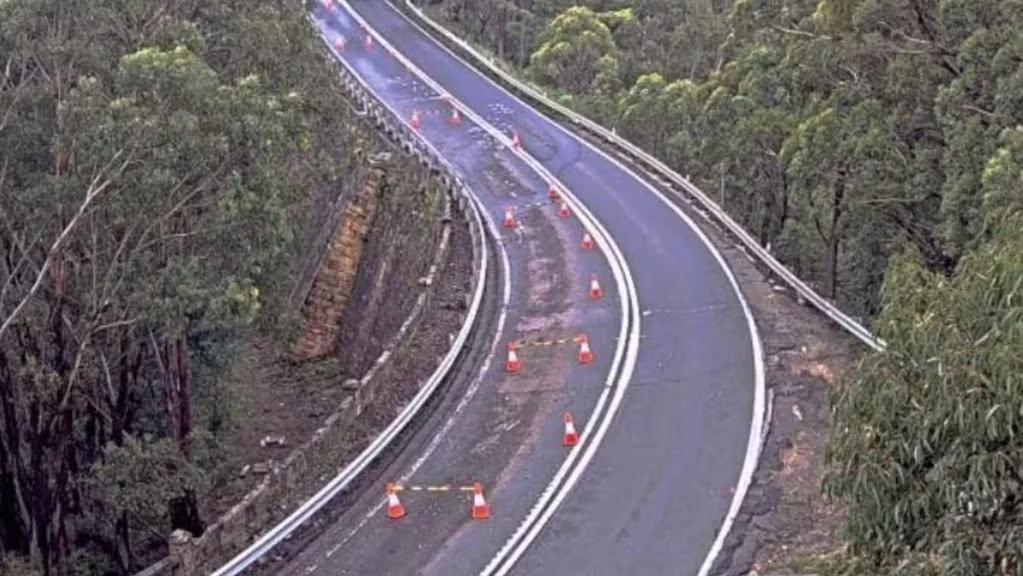
Authorities shut the route on Sunday after engineers identified significant cracking and movement in the substructure of Mitchell’s Causeway, a 194-year-old convict-built section of road on the steep descent from Mount Victoria to Lithgow in the Blue Mountains. What initially appeared to be a serious maintenance issue has now been confirmed as a major geotechnical failure, forcing the NSW government to close the road for months rather than risk lives on one of the state’s most important regional corridors.
Historic Mitchell’s Causeway at the centre of the crisis
Mitchell’s Causeway is not just another stretch of road. Built nearly two centuries ago using convict labour, it forms a historic and strategically important part of the Great Western Highway, the key transport route linking Sydney with Bathurst, Lithgow and the broader Central West. The section carries heavy trucks, regional commuters, tourists and local traffic, making its closure a major blow for communities and businesses across the region.
NSW Roads and Regional Transport Minister Jenny Aitchison said the situation was “incredibly serious” and made clear that authorities would not rush the repair work.
She said the closure was causing real hardship for families, workers, school communities, freight operators and local businesses, but stressed that “there will be no shortcuts on safety” because the road cannot reopen until it is confirmed to be safe.
The government has described the issue as a “major geotechnical failure” on a fragile and historic section of road. Officials also said the significant geological movement now being recorded at the site is something not seen in the last 200 years, underlining the severity of the threat.
Why the road will stay shut for months
Transport for NSW says at least two weeks of specialist geotechnical testing and 3D imaging must be carried out with no passing traffic so engineers can fully understand the extent of the movement beneath the road. Only after that testing is completed can authorities determine the exact repair and stabilisation work required.
Even in the most optimistic scenario, remediation work needed to make the road safe for vehicles would take at least another two months after testing. That means the Great Western Highway closure at Victoria Pass is expected to remain in place for a minimum of three months, with the possibility of further delays if the investigation uncovers deeper structural problems.
Transport Deputy Secretary Matt Fuller said the slope had already been under close monitoring and had received more than $20 million in investment over the past few years. Despite that spending, the latest geological movement has still forced a full shutdown of the route.
Businesses near Victoria Pass hit by sharp revenue losses
The economic damage from the closure is already being felt by small businesses near the bottom of Victoria Pass, where through traffic has effectively disappeared. Shops and food outlets that relied on steady passing motorists now say customer numbers have collapsed almost overnight.
One Little Hartley business, The Lolly Bug, said takings had fallen by 75 per cent since the highway closed. Owner Chloe Tofler said only locals were now coming in to support the shop, while regular through traffic had vanished completely. For small operators trading on thin margins, a revenue drop of that size is not just a slowdown but a serious survival threat.
Business owners are now pleading for government compensation or direct assistance, arguing that although the closure was unavoidable for safety reasons, the financial impact on small regional operators is severe and immediate.
Families and school communities face major travel disruptions
The fallout is not limited to businesses. Families in the region say school travel times have blown out dramatically because of detours and altered bus routes. Some students who previously had a 20-minute trip home are now facing return commutes of nearly two hours.
That extra time on the road is also translating into higher fuel costs and increased wear and tear on vehicles, adding more strain to household budgets. For workers commuting between Blue Mountains communities and Lithgow or Bathurst, the closure is creating daily delays and more expensive travel patterns.
Detours, Chifley Road pressure and public transport changes
With the Great Western Highway shut at Victoria Pass, traffic is now being redirected onto alternative routes. One of the main options is the Darling Causeway, which adds about 25 minutes to trips across the Blue Mountains. Another major diversion is via Chifley Road, a single-lane road now expected to carry a much larger volume of traffic than usual, despite not normally being associated with heavy regional flows.
The pressure on those detours is expected to remain high for the duration of the closure, especially given the importance of the highway for freight movement between western NSW and Sydney.
To reduce disruption, Transport for NSW has introduced a series of public transport measures. Free train travel between Bathurst and Katoomba is being offered from Saturday, while additional train services between Bathurst and Mount Victoria are scheduled from Sunday. A fully accessible coach service is also being introduced between Bathurst and Katoomba, operating 12 times a day, with six services in each direction and stops at Katoomba, Mount Victoria, Lithgow and Bathurst.
School bus routes are also being amended to reflect the closure and the longer alternative journeys now required.
NRL travel plans also affected
The closure is affecting not only daily commuters and freight but also major regional events. Bathurst is due to host an NRL fixture between the Cronulla Sharks and Penrith Panthers, and fans travelling to the game now face a detour of around 30 minutes by road or the need to rely on train services instead.
That adds another layer of disruption for a region that was expecting visitor traffic and event-related spending, at a time when local businesses are already under pressure from the loss of highway movement.
A major test for regional NSW
The closure of the Great Western Highway at Victoria Pass highlights how vulnerable critical transport links can be when ageing historic infrastructure meets unstable terrain and modern traffic demands. What began as cracking in the road has now escalated into a months-long shutdown with wide economic, social and transport consequences.
For now, the NSW government says safety must come first, and the road will not reopen until the site has been fully tested, stabilised and repaired. But for small businesses losing trade, families facing two-hour school commutes, freight operators navigating single-lane detours and visitors trying to reach Bathurst and the Central West, the closure is already reshaping daily life across the region.
Until Mitchell’s Causeway can be made safe again, the Great Western Highway closure at Victoria Pass will remain one of the most important transport and local economy stories in New South Wales.
The disruption also comes at a time when businesses are already under pressure from rising costs and changing economic conditions, adding to concerns about how smaller operators can absorb sudden revenue shocks. Similar to the wider debate around technology-driven disruption and workforce pressure, regional businesses now face a different kind of structural challenge as traffic losses hit sales and daily operations. You can also read our report on Atlassian layoffs and AI disruption for more insight into how economic shifts are affecting businesses and jobs.

Make Swikblog your go-to source on Google for reliable updates, smart insights, and daily trends.