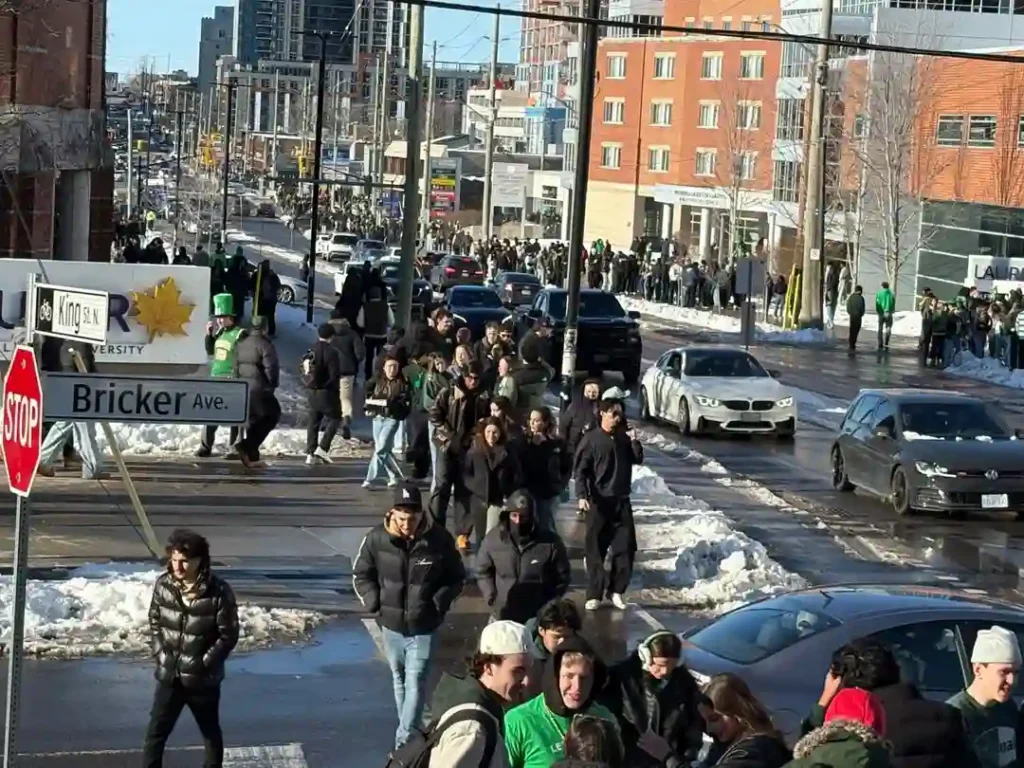

Waterloo’s 2026 St. Patrick’s Day celebrations may have seen a sharp drop in crowd size compared to last year, but the aftermath still tells a story of heavy enforcement, rising concerns, and a city struggling to contain unsanctioned street gatherings. Police issued more than 200 charges, while municipal teams handled dozens of complaints as thousands gathered across multiple days.
According to CBC News, the peak crowd reached approximately 7,500 people on March 14 — significantly lower than the nearly 25,000 attendees recorded in 2025. However, officials emphasized that the reduced turnout did not translate into reduced risk or operational demand.
Waterloo Regional Police Service (WRPS) confirmed that enforcement efforts were not limited to a single day. Between March 13 and March 18, multiple operational deployments were carried out to manage what authorities described as “large unsanctioned gatherings” across the city.
218 Charges Laid Across Multiple Acts During St. Patrick’s Day Enforcement
Police reported a total of 218 charges during the enforcement period, reflecting a wide range of violations tied to alcohol use, traffic disruptions, and public safety concerns.
The breakdown of charges includes 58 under the Liquor Licence and Control Act, highlighting continued issues with public drinking and alcohol-related behavior. The largest share — 128 charges — came under the Highway Traffic Act, pointing to major concerns around road safety, blocked streets, and vehicle-related violations during the celebrations.
Additional charges included three under the Trespass to Property Act, six under the Criminal Code, one under the Cannabis Control Act, 12 by-law-related charges, and 10 categorized as other offences. This diverse mix shows that enforcement extended well beyond simple crowd control, touching on property rights, criminal behaviour, and municipal regulations.
Authorities stressed that even with fewer attendees, the complexity of managing the event remained high, requiring coordinated policing across multiple legal areas.
72 Noise and Nuisance Complaints, Dozens of Fines and Cleanup Orders
Alongside police enforcement, the City of Waterloo’s municipal enforcement team responded to 72 calls related to noise and nuisance complaints. These incidents reflected ongoing disruption in residential areas near the gathering zones.
Enforcement actions included seven nuisance party charges, each carrying an $800 fine, and six charges for blocking or interfering with pedestrian or vehicle traffic, also set at $800. These violations indicate how large crowds impacted both mobility and neighborhood access.
Officials also issued 21 noise charges with $400 fines and three public urination charges, also carrying $400 penalties. Beyond fines, the city issued 49 orders for clean-up and property standards compliance, showing that the impact extended well beyond the duration of the celebrations.
Grant Curlew, acting director of Municipal Enforcement Services, expressed disappointment that individuals continued gathering in ways that created both nuisance conditions and community safety concerns.
Sniper Deployment Sparks Shock as Police Cite ‘Mass Casualty’ Preparedness
One of the most talked-about aspects of this year’s policing strategy was the deployment of a tactical officer positioned to oversee the crowd from a distance. Images of the officer circulated widely, triggering concern and fear among attendees and observers.
Police leadership defended the decision, explaining that the officer was deployed as part of a broader emergency preparedness strategy. WRPS Chief Mark Crowell stated that the tactical overwatch was intended to monitor the entire area and identify potential safety threats that may not be visible at ground level.
“We’re very deliberate and careful about every single thing that we do in our deployment,” Crowell said during a police service board meeting. He added that the measure was taken to mitigate “mass casualty considerations,” indicating that authorities were preparing for worst-case scenarios rather than reacting only to visible crowd behaviour.
The move has since sparked debate over policing tactics, with some questioning whether such measures were excessive, while others see them as necessary given the unpredictable nature of large, unsanctioned gatherings.
Smaller Crowd but Same Risk and High Cost for Waterloo Authorities
Despite the drop in attendance, officials made it clear that planning and resource allocation for the event cannot depend on crowd size alone. Ian McLean, chair of the WRPS police board, emphasized that the city must prepare for the highest possible risk scenario each year.
“We can’t be dependent on whether we have bad weather or where it lands on the calendar,” McLean said, noting that turnout can fluctuate significantly. He stressed that the goal should not just be managing the event, but preventing it altogether due to its risks and financial burden.
Authorities described the event as both “very risky and very expensive,” highlighting the strain placed on policing, municipal services, and community infrastructure over multiple days.
No Major Injuries but Ongoing Concerns Remain
While officials confirmed that there were no significant injuries reported during this year’s celebrations, they remain concerned about the broader implications of such gatherings. Police say the 2026 operation went largely as planned, but the underlying issues have not been resolved.
Chief Crowell noted that authorities will now conduct a detailed analysis based on factors such as crowd size, number of charges, and overall impact on city systems. This analysis will help guide future planning and coordination with community partners.
“We continue to be very concerned with the total cost, the level of risk and the stress upon all of our systems,” Crowell said, adding that efforts will continue to “stem the tide” of such events.
What’s Next for Waterloo’s St. Patrick’s Day Street Gatherings
The 2026 celebrations highlight a growing challenge for Waterloo — even with fewer participants, unsanctioned gatherings continue to create safety concerns, enforcement pressure, and public debate.
City officials and police are now signaling a firmer approach moving forward, with a clear focus on preventing future events from reaching similar scale or impact. Whether through stricter enforcement, policy changes, or community engagement, authorities appear determined to reduce the strain these gatherings place on the city.
More official updates and enforcement details can be accessed via the Waterloo Regional Police Service.

Make Swikblog your go-to source on Google for reliable updates, smart insights, and daily trends.