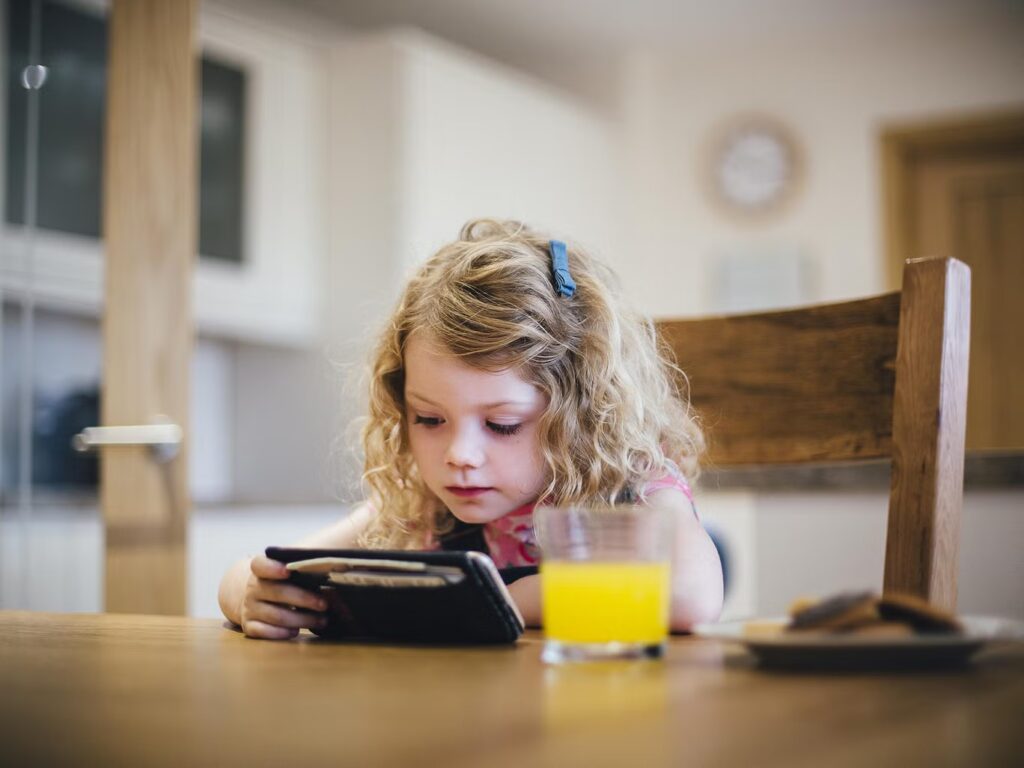

Parents and childcare providers in England are being advised to avoid routine screen time for children under two and limit children aged two to five to no more than one hour a day, or less where possible.
The government published its first national screen-use guidance for under-fives on March 26, 2026. The Department for Education has since issued detailed advice explaining how nurseries, childminders and preschool settings should apply the recommendations.
The limits are precautionary recommendations, not legal restrictions. Parents will not be fined or penalised if a child exceeds one hour, and the guidance recognises that family circumstances and children’s individual needs differ.
Screen time limits by age
For babies and children under two, screen use should generally be avoided. Exceptions include shared activities that encourage communication or bonding, such as video-calling a relative or looking through a digital family photo album with an adult.
Children aged two to five should have no more than one hour of screen time across the entire day. The government says less is preferable, especially when using a device begins to replace sleep, outdoor activity, creative play or conversation.
The recommendation covers time spent looking at televisions, smartphones, tablets, computers and other digital displays. Families should consider screen use at home and in childcare when estimating a child’s daily total.
Audio activities that do not require a child to watch a display, such as listening to music or an audio story, are not treated in the same way.
When screens should be avoided
Screens should be kept away from mealtimes, bedrooms and the hour before bedtime. Background television should also be switched off during play, meals and family conversations because it can distract children and adults.
Young children should not be left to browse video platforms alone. Autoplay, infinite scrolling and recommendation feeds can extend viewing beyond the planned period and may move a child from suitable material to advertising or inappropriate videos.
The advice says social media is not designed for young children and should be avoided. Parents are encouraged to use parental controls, disable autoplay and check programmes or apps before allowing access.
How to choose suitable content
Content should be age-appropriate, slow-paced and easy to follow. Government advice suggests looking for simple stories, predictable sequences, limited scene changes, clearly spoken dialogue and visible facial expressions.
Fast-moving videos containing frequent cuts, flashing images, overlapping music, rapid speech or complicated storylines should be avoided. Social-media-style short videos are specifically identified as unsuitable for young children.
An app or programme being described as “educational” does not automatically make it safe or developmentally useful. Parents and childcare professionals should assess its pace, purpose, advertising, privacy features and whether it encourages meaningful participation.
Advert-free content is preferable because very young children may not understand the difference between a programme and a commercial message.
Why watching together matters
The government recommends co-viewing instead of solitary screen use. An adult can describe what is happening, name objects, ask questions and connect events on the screen with the child’s own experiences.
Useful prompts include asking what a character might do next, encouraging a child to repeat a new word or discussing how someone in the story appears to feel.
This does not mean every programme becomes educational because an adult is present. The material should still be suitable, and viewing should not replace direct play, physical activity or conversation.
Why the government introduced the guidance
The recommendations followed engagement with more than 1,000 parents and a review by the Early Years Screen Time Advisory Group. The panel was established in January 2026 and co-chaired by Dame Rachel de Souza, the Children’s Commissioner for England, and Professor Russell Viner of University College London.
Government figures show that 98% of two-year-olds watch screens each day, while 24% of parents with children aged three to five say they find it difficult to control screen use.
The expert review considered research involving televisions, tablets, phones and computers. It concluded that prolonged solitary viewing can displace sleep, movement, outdoor activity, imaginative play and responsive interaction with adults.
High screen exposure has been associated in research with difficulties involving sleep, language, attention and aspects of social or emotional development. However, an association does not prove that screens alone caused a particular developmental problem.
The panel did not conclude that every form of screen use is harmful. Age, duration, content, context and the activity being displaced all matter. A video call with a grandparent is therefore treated differently from watching an algorithm-driven stream of short videos alone.
Latest advice for nurseries and childminders
The Department for Education’s operational guidance says early years settings should take a precautionary approach. Screen use should be limited, planned in advance and linked to a specific learning or developmental objective.
Nurseries and childminders are encouraged to establish a screen-use policy and explain it to families. They should consider whether a child may already be reaching the recommended limit at home before adding screen activities during the day.
Children should not access screens alone or in groups without adult involvement. Staff should check all material beforehand and avoid content containing autoplay, scrolling, advertising or algorithmic recommendations.
Devices should not routinely be used to occupy children, calm behaviour or fill gaps between activities. Interactive, screen-free teaching is preferred because an adult can respond to a child’s expressions, questions and level of understanding in real time.
Early years settings should discourage children from bringing personal devices unless an individual need has been agreed. Staff use of phones, cameras and other devices must follow the setting’s safeguarding policy.
Warning about AI toys and chatbots
Parents and childcare providers are advised not to give young children AI toys, AI chat applications, interactive robots or smart devices that use artificial intelligence until stronger evidence is available about their effects.
This is a precaution rather than a finding that every AI product causes harm. Concerns include unsuitable responses, privacy, reduced adult interaction and uncertainty about how conversational systems may influence early language and social development.
Smart speakers may fall within this advice when a child is independently interacting with an AI service. Ordinary audio playback controlled by an adult is different from allowing open-ended conversations with an AI system.
Exception for children with SEND
The one-hour limit does not apply in the same way to screen-based assistive technology used by children with special educational needs and disabilities.
Communication devices, accessibility tools and specialist learning technology can be essential for a child’s communication, wellbeing and participation in everyday activities.
Families and professionals should use an individual approach while protecting time for sleep, play, movement and personal interaction where possible.
Practical screen swaps for families
The guidance promotes manageable “screen swaps” instead of expecting every family to remove devices immediately. During meals, a video can be replaced with conversation, quiet music, colouring, a simple table game or “I Spy”.
At bedtime, parents can replace screens with a story, song or calm conversation. Giving a five-minute warning before turning off a device and using a timer may make transitions easier.
Other practical steps include keeping devices out of sight, setting consistent viewing periods, downloading approved content instead of allowing open browsing and creating the same screen-free rules for adults during meals.
Parents are encouraged to consider their own phone use because young children often imitate adult behaviour. Reducing interruptions from notifications can make it easier to maintain conversation and notice when a child is seeking attention.
Is the one-hour limit compulsory?
The guidance is advisory and does not create an offence. It is designed as a daily target that families and early years providers can work towards, not a reason to feel guilty about occasional exceptions.
If reducing screen use causes repeated distress, parents can make gradual changes instead of stopping suddenly. Protecting the hour before sleep, removing screens from meals and reducing background television are practical starting points.
Parents concerned about a child’s sleep, eyesight, speech, behaviour or development should contact a health visitor, GP or another qualified health professional rather than assuming screen exposure is the only explanation.
Where parents can find official advice
The complete recommendations are available through the government’s Best Start in Life screen-time guidance. The supporting evidence report can be accessed through the Department for Education and Department of Health and Social Care.
The recommendations form part of a wider discussion about children’s digital wellbeing and the responsibilities of technology companies. Families can follow new government policy developments as further online-safety measures are announced.
Additional family, health and consumer updates are available on the homepage. The government’s current message is that small, consistent changes—including screen-free meals, calmer bedtime routines and more shared activity—can help families establish healthier habits.
Read More:
- Pink drinks at Starbucks and Dunkin’: Summer 2026 menu highlights
- Buffalo Wild Wings Poppin’ Ranch launch: Price, release date and details
- Visit the Swikblog homepage for more latest news
You may also like: Buckelwal in der Ostsee gerettet: Rückkehr ins offene Meer vor Deutschland sorgt für Aufsehen

Make Swikblog your go-to source on Google for reliable updates, smart insights, and daily trends.