
Morning rail travel in Suffolk was thrown into confusion after a serious overnight fire tore through a building at Oulton Broad North railway station, leaving commuters facing cancellations, revisions and diverted services across key Greater Anglia routes. What began as an emergency response at around midnight quickly turned into a wider transport story by dawn, with passengers travelling between Ipswich, Lowestoft and Norwich waking up to disruption on one of the region’s important local rail links.
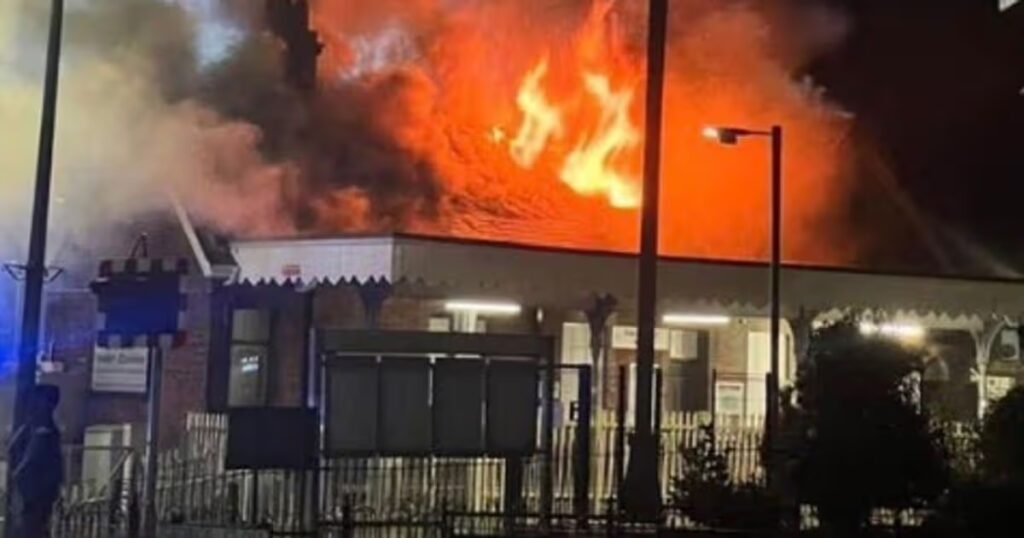
The blaze broke out in the roof of Labone Indian Cuisine, the restaurant based on the platform at the station. Fire crews arriving at the scene found the roof well alight, with flames visible above the station building as emergency services moved in to contain the fire. By early morning, the most dramatic phase of the incident had passed, but the damage left behind was significant enough to disrupt train operations well into the day.
For rail passengers, the practical effect was immediate. Services between Ipswich and Lowestoft were among those hit first, with Greater Anglia warning that some trains would be cancelled, some revised, and others diverted. During the morning peak, trains on the Ipswich to Lowestoft route were expected to operate only between Ipswich and Saxmundham for part of the disruption window, cutting off the full route many regular passengers rely on. Some services were also redirected via Great Yarmouth and Reedham, underscoring how one station fire quickly rippled across a broader section of the East Anglia network.
Live disruption picture: the station fire did not just affect Oulton Broad North itself. Because rolling stock and connecting service patterns feed into other parts of the timetable, passengers travelling on nearby Suffolk and Norfolk routes also felt the impact through delays, altered stopping patterns and cancellations.
According to early reports from the scene, firefighters were called at about midnight and remained there for hours as they worked to extinguish the flames and prevent any flare-up from spreading further. Emergency crews had the fire under control by around 06:00 BST, but the aftermath was still serious. The roof of the building was largely destroyed, and fire crews stayed in place to tackle lingering hot spots while surrounding access remained sensitive. Police and ambulance crews also attended, although no injuries were reported.
That detail matters. In incidents like this, even after the visible flames have gone, station operations cannot simply restart on command. Safety checks, structural assessments, emergency-service access and infrastructure inspections all have to happen before services can return to normal. That is why rail disruption often continues hours after the fire itself appears to be out. In this case, passengers were told to expect continued disruption through the morning, with the wider rail network adjusting around the damage caused at the station.
What happened overnight at Oulton Broad North
The fire appears to have centered on the station-side restaurant building rather than on trains themselves, but the location made it especially disruptive. Oulton Broad North is a working railway station, and any serious blaze involving a structure on or immediately beside the platform creates obvious operational risks. Damage to the building, concerns about debris, and the need for emergency access can all force train operators to suspend or alter services while inspections take place.
Images from the scene showed large flames pushing through the roof and smoke rising above the structure in the dark, creating a dramatic overnight emergency that quickly drew attention across local media. By first light, the most urgent firefighting work had shifted into damage management, with the station area showing the heavy effect of the blaze.
For passengers, the biggest frustration has been uncertainty. The disruption was not limited to a single cancelled train. Instead, it created a moving picture of revised services, route diversions and truncated operations, the kind of situation that can make even short regional journeys far more complicated than expected.
What happens next for passengers and the station
The next phase is likely to focus on inspection, recovery and timetable stabilization. Railway incidents tied to fires usually move from emergency response into a slower operational review, with infrastructure teams checking that the site is safe and train services can run without risk. That means passengers should continue treating the route with caution even after the fire itself has been extinguished.
Anyone planning to travel through this part of Suffolk should keep a close eye on the operator’s live service channels. Greater Anglia’s live train updates remain the key place for real-time information on cancellations, diversions and departures as the situation develops through the day.
The wider local story will now turn to the condition of the station building, the future of the restaurant space, and whether any longer-running timetable or station-access issues emerge after engineers complete their checks. For now, the immediate picture is clear enough: a dramatic station fire overnight has left a visible mark on Oulton Broad North and caused a difficult start to the day for rail passengers across Suffolk and nearby routes.
That is what gives this incident such strong local impact. It was not only a fire story and not only a transport story. It was both at once, unfolding in the early hours, then spilling directly into the morning commute. For passengers heading to work, school or onward connections, the damage at one station became a disruption felt across an entire stretch of the network.
As crews finish making the area safe and rail teams work to restore full service, the hope will be that operations normalize quickly. But after an overnight blaze of this scale, commuters across Suffolk will be watching closely before assuming the line is fully back to normal.

Make Swikblog your go-to source on Google for reliable updates, smart insights, and daily trends.