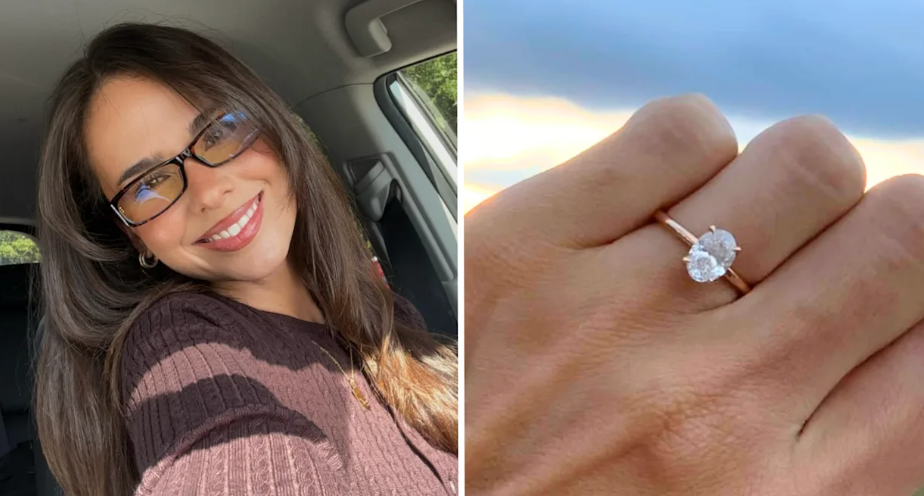

A Sydney teacher’s shock discovery that her $9,000 engagement ring was worth just $500 on resale is sparking wider discussion about the true value of diamond jewellery, particularly as lab-grown stones reshape the global market.
Mia Pimentel, who had been in a relationship for nearly five years, received the gold, one-carat oval solitaire ring during her engagement in 2021. When the couple separated two years later, they agreed to keep the rings they had proposed with — a decision that later led Mia to question its financial worth.
After months of leaving the ring untouched, she sought a valuation through a jeweller friend, expecting at least a reasonable return. Instead, the estimate came back at just $500, a figure that, in her words, left her stunned.
The experience has struck a chord online, with others sharing similar stories of engagement rings bought for thousands being sold for only a fraction of their original price. Some reported receiving as little as $200 for rings that once cost $5,000 or more.
What buyers pay for — and what sellers lose
Jewellery experts say the steep drop is not unusual. The retail price of an engagement ring reflects far more than the materials alone. Buyers are paying for craftsmanship, design, branding and the personalised experience attached to a major life purchase.
When the same ring is resold, those elements largely disappear. Jewellers often dismantle pieces, melt down the gold or reset stones into new designs, effectively removing the original labour value. What remains is the intrinsic worth of the materials — and even that can vary depending on market demand.
Despite rising gold prices over the past year, which might suggest stronger resale value, the structure of the second-hand jewellery market limits how much sellers can recover.
Lab-grown diamonds driving sharper declines
In Mia’s case, another factor played a significant role: the diamond was lab-grown. While these stones have surged in popularity for their lower cost and ethical appeal, they are also depreciating more quickly than natural diamonds.
Advances in production technology have made lab-grown diamonds significantly cheaper to produce. Prices that were once around $2,000 per carat have dropped closer to $500, increasing supply and reducing resale demand.
Lab-grown diamonds now account for an estimated 50–60% of the retail market in Australia, with projections suggesting that share could reach 70% by the end of the year. The rapid growth is changing pricing dynamics, particularly in the secondary market where scarcity plays a critical role.
Unlike natural diamonds, which retain some value due to perceived rarity, lab-grown stones face continuous downward pressure as production becomes more efficient.
For sellers, experts suggest that private sales may offer better outcomes than going through jewellers, as individual buyers may value the design and craftsmanship of a complete ring rather than its raw components.
The broader takeaway is becoming clearer as more cases emerge: engagement rings are rarely financial assets. While they carry emotional weight, their resale value often reflects only materials and market conditions — not the price originally paid.
For more insight into how diamond value is assessed, visit the Gemological Institute of America.
You may also like: Hyundai recalls 300,000 cars over seatbelt defect: Full models list

Make Swikblog your go-to source on Google for reliable updates, smart insights, and daily trends.