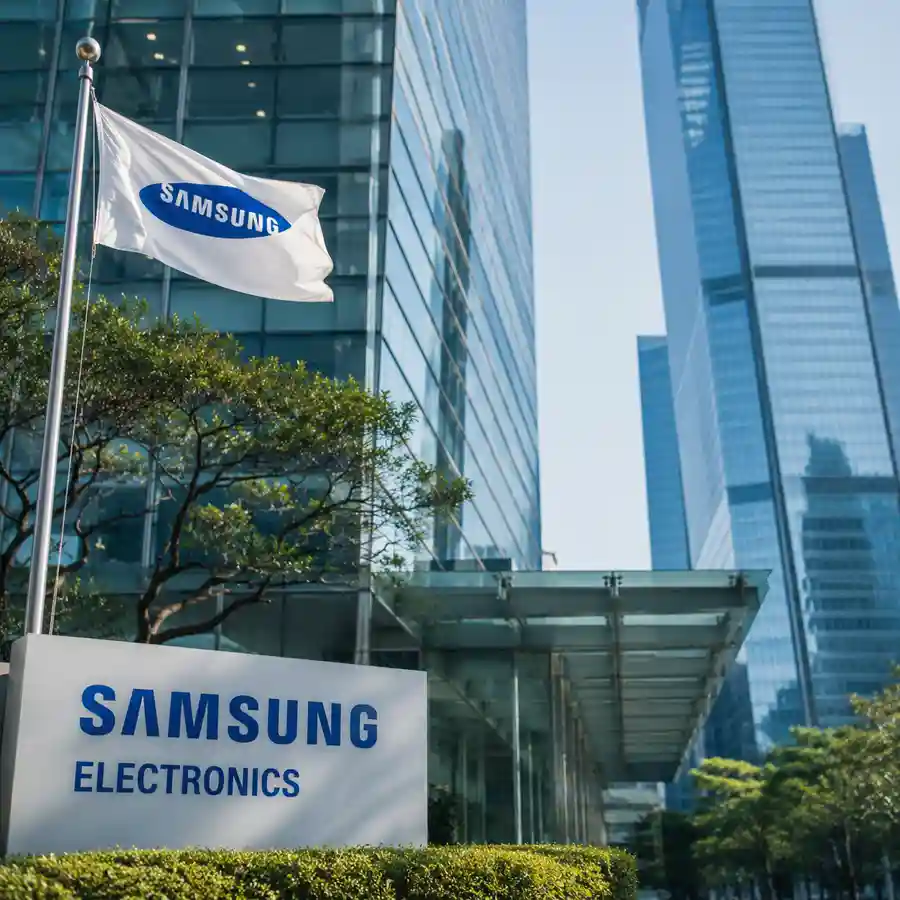

Samsung Electronics has surged past a $1 trillion valuation, marking a major milestone as the global race for AI-powered semiconductors drives investor demand and reshapes the tech market.
The move is not just about one company’s share price. It reflects a broader investor belief that the AI boom has changed the long-term role of memory chips, data center infrastructure and advanced semiconductor manufacturing. Samsung, long known for smartphones and consumer electronics, is now being valued more aggressively for its position at the center of the AI hardware supply chain.
Samsung’s latest surge came after its shares jumped sharply in Seoul, extending a powerful one-year rally driven by rising demand for chips used in artificial intelligence systems. The company became only the second Asian business after Taiwan Semiconductor Manufacturing Co. to reach the trillion-dollar level, underlining Asia’s growing dominance in the global chip race.
The rally also lifted sentiment across South Korea’s equity market. Samsung and SK Hynix together carry enormous weight in the Kospi index, and their gains have helped turn the Korean market into one of the strongest technology-driven stories in Asia. Foreign investors have been increasing exposure to Korean shares as confidence grows that the AI spending cycle may last longer than previous semiconductor booms.
What makes Samsung’s rise especially important is the changing nature of memory demand. In earlier cycles, memory chipmakers were heavily exposed to smartphones, laptops and consumer electronics. Those markets could weaken quickly when consumer demand slowed. This time, the strongest demand is coming from AI data centers, cloud providers and companies building large-scale computing systems.
Artificial intelligence models require enormous processing power, but they also need high-performance memory to move and store data efficiently. That has made advanced memory products more valuable across the AI supply chain. Samsung, SK Hynix and TSMC are now viewed as some of the most important companies behind the infrastructure powering generative AI, enterprise automation and next-generation cloud services.
Samsung’s semiconductor business has already shown the financial impact of this shift. The company recently reported a huge profit recovery in its chip division, helped by stronger pricing and AI-related orders. Memory prices have continued climbing as supply remains tight, giving major producers more pricing power than they had during the previous downturn.
Analysts believe this demand strength may continue into 2027 as customers compete for limited supply of advanced memory components. That expectation has encouraged investors to look beyond Samsung’s recent rally and focus on whether the company could benefit from a multi-year AI infrastructure cycle.
The company is also gaining attention beyond memory chips. Reports that Apple has explored Samsung as a possible manufacturing partner for processors in the United States have added another layer to the story. While TSMC remains Apple’s long-standing chipmaking partner, any move toward a second supplier would highlight Samsung’s strategic value in a world where technology companies want more resilient supply chains.
Governments are also pushing chipmakers to expand production across multiple regions. The United States, South Korea, Japan and Europe are all investing heavily to reduce dependence on concentrated semiconductor supply chains. Samsung’s manufacturing footprint and technical expertise make it a key player in that global shift.
Still, the trillion-dollar headline does not remove every risk. Samsung’s mobile and display businesses are facing pressure from higher material costs and uneven consumer demand. The company is also dealing with rising labor expectations, with workers seeking a larger share of profits created by the semiconductor rebound.
Those challenges matter because Samsung is not a pure-play AI company. It remains a sprawling technology group with exposure to smartphones, televisions, displays, appliances, foundry services and memory chips. That diversity gives Samsung scale, but it also means weakness in one division can partially offset strength in another.
Read More
Perth Bushfire: Herdsman Lake Fire Alert and Smoke Warning
Japan School Bus Crash Leaves Student Killed
New Zealand Universities Hit by Global Canvas Hack
Even so, investors appear focused on the company’s semiconductor upside. Samsung’s valuation remains lower than many US technology giants linked to artificial intelligence, which may explain why some global investors still see room for further gains. The market is effectively asking whether Samsung should be valued less like a traditional hardware company and more like an essential AI infrastructure supplier.
That debate could define Samsung’s next phase. If AI-related memory demand remains strong and chip prices continue rising, the company may strengthen its position among the world’s most influential technology businesses. If supply catches up too quickly or customers slow spending, the market could become more cautious.
For now, Samsung’s $1 trillion valuation shows how quickly the center of gravity in technology has shifted. The companies building the physical foundation of artificial intelligence are no longer operating in the background. They are becoming some of the most closely watched businesses in global markets.
For readers following the wider technology and semiconductor story, more market coverage is available on Swikblog, where AI, global business and major tech developments are tracked as they reshape industries.
Samsung’s milestone is ultimately bigger than a valuation record. It shows that the AI boom is no longer limited to software companies or chatbot makers. The biggest winners may also be the firms supplying the memory, processors and manufacturing capacity that make artificial intelligence possible.
Read more about global semiconductor industry trends from the Semiconductor Industry Association.
By Chetan Sharma

Make Swikblog your go-to source on Google for reliable updates, smart insights, and daily trends.