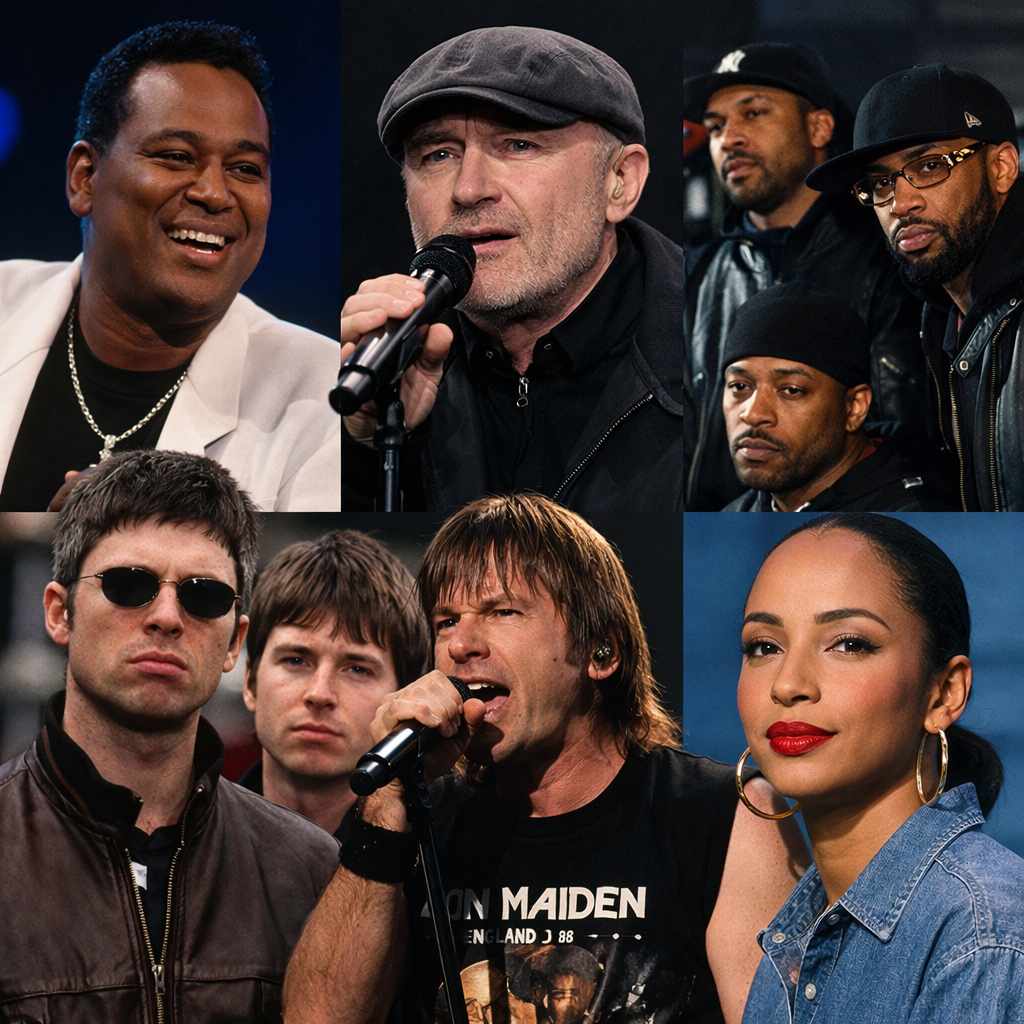

The Rock & Roll Hall of Fame has announced its 2026 inductees, with Luther Vandross, Phil Collins, Oasis and Wu-Tang Clan among the headline names set to be honoured at a ceremony scheduled for November 14 at the Peacock Theater in Los Angeles. The reveal, made live on “American Idol,” has quickly drawn widespread attention, not only for its diverse lineup but also for a controversial omission that has reignited debate over the Hall’s voting process.
This year’s performer class includes eight artists: Luther Vandross, Phil Collins, Billy Idol, Iron Maiden, Joy Division/New Order, Oasis, Sade and Wu-Tang Clan. The ceremony will be recorded and later broadcast in December on ABC and Disney+, extending its reach to a global audience.
For Vandross, the recognition arrives more than two decades after his commercial peak and over 20 years after his death in 2005. Widely regarded as one of the defining voices of modern R&B, he built a career that blended technical precision with emotional depth, producing a catalogue that became synonymous with romance in the 1980s and 1990s. Though born in New York, Vandross maintained strong ties with Detroit, a city that remained one of his most loyal markets throughout his career.
His journey into music began behind the scenes, working as a background vocalist and collaborator with artists such as David Bowie, Barbra Streisand, Diana Ross and Marvin Gaye before emerging as a solo powerhouse. By the 1980s, he had firmly established himself as a crossover success, moving between R&B and mainstream pop charts with ease.
A broader definition of “rock” continues to take shape
The 2026 class reflects the Hall’s continued shift toward recognising influence over genre boundaries. Wu-Tang Clan’s induction highlights hip-hop’s cultural weight, while Sade’s inclusion acknowledges a sound that blended soul, jazz and pop with lasting global appeal. Joy Division and New Order are recognised together for their combined impact on post-punk and electronic music, while Iron Maiden’s long-awaited entry reinforces heavy metal’s enduring presence.
Phil Collins, already inducted as part of Genesis in 2010, enters as a solo artist for the first time, marking the scale of his individual success. Oasis, a defining force of the Britpop era, and Billy Idol, whose career bridged punk and mainstream rock, complete a lineup that spans multiple generations and styles.
Beyond performers, the Hall also named recipients across special categories. The Early Influence Award will go to Celia Cruz, Fela Kuti, Queen Latifah, MC Lyte and Gram Parsons, while the Musical Excellence Award honours Linda Creed, Arif Mardin, Jimmy Miller and Rick Rubin. Television pioneer Ed Sullivan will receive the Ahmet Ertegun Award for his impact on the growth of popular music.
Fan vote controversy returns to the spotlight
Despite the celebratory tone, this year’s announcement has once again raised questions about the role of public voting. New Edition, which dominated the 2026 fan ballot with 1,022,683 votes, was not selected for induction. The result has left many fans questioning how a clear public favourite could be excluded from the final class.
The Hall’s voting system provides part of the answer. While the top seven artists in the fan vote are included on a single ballot, that ballot carries the same weight as each of the more than 1,200 votes cast by artists, historians and music industry professionals. In effect, the fan vote contributes to the outcome but does not determine it.
This is not the first time such a situation has occurred. Dave Matthews Band won the fan vote in 2020 but was not inducted until 2024, while Phish experienced a similar outcome in 2025. The pattern suggests that fan support, while influential, is only one factor in a broader and often opaque selection process.
The final fan vote standings further illustrate the competitive field. Behind New Edition were Phil Collins (900,825 votes), P!NK (852,581), Shakira (738,034), Luther Vandross (732,747), INXS (645,021) and Sade (622,997), among others. Yet only some of those names translated into induction.
As anticipation builds toward November’s ceremony, the 2026 class underscores both the Hall’s evolving definition of musical influence and the persistent debate over how its honourees are chosen. More details about the induction process and categories can be explored on the official Rock & Roll Hall of Fame website, where the institution outlines its voting system and criteria.
The ceremony will return to Cleveland, home of the Hall’s museum, in 2027 — a reminder that while the event travels, the institution’s role in shaping music history remains firmly rooted.

Make Swikblog your go-to source on Google for reliable updates, smart insights, and daily trends.