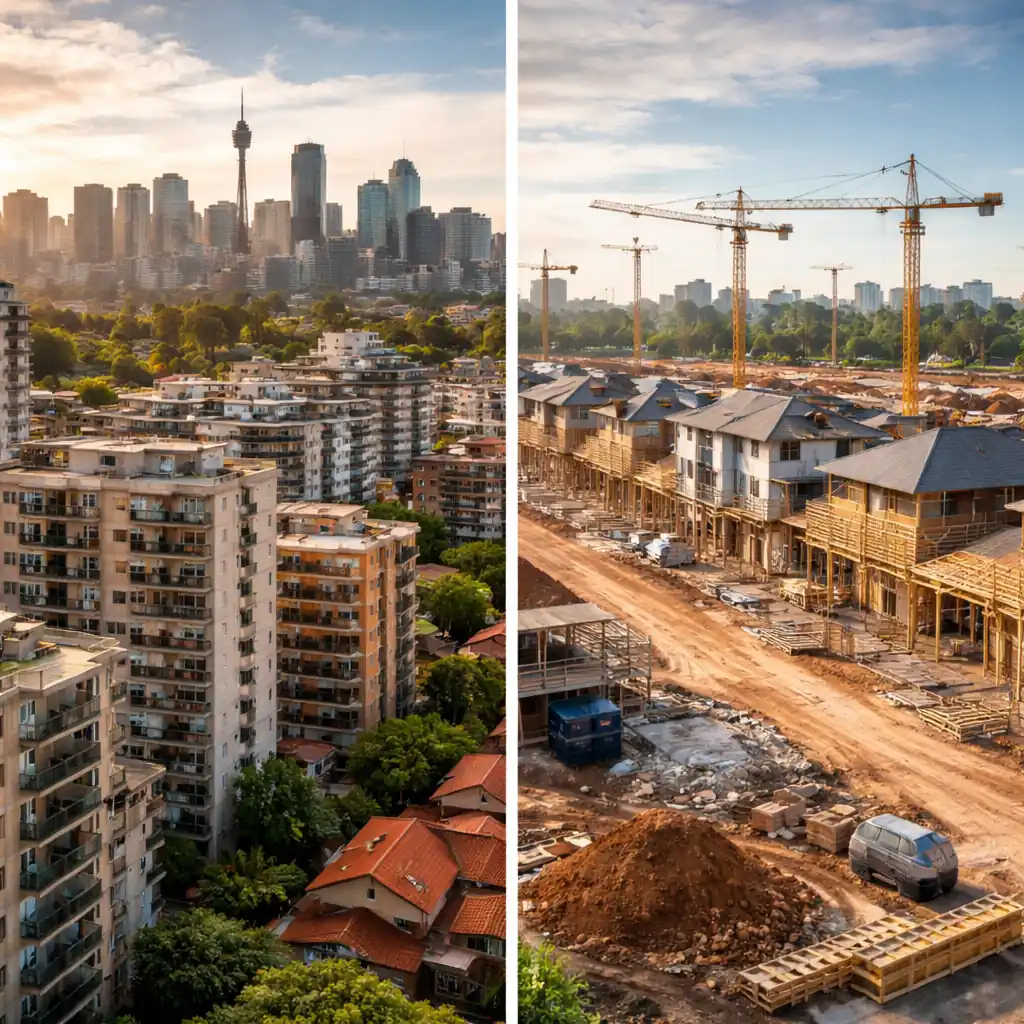

Australia’s housing crisis is intensifying in 2026 as a growing gap between population growth and housing supply continues to put pressure on affordability, rents and everyday living costs. New data shows the country has added people at a much faster pace than it has built homes, leaving buyers and renters competing in an increasingly tight market.
Recent figures highlight the scale of the imbalance. Between 2023 and 2025, Australia’s population grew by around 1.5 million people, while only about 527,000 new homes were completed. That gap — nearly three times more people than homes — is now being cited as a key reason behind persistent housing shortages and rising competition across major cities and regional areas.
The pressure is being felt most clearly in the rental market. Vacancy rates have dropped below 2% in capital cities, leaving tenants with fewer options and limited negotiating power. At the same time, households are now spending a record 33.1% of their income on rent, underlining how deeply the crisis is affecting everyday budgets.
Population growth and migration add to demand pressure
A major driver behind the current situation is strong population growth, supported by high migration levels. Net permanent and long-term arrivals reached nearly 494,540 in the 12 months to January 2026, one of the highest figures on record. Alongside this, Australia is now home to around 2.98 million temporary visa holders, further adding to demand for housing, particularly in rental markets.
While migration remains an important contributor to economic growth and labour supply, its short-term impact on housing demand is immediate. New arrivals need accommodation quickly, often in already stretched urban areas, which increases competition for available properties.
At the same time, experts warn the debate is more complex than simply reducing migration numbers. Lower migration could ease housing demand, but it may also affect workforce availability and economic output. This trade-off has become central to ongoing policy discussions.
Supply constraints and planning gaps slow response
On the supply side, the construction sector has struggled to keep pace. Building timelines have increased significantly in recent years, with some estimates suggesting completion times have risen by more than 30%. Higher material costs, labour shortages and financing challenges have further slowed new housing delivery.
Beyond construction challenges, planning and policy fragmentation are also contributing to the problem. A recent report from the Planning Institute of Australia has called for a coordinated national growth plan, arguing that disconnected decisions around housing, infrastructure and population are making the situation worse.
According to the report, without better alignment between federal, state and local governments, Australians will continue to face longer commutes, higher housing costs and increasing pressure on infrastructure. The institute estimates that improved coordination across transport, housing and land use could deliver long-term economic benefits of up to $29 billion.
The report also highlights the growing risks associated with poor planning, including rising exposure to natural disasters. These costs are already estimated at close to $40 billion annually and could exceed $70 billion per year by 2060 if resilience measures are not strengthened.
Looking ahead, Australia’s population is projected to exceed 40 million by 2065, raising further questions about how the country will manage future growth. Planners have outlined several potential development scenarios, including the emergence of metropolitan megaregions, new cities and more connected regional networks.
Industry experts argue that proactive planning will be critical in shaping how these trends unfold. Without it, the housing system risks remaining reactive rather than strategic, leading to continued supply shortages and rising costs.
There are also calls to revisit existing planning rules, including minimum lot size requirements in established suburbs, which some industry groups say are limiting the ability to deliver more housing in high-demand areas. Smaller lot sizes and higher-density development are increasingly being discussed as part of the solution to improving supply.
For now, the housing crisis remains a defining issue for Australia in 2026. While policymakers are acknowledging the scale of the challenge, the gap between demand and supply continues to shape market conditions. For households, that means ongoing competition, limited choices and continued pressure on affordability.
More details on national planning proposals can be found via the Planning Institute of Australia.
The coming years will be critical in determining whether Australia can close the supply gap or whether housing pressures become further entrenched. Much will depend on how quickly new homes can be delivered and how effectively governments align policy decisions with the realities of population growth.
You may also like: WestJet’s 40-Hour Flight Delay Sparks Compensation Fight

Make Swikblog your go-to source on Google for reliable updates, smart insights, and daily trends.