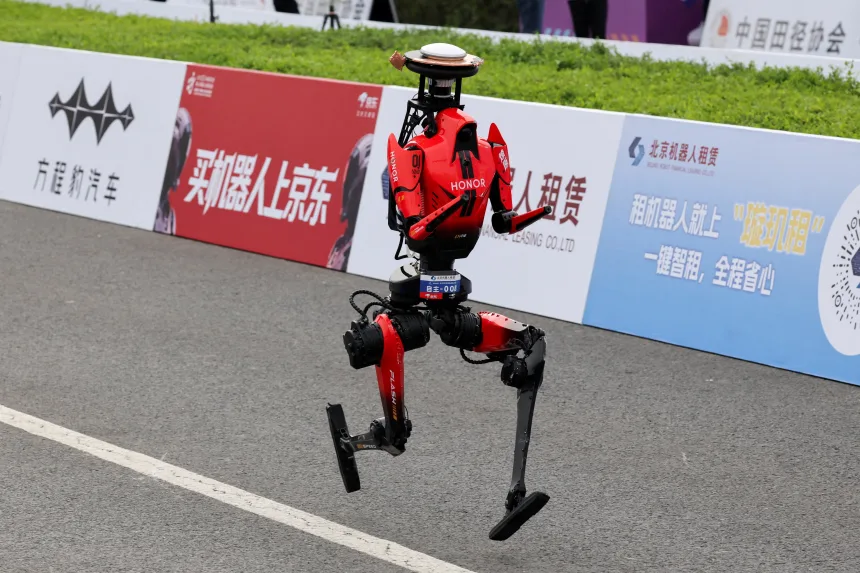

China’s race to lead the humanoid robotics industry found a dramatic new symbol in Beijing this week, where a robot named Lightning reportedly completed a half-marathon in 50 minutes and 26 seconds, a time that would put it ahead of every human runner in history over the same distance.
The performance has grabbed attention not only because of the number on the clock, but because it arrived at a moment when China is pushing hard to turn robotics into one of its defining technologies. Lightning, a bright-red humanoid developed by Chinese smartphone maker Honor, was said to have covered the 21-kilometer course on Sunday with a pace and consistency that stunned spectators and quickly became the talking point of the event.
At 169 centimeters tall, the machine looked compact rather than imposing. Yet as it moved through the course, swinging its short forearms for balance, it reportedly showed none of the hesitation or slowdown that affected many robot entrants in similar events a year ago. By the time it crossed the line, Lightning had not only beaten the rest of the humanoid field, but done so by a massive margin.
The race result is all the more striking when set against the official human benchmark. According to World Athletics, the men’s half-marathon world record stands at 57 minutes and 20 seconds, set by Uganda’s Jacob Kiplimo. If Lightning’s time is accepted at face value, the robot finished more than six minutes faster than that mark.
From awkward experiments to headline-making machines
That kind of leap helps explain why this year’s Beijing event felt different from the one held last year. When the humanoid half-marathon debuted, robot performances were largely underwhelming, reinforcing the idea that machines still had a long way to go before they could handle endurance challenges in real-world conditions. This year, though, the field was far deeper. More than 100 teams entered the humanoid category, nearly five times the number that took part in the inaugural contest.
Even in that larger and more competitive field, Lightning separated itself clearly. Organizers said its win came down to autonomous navigation and burst power, two qualities that allowed it to sustain speed while staying stable across the race. That combination helped it beat the previous champion robot by almost two hours, underlining how fast the development curve is moving.
The contrast with the human side of the event also drew notice. Zhao Haijie and Wang Qiaoxia won the men’s and women’s categories respectively, but both needed more than an hour to complete the course. In ordinary circumstances, that would be the main sporting story. Instead, the attention shifted to a humanoid runner that appeared to turn a showcase event into a statement about where machine performance could be heading.
What makes the moment even bigger is that it did not arrive in isolation. China has spent years building the policy, funding, and industrial support needed to strengthen its robotics base. Back in 2015, the government identified robotics as one of 10 key sectors in its plan to upgrade Chinese industry and move beyond the country’s reputation as a cheap-labor factory. That long-term focus created the groundwork for the wave of development now on display.
The message became even more direct in 2023, when Chinese officials described humanoid robotics as a new frontier in technological competition. The country set a 2025 target aimed at mass production and more secure supply chains for core components. That goal was not left sitting in a policy file. It has been carried into broader economic planning, helping drive investment, experimentation, and public showcases that are meant to signal how serious the country is about closing the gap with the United States.
In that sense, Lightning’s headline-grabbing run works as more than a race result. It fits into a larger national story. China has already been using public events to display advances in humanoid machines. Last year, Beijing hosted what was billed as the world’s first Humanoid Robot Games, with events that ranged from soccer and boxing to martial arts. Earlier this year, robots dressed in kung-fu costumes performed synchronized choreography during China’s annual New Year television gala, a performance designed to impress a mass audience and reinforce the image of rapid progress.
Why the race matters beyond the finish line
Sporting events offer something that lab demonstrations do not. They place machines in an environment that is easier for the public to understand. A robot lifting a component in a factory may be technically impressive, but a robot running 21 kilometers faster than elite athletes creates a much sharper reaction. It gives people a visible way to measure change.
That is why Sunday’s result has wider significance, especially in the context of the technology rivalry between China and the US. American companies have often been seen as setting the pace with more advanced humanoid prototypes. But China is betting that scale, manufacturing depth, and strong policy support can help it move faster in turning robotic concepts into commercial systems. A machine like Lightning, whether viewed as a breakthrough or a demonstration of how quickly the field is moving, strengthens that narrative.
There are still obvious questions about standardization, verification, and how robot performances should be measured against human athletic records. But even with those debates likely to continue, the symbolism of the event is hard to ignore. A year ago, humanoid runners were trailing far behind the human field. This time, the standout machine reportedly left both robots and people behind.
For readers tracking the future of automation, this race was about more than one finish time in Beijing. It was another sign that humanoid robotics is moving from spectacle toward something more serious. And if China continues to blend policy ambition, manufacturing muscle, and public demonstration as effectively as it has so far, Lightning may not be remembered as a one-off curiosity, but as an early marker of a much bigger shift.
You may like: Manchester Marathon 2026 full route, start times and road closures today.

Make Swikblog your go-to source on Google for reliable updates, smart insights, and daily trends.