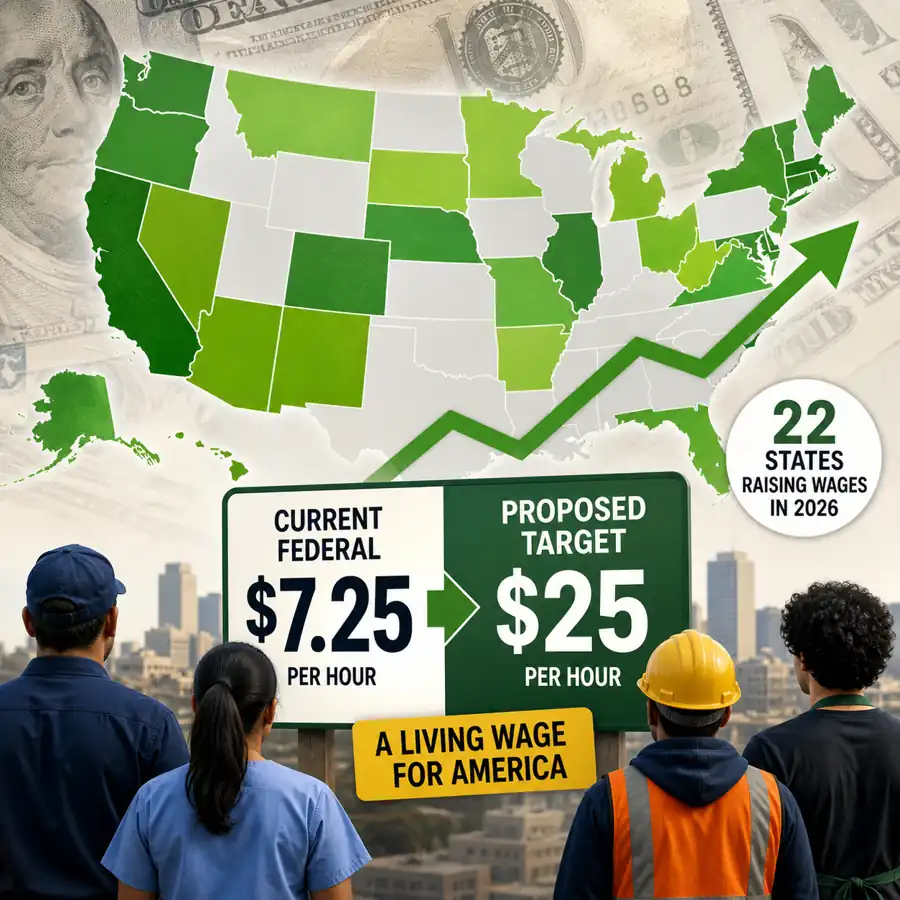

A fresh push to overhaul the U.S. wage floor is gathering attention in Washington, with lawmakers introducing a proposal that could lift the federal minimum wage to $25 an hour over the next decade. The move comes as millions of workers continue to grapple with rising living costs, even as wages in many states have already begun climbing above the long-standing federal baseline.
The proposed legislation, known as the Living Wage for All Act, was introduced by a group of Democratic lawmakers who argue that the current federal minimum wage of $7.25 per hour—unchanged since 2009—no longer reflects the economic realities faced by working families. Their plan would gradually increase wages nationwide, with larger employers required to meet the $25 threshold by 2031, while smaller businesses would have until 2038 to comply.
This renewed effort comes at a time when wage policies across the country are already shifting. A growing number of states have taken independent action, with 22 states and Washington, D.C. set to raise minimum wages in 2026. In total, around 30 states now offer wages above the federal floor, creating a patchwork system where earnings vary significantly depending on location.
The map of upcoming changes highlights how regions such as the West Coast and Northeast continue to lead with higher wage levels, often exceeding $15 per hour, while parts of the South and Midwest remain closer to the federal minimum. Several states introducing increases in 2026 are also phasing in adjustments to keep pace with inflation or cost-of-living benchmarks.
Supporters of the federal proposal say a nationwide standard is necessary to reduce inequality and provide financial stability for workers. They point to rising costs for essentials such as housing, food, and healthcare, arguing that wages have failed to keep up. The legislation also includes provisions aimed at aligning minimum pay with broader economic wage trends over time.
Under the plan, workers who rely heavily on tips would also see meaningful changes. The current tipped wage, which stands at just $2.13 per hour, would begin increasing to $6 per hour before continuing upward. Youth workers and employees with disabilities would also receive higher starting minimums, set at $6 and $5 per hour respectively, marking a shift toward more uniform wage protections.
Backers of the bill argue that the timing reflects broader economic pressures. With corporate profits remaining strong in several sectors, they believe the policy could help rebalance income distribution while supporting consumer spending. According to recent labor data from the U.S. Bureau of Labor Statistics, wage growth has been uneven, with lower-income workers still facing the steepest affordability challenges.
However, the proposal is likely to face a complex path through Congress. It must pass through multiple committees and votes before reaching the president’s desk, and similar efforts in the past have struggled to gain bipartisan support. Critics warn that a significant increase in the minimum wage could lead to unintended consequences, including reduced hiring or higher prices as businesses adjust to increased labor costs.
Despite these concerns, the debate reflects a broader shift in how wages are viewed in the modern economy. As more states move ahead with their own increases, pressure is building for a federal update that bridges the growing gap between regions. For many workers, the outcome could shape not just paychecks, but long-term financial security in an increasingly expensive economic landscape.

Make Swikblog your go-to source on Google for reliable updates, smart insights, and daily trends.