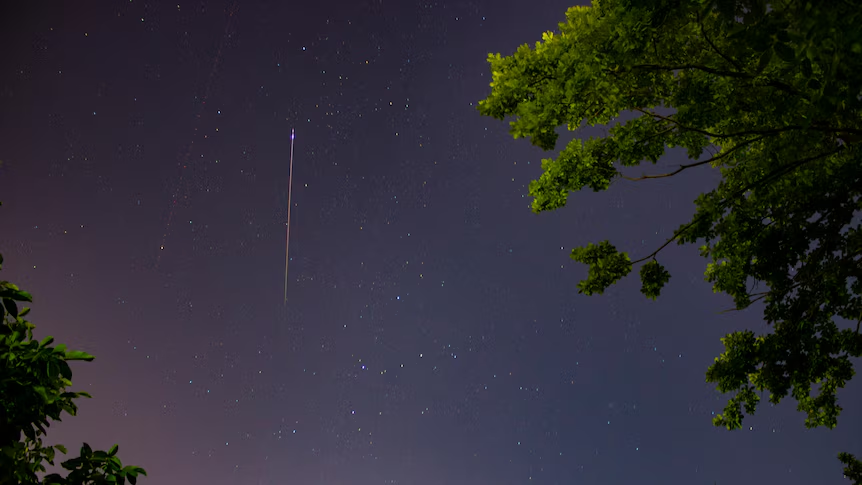

May 2026 is shaping up to be a lively month for skywatchers, even though one of its biggest attractions may not deliver its usual sparkle. The Eta Aquariids meteor shower will peak under bright moonlight, making many faint meteors harder to see. But the month is far from disappointing. A faint comet in the western sky, Venus and Jupiter moving toward a close meeting, and a rare “blue” micromoon at the end of May will give astronomy lovers several reasons to look up.
The Eta Aquariids are active every year when Earth moves through the dusty trail left behind by Halley’s Comet. These small grains of comet debris hit Earth’s atmosphere at high speed and burn up, creating the streaks of light we call meteors. The shower is usually one of the better annual displays for observers in the Southern Hemisphere because its radiant point rises higher before dawn.
This year, however, timing is not ideal. The shower is expected to peak around May 6 and 7, just a few days after the full moon. That means a bright waning gibbous moon will be in the sky during the best viewing hours, washing out many of the weaker meteors. In a dark year, observers might hope for 20 to 30 meteors an hour before sunrise. In 2026, the number is likely to be much lower, possibly closer to 5 to 10 meteors an hour from good locations.
The best chance to spot any Eta Aquariids will come in the hour or two before dawn. The meteors appear to radiate from near Eta Aquarii in the Aquarius constellation, which rises after midnight and climbs higher toward sunrise. The higher this point gets, the more meteors can be seen. Viewers do not need to look directly at Aquarius; in fact, scanning a wide patch of sky often gives a better chance of catching longer meteor trails.
Some forecasts online may mention higher numbers, but these usually refer to the zenithal hourly rate, or ZHR. This is a theoretical estimate based on perfect conditions: a dark sky, clear weather, excellent eyesight and the meteor shower’s radiant directly overhead. Real observing conditions are almost always less generous, especially when moonlight is present.
For anyone still hoping to watch, the setup is simple. Choose the darkest safe location available, stay away from streetlights, give your eyes at least 20 minutes to adjust, and avoid checking your phone. A reclining chair or blanket helps because meteor watching is mostly about patience. Even in a weaker year, a bright fireball can still make the early alarm worthwhile.
Read More
May also brings a more unusual target: Comet C/2025 R3 PanSTARRS. The comet recently completed its turn around the Sun and is now placed in the western sky shortly after sunset. It is not expected to dominate the sky like a great comet, but it is bright enough to interest binocular users and astrophotographers. Under very dark skies, it may sit close to naked-eye visibility, though most people will have a better chance with binoculars.
Comet PanSTARRS may appear as a soft, fuzzy glow rather than a sharp point of light. Its blue-green colour comes from gases reacting to sunlight as the comet warms. A clear western horizon will be important because the comet is best seen soon after sunset. Those using cameras or small telescopes may capture more structure than the human eye can see, including a faint tail.
What makes C/2025 R3 PanSTARRS interesting is its likely origin in the distant outer solar system. Unlike Halley’s Comet, which returns roughly every 76 years, this object may not come back for thousands of years, if at all. That gives its 2026 appearance extra value for observers who enjoy rare sky events.
The evening sky will also feature two of the brightest planets. Venus is already shining strongly in the west after sunset and is often so bright that casual observers mistake it for an aircraft. Jupiter sits higher toward the north-west and is also easy to identify, though it is not as dazzling as Venus.
Over the next several weeks, Venus and Jupiter will appear to move closer together from our viewpoint on Earth. Their closest pairing is expected around June 9 and 10, but the build-up through May is worth following. Watching the gap shrink night after night is one of the easiest ways to notice planetary motion without using a telescope.
The final sky event of the month belongs to the Moon. May begins with a full moon and ends with another on May 31. The second full moon in a calendar month is commonly called a “blue moon,” although the Moon will not actually turn blue. The phrase refers to rarity, not colour.
This full moon is also being described as a micromoon because it occurs when the Moon is near apogee, its farthest point from Earth. A micromoon is the opposite of a supermoon, which happens when the full moon occurs near the Moon’s closest approach. The difference in size and brightness is real but subtle, so most people will not notice it with the naked eye.
For readers who follow seasonal sky events, this makes May 2026 a useful reminder that not every celestial event needs to be dramatic to be worth watching. A dimmed meteor shower, a faint comet, two bright planets and a rare lunar calendar moment all tell different parts of the same sky story. You can follow more science and space updates on Swikblog.
For official skywatching guidance and monthly observing updates, readers can also check NASA’s skywatching resources.

Make Swikblog your go-to source on Google for reliable updates, smart insights, and daily trends.