
April 2026 marked a pivotal moment in the global artificial intelligence race, with Google unveiling a sweeping set of innovations that signal a deeper shift toward autonomous, agent-driven systems. In its latest AI recap, the company outlined more than 260 announcements spanning enterprise infrastructure, developer tools, creative platforms, and consumer applications — all pointing toward what it calls the “agentic era” of AI.
The scale of these updates reflects not just product expansion, but a strategic move to embed AI across every layer of digital interaction, from cloud computing to everyday productivity tools.
AI adoption surges across Google Cloud ecosystem
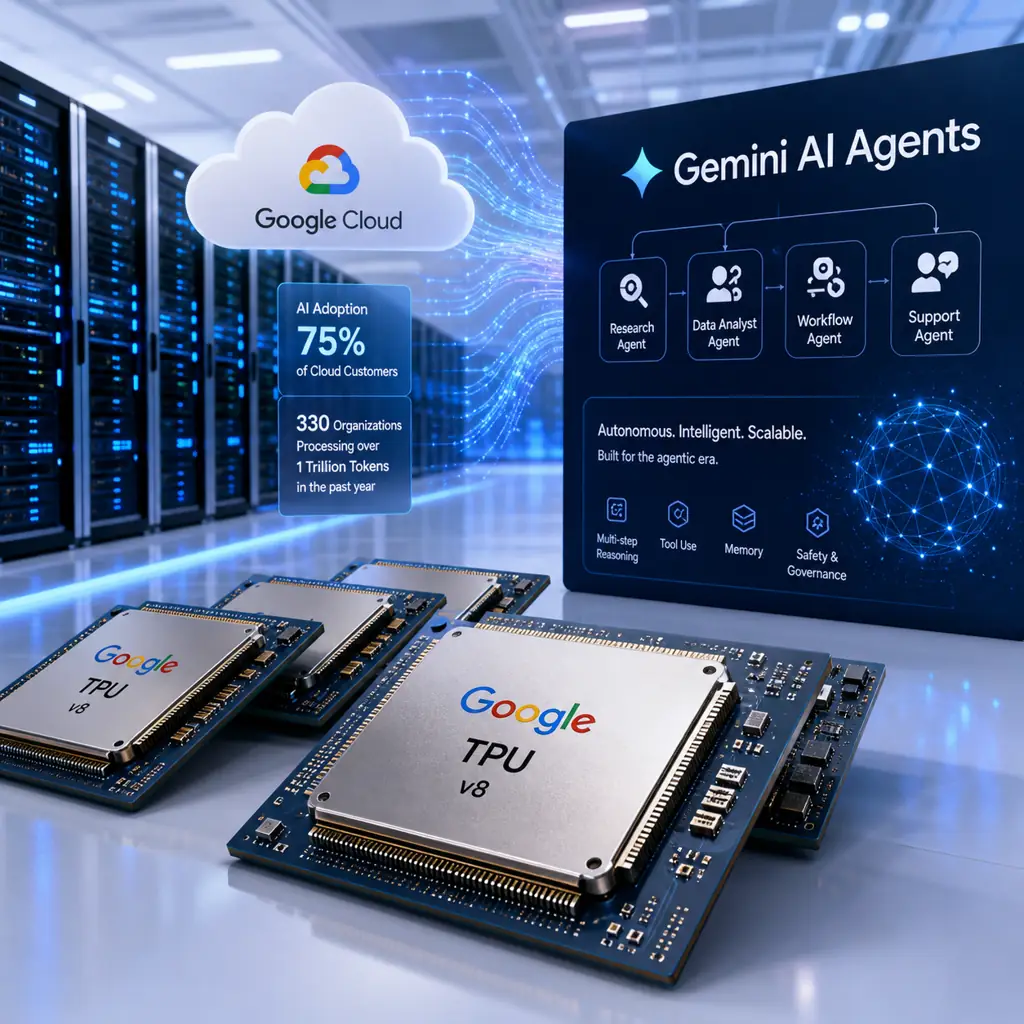
One of the most striking takeaways from the April recap is the rapid acceleration of AI adoption within Google Cloud. Nearly 75% of Google Cloud customers are now actively using AI tools, highlighting how quickly businesses are integrating machine intelligence into their operations.
The usage scale is equally significant. Around 330 organizations processed over one trillion tokens each in the past year, demonstrating how AI workloads are expanding beyond experimentation into mission-critical systems.
This growth signals a clear shift: AI is no longer a niche capability but a core layer of enterprise infrastructure driving automation, decision-making, and operational efficiency.
Gemini Enterprise Agent Platform drives the agentic shift
At the center of Google’s AI strategy is the launch of the Gemini Enterprise Agent Platform, designed to enable organizations to build and manage autonomous AI agents capable of executing complex workflows.
Unlike traditional software tools, these agents can perform multi-step tasks, adapt to changing inputs, and make decisions in real time. This marks a significant evolution in enterprise computing, where AI systems move from assisting users to independently managing processes.
The platform positions Google as a major player in the rapidly growing agentic AI space, where businesses are seeking scalable solutions to automate increasingly complex operations.
Read More
- Visit Swikblog Homepage
- Etihad A380 Toronto Flight Diverts to Munich After Medical Emergency
- Delta Cancels 400 Flights and Delays 1,000 Amid Staffing Issues
- Foxconn Satellite Launches on SpaceX Falcon 9
- Pokémon x Target Collection With 100 Items Set for June 6 Release
- Pittsburgh Marathon 2026 Results: Will Loevner and Jane Bareikis Win
Next-generation TPUs power large-scale AI workloads
To support the growing computational demands of AI systems, Google introduced its eighth-generation Tensor Processing Units (TPUs). These specialized chips are designed specifically for large-scale AI workloads, offering improved performance while maintaining energy efficiency.
The focus on efficiency is critical as AI models become more compute-intensive. By co-designing hardware and software, Google aims to deliver both higher performance and reduced energy consumption — a balance that is becoming increasingly important across the tech industry.
This infrastructure investment underlines the reality that the future of AI is not just about smarter models, but also about the systems that power them.
Creative tools expand access to AI-powered content
Google is also pushing AI into mainstream creativity with the introduction of Google Vids, a tool that allows users to generate up to 10 AI-powered videos per month at no cost. This development lowers the barrier to professional content creation, enabling individuals and small businesses to produce high-quality videos without extensive resources.
Alongside this, Deep Research Max brings advanced automation to complex research tasks. Designed to handle deep data synthesis independently, it reduces the time required for analysis and allows users to focus on insights rather than manual processing.
These tools highlight a broader trend: AI is becoming a creative partner, not just a productivity enhancer.
Developer tools and open models gain momentum
Developers and learners are also seeing major benefits from Google’s AI push. The introduction of Learn Mode in Google Colab transforms the platform into a personalized coding tutor, offering step-by-step explanations that help users understand not just the output, but the reasoning behind it.
Meanwhile, the open AI model Gemma 4 continues to gain traction, with more than 500 million downloads since its initial release. Built for advanced reasoning and agent-based workflows, it reflects growing demand for accessible, high-performance AI systems.
The combination of open models and educational tools is helping to expand the global developer ecosystem, making advanced AI capabilities more widely available.
AI expands into communication, learning and healthcare
Google’s AI strategy is not limited to enterprise and developer tools. The company is also expanding into communication and healthcare, areas where AI can have direct real-world impact.
Google Translate, now used by over 1 billion users, continues to evolve with new features such as pronunciation practice, enhancing language learning and accessibility.
In healthcare, a new initiative backed by a $10 million investment aims to bring AI training to rural healthcare workers, ensuring that technological advancements reach underserved communities.
Wearable technology is also advancing, with Fitbit integrating AI to deliver more personalized health insights based on user biometrics. This signals a future where AI plays a central role in preventive healthcare and daily wellness management.
As outlined in the broader Google AI updates, the company’s approach is to integrate intelligence across platforms while scaling the infrastructure required to support it.
Across enterprise systems, creative tools, and consumer applications, the April 2026 AI recap reveals a clear trajectory: AI is becoming embedded in every layer of technology. The shift toward agentic systems suggests a future where digital tools are no longer passive, but actively participate in solving complex problems, reshaping how businesses operate and how individuals interact with technology.

Make Swikblog your go-to source on Google for reliable updates, smart insights, and daily trends.