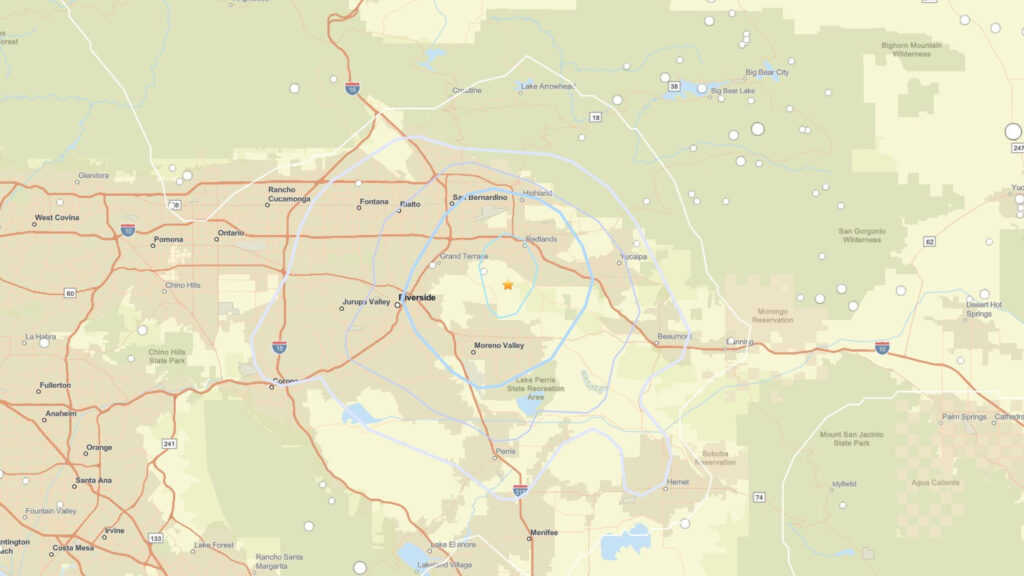

A pair of small but widely felt earthquakes shook the Redlands area of Southern California on Wednesday morning, reminding residents across the Inland Empire how quickly routine mornings can be interrupted in one of the country’s most active seismic regions.
The first tremor, recorded at magnitude 3.3, struck at about 9:45 a.m. PDT near Redlands in San Bernardino County. A second quake, measured at magnitude 3.2, followed less than a minute later in the same general area, creating what many residents described as a quick double jolt.
According to the U.S. Geological Survey, the earthquake was centered southwest of Redlands, close to the San Bernardino and Riverside county line. Other reports placed the epicenter roughly four miles northwest of Loma Linda, at a shallow depth of just over two miles.
That shallow depth likely helped make the shaking more noticeable, even though both earthquakes were minor in magnitude. Smaller earthquakes can still feel sharp when they occur close to the surface and near populated communities.
Reports submitted through the USGS “Did You Feel It?” system showed shaking was noticed in several Southern California cities, including Riverside, Ontario, Perris, Corona, Rancho Cucamonga, Yucaipa, Orange and Downey. The USGS Community Internet Intensity Map categorized the shaking as light, meaning it was strong enough to be felt indoors but not expected to cause major damage.
No injuries or structural damage were immediately reported after the Redlands-area earthquakes. Local infrastructure, schools, roads and utilities appeared to remain operational, and authorities did not issue any evacuation orders or emergency warnings.
Even so, the sudden back-to-back tremors sparked concern across the Inland Empire as residents shared experiences online about rattling windows, shaking furniture and loud rumbling sounds. Small earthquakes often create intense reactions in Southern California because the region remains overdue for a potentially larger seismic event.
California’s earthquake history has repeatedly shown that preparedness matters. Experts continue encouraging families to maintain emergency kits and communication plans in case stronger earthquakes strike without warning. Readers looking for more preparedness coverage and breaking regional news updates can also explore recent reports published on Swikblog.
The Redlands region sits within Southern California’s broad network of active faults. While the San Andreas Fault is the best-known fault line in the state, several smaller fault systems surrounding San Bernardino and Riverside counties generate regular seismic movement throughout the year.
Earthquake experts note that California experiences thousands of earthquakes annually, although most are too weak to be noticed by residents. Magnitude 3-range earthquakes generally cause little damage, but they are commonly felt when they occur near populated areas.
Read More
The second quake recorded Wednesday morning was classified as an aftershock because it followed closely after the initial earthquake in nearly the same location. Aftershocks are common following seismic events and can continue for hours or days, though they are usually weaker than the original tremor.
Scientists still cannot accurately predict earthquakes, despite advances in seismic monitoring technology. However, agencies across California continuously track movement along fault systems to provide rapid updates when earthquakes occur.
Emergency management officials regularly advise residents to keep earthquake kits stocked with bottled water, medications, non-perishable food, flashlights, batteries and phone chargers. Experts also recommend securing televisions, shelves and heavy furniture to reduce injury risks during stronger shaking.
The Ready.gov earthquake safety guide advises people to follow the “Drop, Cover and Hold On” method during earthquakes. Taking cover under sturdy furniture and protecting the head and neck can significantly reduce injury risks during sudden tremors.
Wednesday’s earthquakes may not have caused serious damage, but they served as another reminder of the unpredictable nature of life in Southern California. For many residents, the brief shaking was enough to reignite concerns about the region’s long-term earthquake risk and the importance of staying prepared year-round.
Authorities are continuing to monitor seismic activity near Redlands for additional aftershocks. Residents can follow official updates through the USGS earthquake monitoring system and local emergency management agencies.

Make Swikblog your go-to source on Google for reliable updates, smart insights, and daily trends.