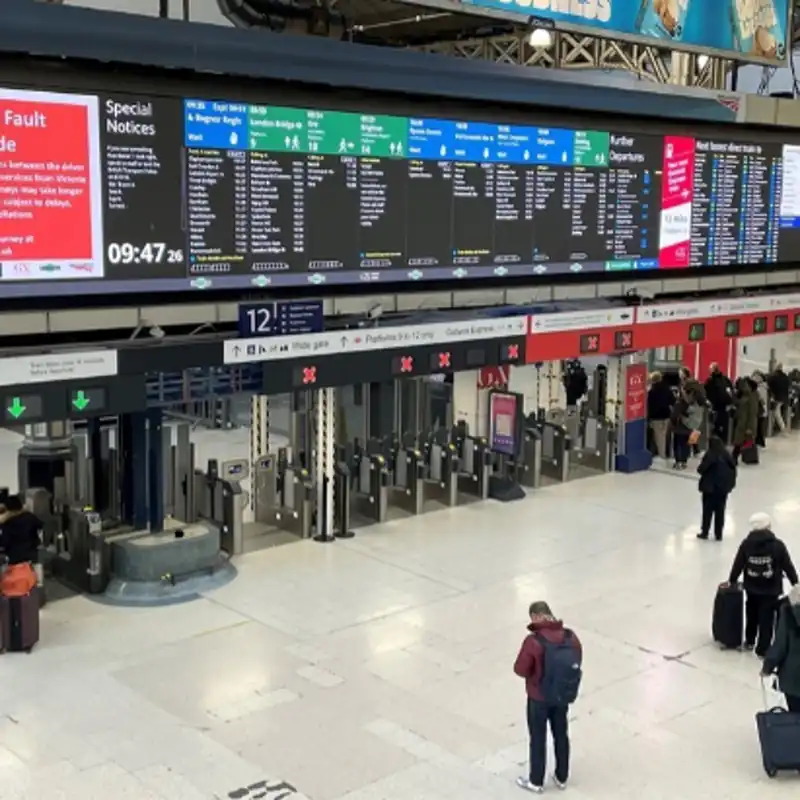

A major rail communication failure brought parts of southern England’s train network under pressure on Thursday, causing cancellations, revised timetables and delays of up to 90 minutes across several busy commuter and airport routes.
The disruption was caused by a fault in the radio system used by train drivers and signallers. The system is a key safety and operations tool on the railway, allowing drivers to remain in contact with control teams while trains are moving across the network.
National Rail said the technical issue had been fixed later in the day, but passengers were still warned to expect disruption until services fully recovered. The problem began shortly before 9am, hitting the network during a busy travel period and leaving many commuters facing longer journeys.
London Waterloo services were among the most affected, with South Western Railway warning that trains across its network could be cancelled, delayed or changed. The impact also reached routes operated by Southern, Thameslink, Gatwick Express, Great Western Railway, London Overground and CrossCountry.
Why one radio fault caused so much disruption
Railway radio systems are not just used for routine communication. They help drivers receive instructions from signallers, support safe train movements and allow operators to respond quickly when problems happen on the tracks.
When that communication link fails, train companies cannot simply continue running a full timetable as normal. Services may need to be slowed, held, diverted or cancelled while engineers investigate the issue and confirm that the network can operate safely.
That is why passengers continued to face problems even after the fault was removed. Once disruption spreads across a busy rail network, trains and staff can end up in the wrong places. Operators then have to rebuild the timetable, move trains back into position and manage crowded stations.
South Western Railway appeared to face some of the heaviest disruption, with warnings across its wider network, including long-distance routes towards the south-west. Southern services to and from London Victoria were also affected, while Thameslink passengers travelling around Brighton, Horsham and Three Bridges were told to check journey information carefully.
Gatwick Express passengers were warned of further delays and possible cancellations, creating extra concern for airport travellers heading to and from London Victoria. Great Western Railway also reported disruption on parts of its network.
Some passengers were advised to use alternative routes where available, and certain tickets were accepted on other services at no extra cost.
What passengers should do after the disruption
Passengers affected by the delays may be able to claim compensation through Delay Repay, the refund scheme used by train operators in Britain.
In many cases, passengers can claim if they arrive at their final destination 15 minutes or more later than scheduled. The amount depends on the operator, the ticket type and how long the delay lasted.
Passengers should keep their ticket, note the journey they attempted to make and submit a claim through the train company that operated the delayed or cancelled service. Season ticket holders may also be eligible, including those using digital tickets through train company apps.
Official guidance on rail refunds and compensation is available on the National Rail compensation page.
The incident is likely to raise fresh questions about the resilience of Britain’s railway communication systems. A similar GSM-R radio fault caused widespread rail disruption in December 2024, a failure described at the time as rare by industry observers.
The GSM-R system was introduced across Britain’s railway between 2007 and 2014 at a reported cost of £1.86 billion. It remains a central part of how drivers and signallers communicate during train operations.
For passengers, the main concern was simpler: whether their train would run, how long they would be delayed and whether they could still complete their journey. By late afternoon, services were beginning to return to normal, but operators continued advising people to check live updates before travelling.
The disruption showed how quickly a single technical failure can spread across multiple rail companies, especially on routes serving London, the south coast, airport links and long-distance connections into the south-west.
You may like: Love Is Blind Season 10 Reunion Reveals Amber Morrison and Jordan Faeth Breakup After Short Marriage

Make Swikblog your go-to source on Google for reliable updates, smart insights, and daily trends.