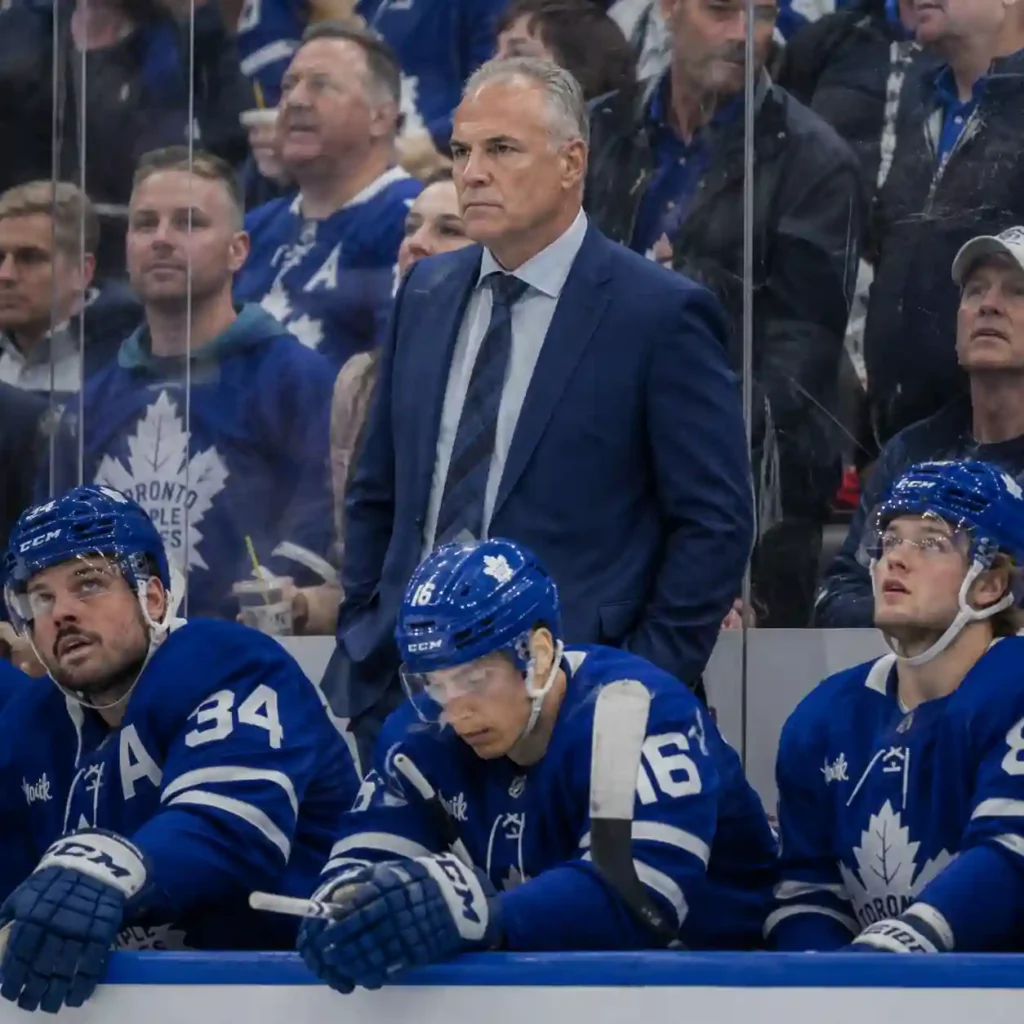

The Toronto Maple Leafs have made another major change, firing head coach Craig Berube after only two seasons and pushing the franchise into a new phase under recently appointed general manager John Chayka.
The decision comes after a season that moved from concern to collapse. Toronto finished 32-36-14 and missed the Stanley Cup Playoffs for the first time since 2016, a sharp fall for a club that had spent years trying to turn regular-season promise into real postseason progress.
Berube’s departure is not an isolated coaching change. It is part of a wider reset that has already included the dismissal of former general manager Brad Treliving in late March, the hiring of Chayka earlier this month and the return of Maple Leafs legend Mats Sundin in a senior adviser role.
Chayka made it clear that the organization viewed the move as a change in direction rather than a harsh personal judgment on Berube.
“Craig is a tremendous coach and an even better person,” Chayka said in the team’s statement. “This decision is more reflective of an organizational shift and an opportunity for a fresh start than it is an evaluation of Craig.”
That wording is important because Berube did not arrive in Toronto as an unproven coach. He was hired in May 2024 by Treliving with a clear purpose: bring structure, accountability and a harder playoff edge to a team that had often been criticized for falling short when pressure increased.
There was early evidence that the plan could work. In Berube’s first season, the Maple Leafs reached the postseason and advanced to the second round, only the second time Toronto had gone that far since the 2012-13 season. It was not a championship breakthrough, but it gave the franchise something to build on.
The problem was that the foundation did not hold.
Toronto’s Season Fell Apart Faster Than Expected
The 2025-26 season began with a different feel around the Maple Leafs. Mitch Marner’s offseason departure in a sign-and-trade had already changed the identity of the forward group, removing one of Toronto’s most creative players and forcing the team to adjust how it generated offense.
Even with that change, the Leafs were not immediately out of the race. They stayed around the playoff picture for a stretch and climbed as high as eight games above .500 in mid-January. At that point, the season still looked recoverable.
Then came the slide that changed everything.
Toronto lost eight straight games after the Olympic break, and the performances were often more troubling than the results. The Leafs were too open defensively, too easy to pressure and too inconsistent in the areas Berube-coached teams are usually expected to control.
One of the clearest signs of frustration came after a 5-2 loss to the Ottawa Senators on Feb. 28, when Toronto was badly outshot. Berube publicly challenged his players, pointing to the need for more heart and competitiveness. It was the kind of message a coach uses when he believes effort and engagement have slipped below an acceptable level.
But public challenges only matter if the response follows. Toronto never produced enough of one.
The defensive decline became the biggest issue of the season. The Maple Leafs allowed the second-most goals in the NHL, a damaging number for any team, but especially for one that had hired Berube to tighten its structure. Defensive breakdowns, poor coverage and long stretches without control turned too many games into chase situations.
Read More
Injuries made the picture even worse. Captain Auston Matthews was limited to 60 games, and his season ended after a knee-on-knee hit from Anaheim Ducks defenseman Radko Gudas. Losing Matthews for key stretches weakened Toronto’s attack and added more uncertainty around the team’s direction.
By the March 6 trade deadline, the organization’s actions showed where the season was heading. Toronto moved Scott Laughton to the Los Angeles Kings, Bobby McMann to the Seattle Kraken and Nicolas Roy to the Colorado Avalanche a day earlier. Those were not moves made by a team preparing for a playoff push. They were signals that management had accepted the need to look beyond the current season.
Swikblog previously covered the earlier front-office shake-up when Brad Treliving was fired by the Maple Leafs. Berube’s firing now completes another layer of that reset, giving Chayka control over both the front office direction and the next coaching hire.
What the Firing Means for the Maple Leafs
The next head coach will inherit more than a job behind the bench. He will inherit a franchise trying to answer several difficult questions at once.
The first is identity. Toronto has tried star power, veteran coaching, deadline additions and different front-office voices, yet the result remains familiar: pressure, disappointment and another offseason of uncertainty. Chayka’s next coaching choice will reveal whether he wants a younger developmental voice, another experienced NHL coach or a tactician who can reshape the roster around a different playing style.
The second question is Matthews. ESPN’s coverage of the Maple Leafs has also pointed to uncertainty around the captain’s future in Toronto, which makes this offseason even more significant for the organization. For official team coverage and updated NHL context, readers can follow ESPN’s Toronto Maple Leafs page.
The third question is how Toronto uses its draft lottery win. Landing the No. 1 pick gives the Leafs a rare chance to add a major young piece, but it also complicates the timeline. A team with Matthews is expected to compete. A team with the top pick may be tempted to reset more aggressively. Chayka now has to decide whether this is a retool, a rebuild or something in between.
Berube leaves with a mixed Toronto legacy. He gave the Leafs a second-round appearance in his first year, but his second season exposed too many weaknesses for a new management group to ignore. The defensive collapse, playoff miss, losing streak after the Olympic break and trade-deadline selloff all made change feel inevitable.
For Toronto, the firing is less about one coach and more about a franchise admitting that its previous plan no longer worked. Chayka now gets the fresh start he referenced. The harder part is making sure it does not become just another reset in a long list of Maple Leafs resets.

Make Swikblog your go-to source on Google for reliable updates, smart insights, and daily trends.