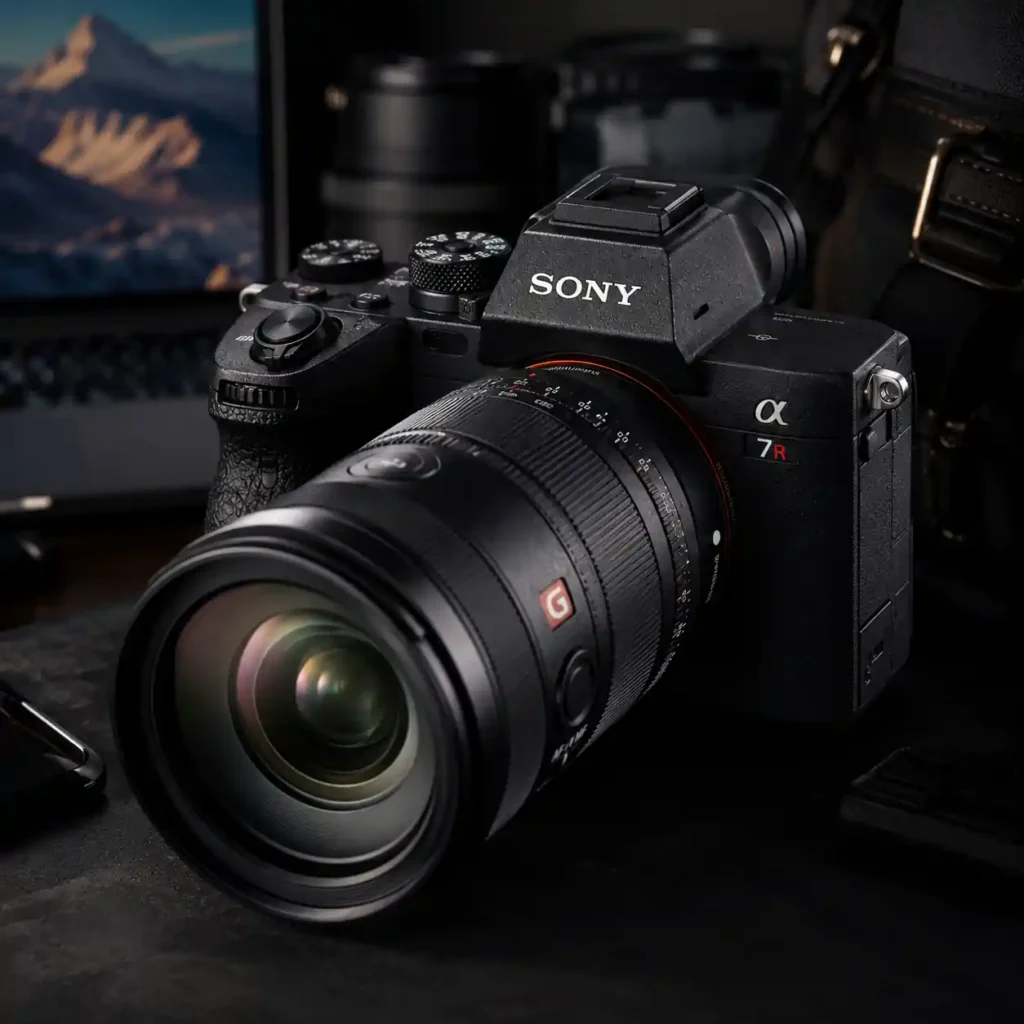

Sony has officially introduced the Sony a7R VI, and the new mirrorless camera is already generating major attention among professional photographers and creators. The biggest headline is the new 66.8MP full-frame stacked Exmor RS sensor combined with blackout-free 30fps RAW burst shooting, making it one of the fastest high-resolution cameras Sony has ever produced.
For years, Sony’s a7R lineup was known mainly for delivering outstanding image quality and massive resolution for studio, landscape and commercial photography. But speed was always the compromise. With the a7R VI, Sony appears to be removing that trade-off by combining ultra-high resolution with professional-level autofocus and burst performance.
The Sony a7R VI launches at $4,499 and sits between the Sony a7R V and flagship Alpha models like the a1 II and a9 III. Early reviews suggest this may become Sony’s most versatile photography-focused camera to date.
New 66.8MP stacked sensor brings major speed upgrade
The biggest hardware change is the move from the 61MP sensor found in the a7R IV and a7R V to a completely new 66.8MP stacked CMOS sensor. Sony’s stacked sensor technology dramatically improves readout speed, reducing rolling shutter while enabling much faster shooting performance.
The camera can now shoot full-resolution 14-bit RAW images at up to 30 frames per second using the electronic shutter. Previous a7R cameras were far slower in comparison, especially when shooting high-resolution RAW bursts.
For wildlife, sports and action photographers, this is a huge shift. High-resolution cameras traditionally struggled with fast-moving subjects because autofocus and buffer performance could not keep up. The a7R VI changes that by pairing its high-resolution sensor with Sony’s newer BIONZ XR2 processor and upgraded AI autofocus system.
Sony has also added blackout-free shooting, allowing photographers to continuously track subjects through the viewfinder while shooting at high speed. Pre-Capture mode is another notable addition, recording frames before the shutter is fully pressed, which can help capture unpredictable moments like birds taking flight or sports action.
Read More
AI autofocus and wildlife performance improvements
Sony is heavily focusing on AI-powered autofocus with the a7R VI. The camera uses upgraded Real-time Recognition AF+ technology with improved subject detection for humans, birds, animals, insects and vehicles.
Early reviewers highlighted how the camera performs especially well for bird and wildlife photography. The autofocus system is better at detecting small and distant subjects, while tracking reliability has improved significantly when subjects move quickly across the frame.
The a7R VI uses a 759-point phase-detection autofocus system with 94% frame coverage. Sony says the camera can focus in lighting conditions as low as EV-6 and even supports autofocus at apertures up to F22.
For photographers using long telephoto lenses, that could become one of the camera’s strongest selling points.
Readers interested in Sony’s recent high-performance hardware launches can also check Swikblog’s coverage of the Sony Inzone M10S II gaming monitor, another premium product focused on speed and advanced display technology.
8K video, Dual Gain mode and rolling shutter improvements
Video performance also gets meaningful upgrades. The Sony a7R VI supports 8K recording at up to 30p along with 4K recording at up to 120fps. Sony has also improved rolling shutter performance compared with earlier a7R models.
One of the most talked-about additions is the new Dual Gain video mode. According to early lab testing from CineD, the camera delivers very strong dynamic range performance in Dual Gain mode, reaching up to 14 stops in certain recording conditions.
The faster sensor also helps reduce rolling shutter distortion. CineD measured rolling shutter at around 13.5ms in 8K mode and as low as 7.2ms in some 4K recording modes when Dual Gain was disabled.
However, the camera is not completely without compromises for filmmakers. Unlike some competing hybrid cameras, the a7R VI still lacks internal RAW recording, ProRes support and open-gate video recording. Some reviewers also noted that 4K quality can appear slightly softer compared with oversampled competitors.
Still, the overall video package is significantly improved over the a7R V and should satisfy many creators who primarily focus on photography but also shoot professional video content.
According to Engadget’s launch coverage, Sony has also upgraded stabilization performance to 8.5 stops, improved the electronic viewfinder brightness and introduced illuminated rear buttons for low-light shooting.
New design changes and battery upgrade
At first glance, the a7R VI looks similar to the a7R V, but Sony has made several practical design improvements. The grip is slightly larger, the camera now includes illuminated buttons, and there is a new customizable “*” shooting mode that supports up to 30 custom configurations across photo and video modes.
Sony also introduced a brand-new NP-SA100 battery. The new battery offers higher capacity and health monitoring features, although it is not backward compatible with older Sony Alpha batteries.
The camera includes dual USB-C ports, Wi-Fi 6E support, a 9.44-million-dot EVF and improved in-body stabilization rated up to 8.5 stops.
For photographers who mainly shoot landscapes, commercial projects, portraits or wildlife, the Sony a7R VI may become one of the most complete cameras currently available. It combines massive resolution, faster autofocus, strong burst shooting and better video capabilities into a single body.
While the $4,499 price tag places it firmly in the premium category, the a7R VI appears designed for photographers who want flagship-level performance without moving all the way up to Sony’s even more expensive Alpha 1 series.
With the new stacked sensor, improved AI autofocus and much faster overall performance, Sony’s latest launch could become one of the most important mirrorless cameras of 2026.

Make Swikblog your go-to source on Google for reliable updates, smart insights, and daily trends.