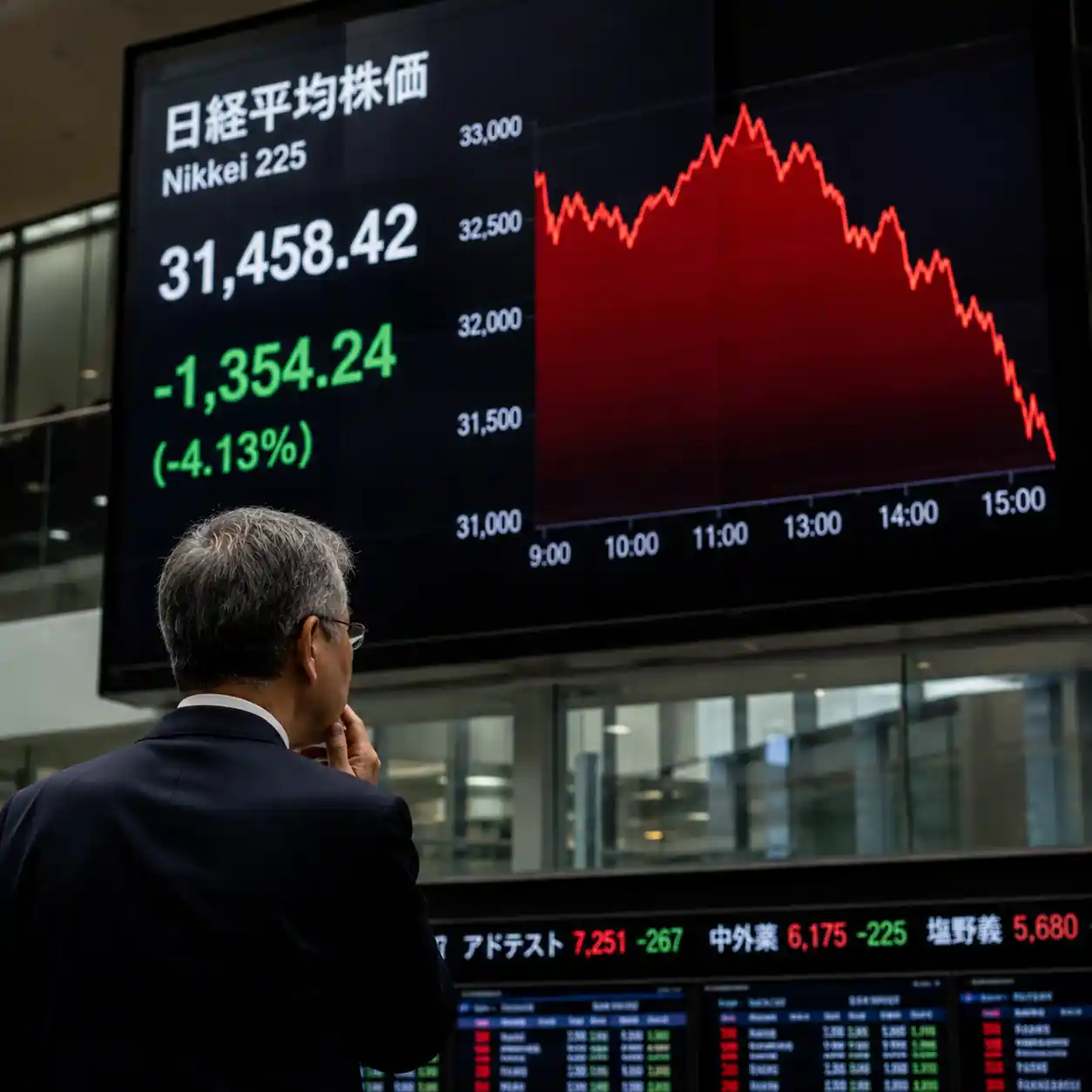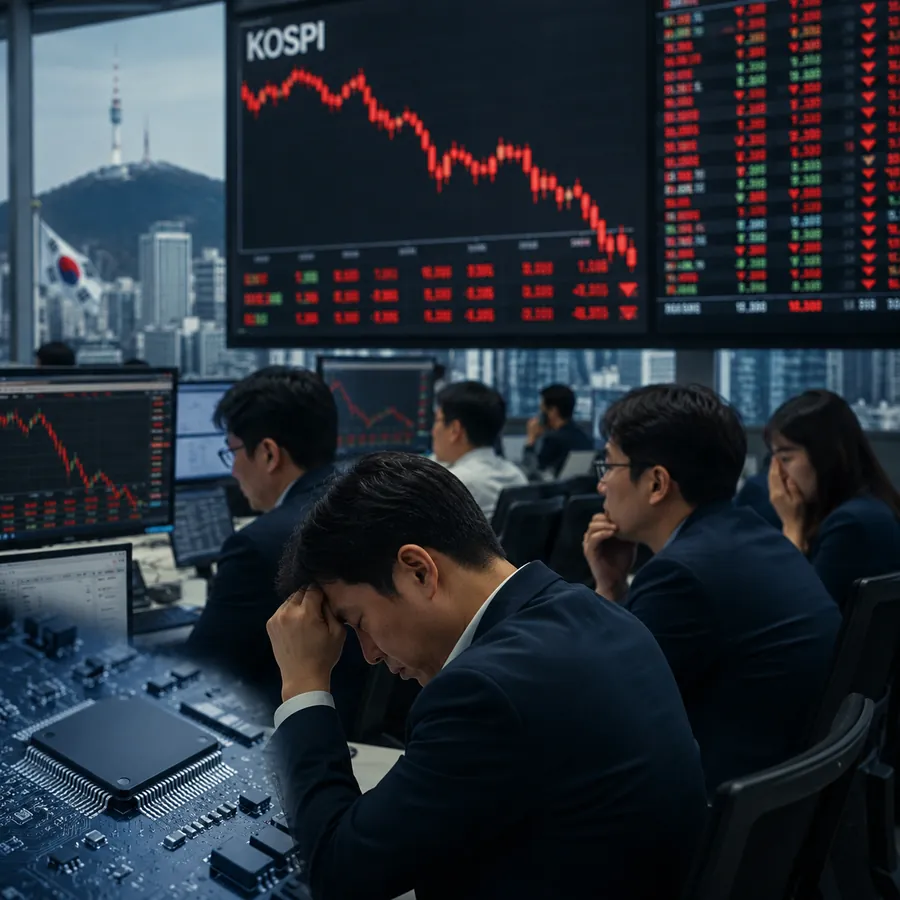

Korean stocks suffered a sharp market shock on Monday as the Kospi tumbled more than 8%, triggering a 20-minute trading halt after investors pulled money out of crowded artificial intelligence and chip-related trades.
The sell-off hit one of Asia’s strongest stock markets and quickly turned into a wider warning for investors betting heavily on AI stocks. The Kospi was still down around 7% in afternoon trading, while the smaller Kosdaq market also faced a trading suspension as volatility spread beyond large-cap names.
- The Kospi Index fell more than 8%, triggering a temporary trading halt shortly after market open.
- South Korea’s chip giants Samsung Electronics and SK Hynix were at the centre of the AI-led sell-off.
- Foreign investors had already sold more than $10 billion worth of Kospi shares on a net basis last week.
- Margin debt in South Korea reached a record 38 trillion won, or about $24.4 billion, by the end of May.
- The Korean won recently touched its weakest level against the US dollar since March 2009.
The main reason behind the fall was simple: investors had become nervous that the AI trade had moved too far, too fast. South Korea had been one of the biggest winners from the global AI rally because its largest companies are deeply tied to memory chips, data centres and semiconductor demand.
Samsung Electronics and SK Hynix are not just regular stock market names in Korea. They are among the most important companies for the country’s equity market, and both have become major investor favourites because of rising demand for advanced memory chips used in artificial intelligence systems.
That strength became a risk when sentiment changed. Once investors started selling AI-linked stocks, South Korea was hit hard because so much money had already moved into the same trade. The sharp drop showed how quickly a popular market theme can reverse when traders begin cutting exposure at the same time.
The pressure was also linked to leveraged exchange-traded funds tied to Korean chipmakers. These funds can increase gains when stocks rise, but they can also make losses worse when markets fall. As prices dropped, some funds were likely forced to rebalance, adding more selling pressure during an already weak session.
The size of retail and leveraged positioning made the fall more serious. Margin debt had climbed to a record 38 trillion won, equal to around $24.4 billion. High margin debt means many investors are using borrowed money to buy stocks. When the market drops fast, some of those investors may be forced to sell, which can deepen the decline.
Foreign selling added another major concern. Overseas investors had pulled more than $10 billion from Kospi shares on a net basis in the previous week. That kind of outflow matters because foreign investors are a major force in Asian equity markets. Continued selling suggests global funds may be reducing exposure to Korean tech stocks rather than simply reacting to one bad trading day.
The move also came during a difficult period for global markets. Technology stocks have been under pressure as investors question high AI valuations, while rate concerns, oil prices and geopolitical risks have made traders more cautious. Recent stock market weakness tied to oil and geopolitical pressure has already made investors more defensive toward growth stocks.
Market Sentiment Turns Cautious After Kospi Trading Halt
Market sentiment has quickly shifted from confidence to caution. For months, Korean stocks benefited from strong demand for AI hardware and semiconductor exposure. Investors treated Samsung Electronics and SK Hynix as key winners from the global AI buildout.
Monday’s sell-off changed that tone. The trading halt showed that the decline was not just normal profit-taking. It was a fast reset in one of the most crowded trades in Asia. When a market falls more than 8% in a single session and triggers exchange action, investors usually become more careful about adding risk too quickly.
Still, the long-term story for Korean chip stocks has not disappeared. Demand for high-bandwidth memory, AI servers and data-centre chips remains a major growth driver. Large technology companies are still spending heavily on AI infrastructure, and that keeps South Korea important in the global semiconductor supply chain.
The problem is valuation and timing. Investors may still believe in the AI growth story, but they may no longer want to pay peak prices after such a strong rally. That is why the next few sessions matter. If Samsung Electronics and SK Hynix stabilize, the Kospi could recover some losses. If foreign selling continues, the pressure may last longer.
The Korean won is another important signal. The currency recently fell to its weakest level against the dollar since March 2009 before rebounding after government support measures. A weak currency can make foreign investors more cautious because it adds another layer of risk on top of falling stock prices.
Investors will now watch official market updates from the Korea Exchange, foreign fund flows, chip stock performance and currency movement. Together, these signals will decide whether the Kospi’s sharp fall becomes a short correction or a deeper pullback in Asia’s AI-linked market rally.
For now, the message from the market is clear: Korean stocks are still tied closely to the AI boom, but investors are no longer ignoring the risks of crowded positioning, leverage and fast-changing global sentiment.

Make Swikblog your go-to source on Google for reliable updates, smart insights, and daily trends.