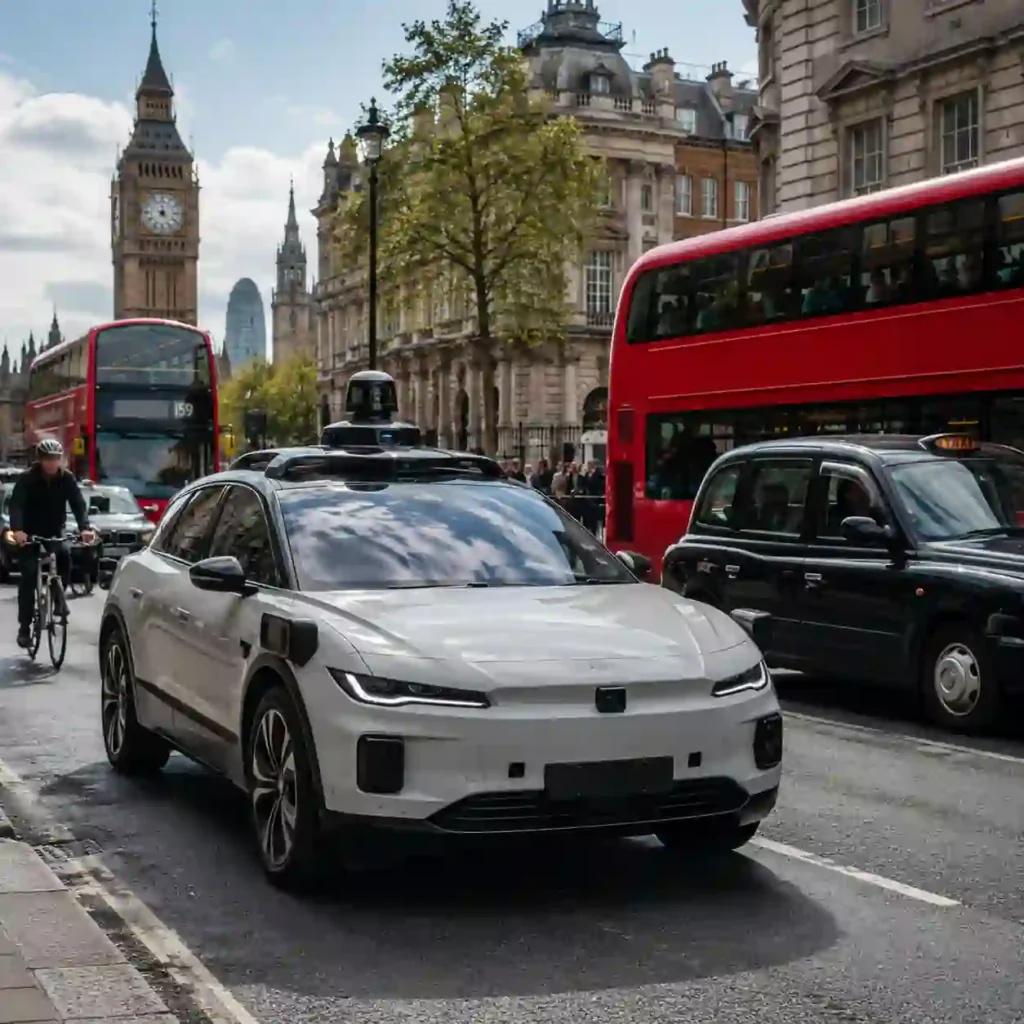

London is preparing for a major transport shift this summer as robotaxis move closer to commercial rides in the British capital. UK autonomous driving startup Wayve, working with Uber, is expected to begin carrying passengers with human safety operators on board during the first stage of the rollout.
The launch puts London at the centre of Europe’s robotaxi race, with Alphabet-owned Waymo and China’s Baidu also preparing for the market. The competition is no longer only about technology. It is about regulation, public trust, safety performance and whether driverless taxis can handle one of the world’s most complicated urban road networks.
Unlike many cities where autonomous vehicles have been tested, London presents a unique challenge. The capital’s centuries-old street layout, heavy pedestrian traffic and constant roadworks create conditions that can test even the most advanced self-driving systems.
Why London Is a Tough Robotaxi Test
Wayve executives say London has around 20 times more road construction than San Francisco and roughly 10 times more vulnerable road users, including cyclists and pedestrians. Those factors make the city one of the most demanding environments for autonomous driving technology.
The company is using vehicles such as the Ford Mustang Mach-E equipped with cameras, sensors and artificial intelligence software designed to react to changing road conditions in real time. During demonstration rides, the system has been shown navigating pedestrians, temporary road closures and busy intersections without human intervention.
Passengers participating in early trials often spend the first few minutes watching the steering wheel move by itself before treating the experience like any other ride-hailing journey. That shift from curiosity to normality is exactly what robotaxi operators hope to achieve as the technology moves into commercial use.
Read More
Uber, Waymo and Baidu Join the Race
Wayve and Uber may be launching first, but competition is intensifying. Waymo, owned by Google parent Alphabet, already operates robotaxi services across 11 US cities and is widely viewed as one of the industry’s most experienced autonomous vehicle operators.
Meanwhile, Chinese technology giant Baidu is preparing its own London entry through a partnership with Lyft. Testing is expected to begin in the coming weeks ahead of a broader launch later this year. Lyft executive Jeremy Bird has indicated that early robotaxi fares will likely remain similar to traditional taxi prices.
The growing interest from global players shows that London is becoming one of the most important battlegrounds for autonomous mobility in Europe. Success in the capital could influence expansion plans across the continent.
London’s transport landscape is already undergoing significant change beyond autonomous vehicles. City authorities are also pursuing major infrastructure and mobility projects designed to reduce congestion and improve pedestrian access in busy areas. Recent developments surrounding Oxford Street’s pedestrianisation plans highlight how policymakers are rethinking the future of movement through some of the capital’s most heavily visited districts.
Britain Sees a £42 Billion Opportunity
Britain has moved faster than many European countries in creating a regulatory framework for self-driving vehicles. The Labour government believes the autonomous vehicle sector could generate around 38,000 jobs and contribute £42 billion to the UK economy by 2035.
Supporters argue that autonomous vehicles could improve road safety, increase mobility options and create a new high-tech industry with global export potential. The UK government has already introduced programmes aimed at helping companies test and deploy self-driving technology safely.
Further details about Britain’s autonomous vehicle strategy are available through the UK self-driving vehicle pilot scheme guidance.
Safety Remains the Biggest Challenge
While robotaxi companies promote the technology’s potential, recent incidents have highlighted the challenges still facing the industry.
Earlier this year, several Baidu robotaxis reportedly stalled in central China, leaving passengers stranded. Waymo also recalled nearly 4,000 vehicles after incidents involving robotaxis entering highway construction zones that had been closed to traffic.
Industry experts warn that public acceptance could change rapidly if serious accidents occur. McKinsey transport specialist Philipp Kampshoff recently noted that robotaxi operators are effectively one major incident away from significant public backlash.
Waymo has responded by pointing to internal safety data, claiming its vehicles are involved in significantly fewer serious crashes than human drivers. Company representatives also say their AI systems can identify subtle pedestrian movements that may indicate an intention to cross the road.
Whether those claims translate into long-term public confidence will depend on how the technology performs during real-world operations.
Traditional Taxi Drivers Remain Skeptical
Not everyone is convinced robotaxis will become a mainstream transportation solution.
Steve McNamara, head of London’s taxi association, has argued that autonomous taxis are a solution to a problem that does not exist. He believes robotaxi companies are investing heavily in marketing and public relations to convince policymakers and passengers that driverless services are necessary.
The debate comes at a sensitive time for the city’s taxi industry. Following Uber’s rise, London’s taxi fleet reportedly declined from approximately 22,300 vehicles in 2009 to around 14,800 in 2024.
Critics also question whether autonomous vehicles can operate efficiently in some of London’s busiest districts, where human drivers often need to make quick decisions in dense and unpredictable traffic conditions.
What Coomercial Robotaxi includes?
The first commercial robotaxi rides in London will include human safety operators while companies gather data and regulators assess performance. The gradual approach is designed to build trust and demonstrate that autonomous vehicles can safely coexist with traditional road users.
The coming months could prove decisive. If Wayve, Uber, Waymo and Baidu successfully navigate London’s challenging streets, the city may become a blueprint for robotaxi expansion across Europe. If safety concerns or operational issues emerge, the industry’s progress could slow considerably.
For now, London is set to become one of the most closely watched autonomous vehicle markets in the world, with technology companies, regulators, transport operators and passengers all watching the outcome closely.

Make Swikblog your go-to source on Google for reliable updates, smart insights, and daily trends.