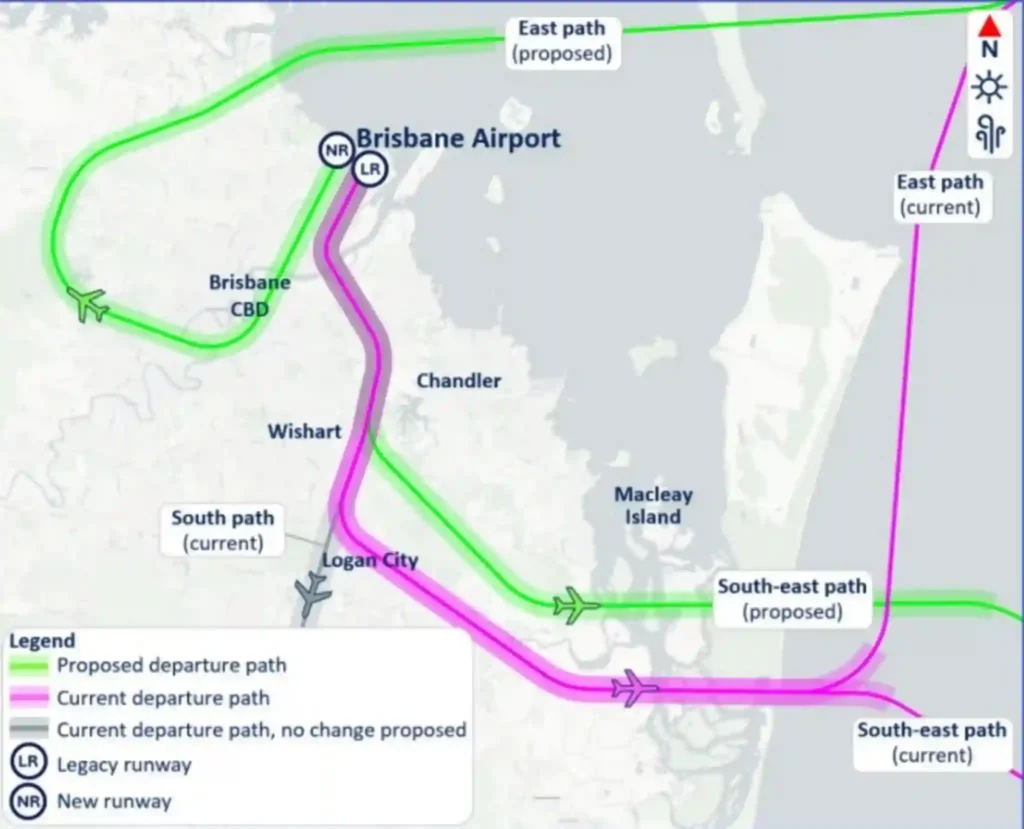

Brisbane Airport has begun using redesigned flight paths intended to move more aircraft away from heavily populated areas, following years of complaints from residents affected by overhead noise. Airservices Australia says four route changes could reduce the number of people living beneath key arrival and departure corridors by close to 140,000 across Brisbane, Moreton Bay and nearby island communities.
The revised routes started operating on July 9, 2026, after a lengthy investigation and consultation process. The changes affect aircraft approaching from the north and south, departures heading towards the south-east and some non-jet services arriving near Redcliffe.
While the plan has been welcomed by Brisbane Airport and the Queensland government, community campaigners say the announcement should not be interpreted as a guarantee that 140,000 people will experience quieter homes. They argue that the calculation is based on modelled flight corridors rather than measured noise exposure.
Key changes now affecting Brisbane flights
- Northern arrivals have been moved further north to reduce overflights across areas containing about 59,000 residents.
- New shorter approaches are available for some non-jet aircraft near Redcliffe.
- Southern arrival routes have changed ahead of future simultaneous runway operations.
- South-east departures from the older runway are being moved further east.
- Regular side-by-side arrivals on both runways are expected from late 2027.
Northern arrivals moved away from more populated areas
The most significant population reduction is linked to flights arriving at the northern end of Brisbane Airport’s newer western runway.
Those aircraft already approach largely over water, but the route has now been moved further north. Airservices Australia estimates the change will remove about 59,000 people from the main modelled overflight corridor.
The revised path is expected to avoid more homes near the southern part of Bribie Island and other communities around northern Moreton Bay. It does not mean aircraft will no longer be visible or audible in those areas, because individual tracks can vary with weather, safety requirements and traffic conditions.
However, shifting the centre of the route away from denser residential areas should reduce the number of people who experience aircraft passing directly overhead.
Different approach options for aircraft near Redcliffe
A second change creates new short-approach connections for non-jet aircraft landing at the northern end of the new runway.
Under a short approach, an aircraft turns towards the runway closer to the airport instead of following the entire longer arrival route. This gives air traffic controllers another option for distributing aircraft movements rather than repeatedly sending flights along the same track.
Airservices says the arrangement should help share noise between long and short approach routes and reduce the visual concentration of arriving aircraft over Redcliffe.
The option will not be used by every flight. Aircraft type, traffic levels, weather and operational safety will determine when a shorter approach is possible.
South-east departures shifted further east
Departure routes from Brisbane Airport’s older eastern runway towards the south-east are also being realigned.
By moving the routes further east, Airservices estimates approximately 44,500 fewer residents will be located within the main overflight corridor.
The final design may still receive minor adjustments after residents from the Southern Moreton Bay Islands raised concerns during consultation. That means the general direction has been decided, but smaller changes may still be made before every detail of the route is settled.
The adjustment is intended to reduce the number of homes directly beneath departing aircraft rather than eliminate aircraft noise throughout the wider region.
New southern arrivals prepare airport for simultaneous landings
Arrival paths approaching the southern ends of Brisbane Airport’s two runways have been redesigned to support Independent Parallel Runway Operations, commonly shortened to IPRO.
The procedure allows aircraft to approach and land independently on both parallel runways at the same time. Airservices estimates the new southern arrival structure will reduce the number of people overflown by about 35,000.
Regular use of IPRO is not expected until late 2027, but the new flight paths began operating in July 2026. Airservices said introducing them earlier allows some of the expected noise-reduction benefits to begin before simultaneous arrivals become a routine part of airport operations.
The change could also increase the number of aircraft Brisbane Airport can process during busy periods. That has led some residents to question whether the plan is primarily a noise-relief measure or part of a broader effort to expand airport capacity.
How the final routes were selected
Airservices Australia said its decision was based on more than population figures alone.
The federally owned air navigation organisation examined expected noise levels, the frequency of overflights, cumulative community impacts, aircraft altitude, route distance, fuel emissions and the number of people located under each possible path.
Donna Marshall, Airservices Australia’s head of community engagement, said residents had repeatedly asked the organisation to reduce the effects of aircraft operations on local communities. Moving routes away from larger concentrations of people was identified as one of the most practical ways to respond.
The latest changes follow earlier measures aimed at increasing the use of flights over water and allowing aircraft to remain higher for longer when travelling above residential areas.
Official maps and detailed information about the route review can be found through the Airservices Australia Noise Action Plan for Brisbane.
Airport says passengers may spend less time waiting in the air
Brisbane Airport has supported the changes, saying they could provide benefits for both nearby communities and passengers.
Tim Boyle, Brisbane Airport’s head of airspace, said directing flights over fewer people was an important consideration. He also said more efficient traffic management could reduce the time aircraft spend waiting in holding patterns during peak periods.
Less time circling before landing may improve punctuality, reduce unnecessary fuel use and make the passenger experience more predictable during busy travel periods.
The airport says it must continue supporting Queensland’s growing demand for domestic and international connections while limiting the effects of increased aircraft activity on nearby neighbourhoods.
Recent disruption across Australia’s aviation network has also highlighted how delays can affect passengers far beyond a single airport, as seen during widespread flight cancellations and delays affecting Australian travellers.
Community group disputes the scale of the noise relief
The Brisbane Flight Path Community Alliance has strongly criticised the announcement and questioned the claim that close to 140,000 people will receive meaningful noise relief.
Alliance chair Professor Marcus Foth said the figure counts residents located within a modelled corridor extending around each flight path. He argued that this does not directly measure how often aircraft pass over individual homes, the level of noise heard indoors, sleep disruption or the cumulative health impact of repeated flights.
The group also says the plan does not address several measures it has long requested, including an airport curfew, a limit on the number of flights, guaranteed use of routes over water and legally enforceable noise targets.
Its concern is that some noise may simply be redistributed from one community to another while the airport gains greater operational capacity from its two runways.
Read More:
- Baw Baw parking fine refunds: What affected drivers need to know
- Young kangaroo found hanging in suspected snare incident near Melbourne
- Visit the Swikblog homepage for more latest news
Why the 140,000 figure does not mean silence
The population estimates provide a useful indication of how many people may no longer sit directly beneath selected routes, but they should not be read as a prediction that all aircraft noise will disappear for those residents.
Noise exposure depends on the altitude of each aircraft, the type of plane, wind direction, weather conditions, the number of flights and whether operations occur during daytime or overnight hours.
Some residents outside the defined corridor may still hear aircraft, while communities closer to a newly shifted route may notice more activity than before.
The combined figures of 59,000, 44,500 and 35,000 also describe changes to different flight paths and operating conditions. They are estimates based on route modelling rather than individual household noise assessments.
Flight path dispute has become a major political issue
Aircraft noise has been a persistent issue in Brisbane since the airport’s second runway opened in July 2020.
The dispute later became a prominent political issue in Brisbane’s inner suburbs. Former federal Greens MP Max Chandler-Mather campaigned heavily on flight-path concerns after defeating Labor’s Terri Butler in the seat of Griffith in 2022.
Queensland Premier David Crisafulli said it was positive that the airport was responding to community concerns. He also emphasised that additional flights bring employment, tourism and economic opportunities to the state.
The new routes represent a substantial operational response to years of complaints, but disagreement is likely to continue as residents assess whether the changes produce a noticeable difference in daily life and Brisbane Airport prepares for more intensive use of both runways from late 2027.

Make Swikblog your go-to source on Google for reliable updates, smart insights, and daily trends.