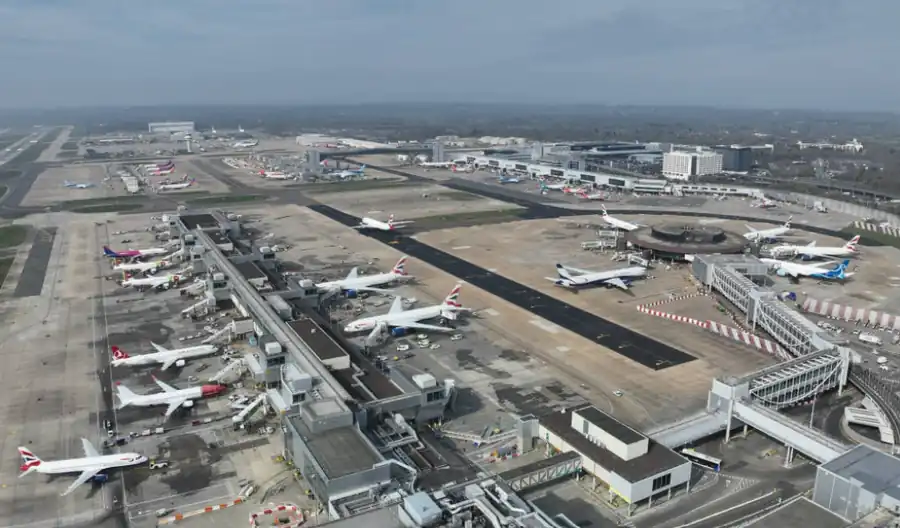
British Airways aircraft at Gatwick Airport after a technical fault caused runway closure and multiple flight diversions

Gatwick Airport Flights Diverted After British Airways Technical Fault Closes Runway

Flights bound for London Gatwick Airport faced major overnight disruption on 15 July 2026 after a British Airways aircraft developed a technical issue and temporarily blocked the runway. Nine inbound planes transmitted the general emergency code 7700, while a total of 14 flights were diverted to alternative UK airports.

The affected aircraft had been waiting to land while Gatwick’s runway remained unavailable. Flight-tracking information indicated that the emergency declarations were likely connected to falling fuel reserves after extended holding, rather than separate mechanical problems affecting all nine aircraft.

What happened at Gatwick Airport?

The disruption began after British Airways flight BA2673 arrived from Palma de Mallorca shortly after midnight. Reports placed its landing at approximately 12:10am to 12:12am BST. Airport rescue and firefighting vehicles attended the aircraft after reports of a technical fault.

Some reports suggested the aircraft may have experienced a nose-steering issue, although neither British Airways nor Gatwick publicly confirmed that specific cause. The verified explanation remained a technical problem involving the aircraft.

British Airways said the flight landed safely and that customers disembarked normally. No injuries were reported. The aircraft was eventually moved away, allowing Gatwick’s runway to reopen at approximately 1:30am.

Nine flights issued the Squawk 7700 emergency code

Flightradar24 reported that nine Gatwick-bound flights transmitted Squawk 7700. This is the universal transponder code used when a flight crew needs to inform air traffic control of a general emergency and receive priority assistance.

The code does not automatically mean an aircraft is in immediate danger or has suffered a mechanical failure. In this incident, several planes had spent additional time circling while waiting for the runway to reopen. As usable fuel reduced, crews could declare an emergency to secure priority handling and a safe diversion.

Aircraft operated by British Airways, easyJet, TUI and Jet2 were reportedly among the affected services. The concentration of emergency alerts attracted significant attention from aviation followers monitoring flight-tracking platforms overnight.

Read More

t-size:23px;margin:25px 0 12px;”>Which flights and airports were affected?

Affected services had travelled from holiday destinations including Tenerife, Lanzarote, Fuerteventura, Valencia, Rhodes, Athens, Bari, Rome and Agadir.

Fourteen flights were ultimately diverted to airports including London Stansted, London Luton, Heathrow, Birmingham and Bristol. Some aircraft later returned to Gatwick after normal landing operations resumed.

A passenger travelling from Tenerife described landing at Stansted instead of Gatwick and remaining onboard while waiting for information about the next stage of the journey. Diversions can leave airlines needing to arrange ground transport, refuelling, replacement crews or a later positioning flight.

Why one aircraft caused widespread disruption

Gatwick has two runways, but it normally operates as a single-runway airport. Its northern runway is primarily used as a taxiway and serves as a standby option under restricted circumstances. When an aircraft remains on the main runway, arriving and departing traffic can therefore be affected almost immediately.

Incoming flights may initially enter holding patterns, but crews must continuously assess weather, traffic conditions and the fuel required to reach an alternative airport. This explains how a relatively short runway closure can produce diversions across several locations and delays that continue after the runway reopens.

The incident follows wider concern about London flight cancellations and pressures affecting UK air travel, where operational changes can quickly disrupt passengers during busy travel periods.

Gatwick confirms runway reopened after short closure

Gatwick confirmed that its runway had closed for a short period because of a technical issue with an aircraft. The airport said a small number of flights were diverted, with most later returning to Gatwick, and stressed that safety and security remained its highest priority.

Passengers travelling after the incident should check live departure and arrival information with their airline before leaving for the airport. Official operational information is available through the London Gatwick Airport website.

Add Swikblog as a preferred source on Google

Make Swikblog your go-to source on Google for reliable updates, smart insights, and daily trends.