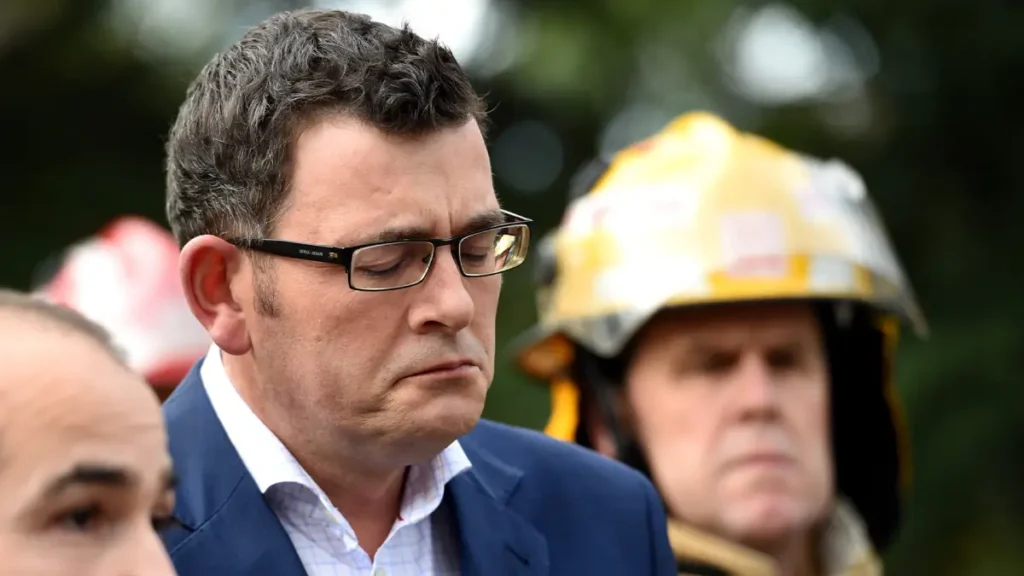

Victoria’s anti-corruption watchdog has found no corrupt conduct in its investigation into former premier Daniel Andrews and his government’s dealings with the United Firefighters Union. However, the report identified “serious and concerning conduct” involving ministers, MPs and senior public servants.
The Independent Broad-based Anti-corruption Commission released its Operation Richmond report on August 5, 2026. It examined firefighter workplace agreements negotiated between 2016 and 2019 and decisions connected to the establishment of Fire Rescue Victoria.
What Operation Richmond investigated
IBAC opened the investigation in 2018 after receiving allegations connected to Andrews and UFU secretary Peter Marshall. One allegation claimed Marshall had blackmailed or compromised Andrews to obtain a favourable firefighter agreement.
The investigation was completed in 2022, but legal proceedings and challenges brought by the UFU and Marshall delayed publication.
The final Operation Richmond report published by IBAC did not substantiate the blackmail allegation. It found no corrupt conduct, detected no criminal offences and recommended no prosecutions.
Secret negotiations excluded Jane Garrett
The report’s main concern was how the Andrews government handled the 2016 Country Fire Authority enterprise bargaining dispute.
Andrews authorised then-special minister of state Gavin Jennings to negotiate directly with Marshall. The discussions occurred without the knowledge or involvement of emergency services minister Jane Garrett, the CFA board and relevant government agencies.
Jennings, senior public servant Tony Bates and UFU representatives met in rented spaces and a hotel room. After an agreement was reached, Jennings messaged Andrews that a “handshake” had occurred.
IBAC found that a later meeting between Andrews and Marshall was effectively staged to create the appearance that the UFU was formally presenting its proposal. Garrett was not told that its substance had already been privately negotiated.
Garrett opposed the agreement because of concerns about the CFA, public safety and government accountability. She resigned from cabinet in 2016. The CFA board also rejected the proposal and was later dismissed, with replacement members appointed outside the proper process if they were considered amenable to the government’s position.
Marshall exercised ‘extraordinary influence’
IBAC said the undisclosed process gave Marshall privileged access to ministers, advisers and public servants, enabling him to exercise “extraordinary influence” over negotiations.
The watchdog found that normal checks and accountability mechanisms failed because responsible ministers, departments and agencies had been excluded.
Marshall continued to receive privileged access during later Metropolitan Fire Brigade negotiations and after Lisa Neville became emergency services minister. IBAC found that he attempted to influence Neville, but it did not determine that his efforts successfully changed a decision.
381 messages and confidential information
IBAC found that Bates and Marshall exchanged 381 text messages between May and September 2016. Bates described the CFA as “clowns” and “childish” in messages to Marshall.
Bates also passed on advance information about a cabinet reshuffle and confidential updates from a CFA board meeting. IBAC criticised Bates and senior official Chris Eccles for failing to maintain the impartiality expected of public servants.
The findings add an integrity dimension to wider changes affecting the bureaucracy, including Victoria’s public-sector overhaul involving job cuts and agency restructuring.
Other corruption risks identified
Operation Richmond examined Metropolitan Fire Brigade concerns that parts of an agreement could be unlawful or interfere with safety obligations. It also found that MFB board member Greg Sword shared confidential information with Marshall in breach of his professional duties.
IBAC investigated the employment of an unnamed crossbench MP’s relative while the UFU sought parliamentary support for firefighter cancer-compensation legislation. The arrangement was identified as a corruption risk, but no corrupt conduct finding was made.
Why no corruption was found
IBAC must apply the legal definition of corrupt conduct contained in Victorian law. Behaviour can be secretive, improper or contrary to government standards without satisfying every legal element required for a corruption finding.
The report identified breaches of policies, procedures, codes of conduct and Westminster conventions. It found that government leaders weakened established safeguards but concluded that the evidence did not establish statutory corruption or criminal wrongdoing.
Traveller Fined at Brisbane Airport Over Undeclared Ham Hock: What Happened
NAPLAN Results 2026: Numeracy Improves While Year 3 Maths Performance Slips
Visit the homepage for the latest Australia news, education updates and consumer stories
How Andrews, Marshall and the government responded
Andrews stressed that no corrupt conduct was found against him, ministers or public servants. He rejected the blackmail allegation and said the dysfunctional firefighter dispute needed to be resolved in the public interest.
Marshall also highlighted the absence of a corruption finding and called for IBAC’s conduct and surveillance methods to be reviewed.
Premier Ben Carroll described the behaviour detailed in the report as unacceptable and promised to implement every recommendation.
The report has arrived during an election year when government integrity and Labor’s relationships with public-sector unions are politically sensitive. Similar industrial pressure is evident in the dispute over Victorian teachers rejecting Labor’s proposed 28% pay agreement.
Reforms recommended by IBAC
IBAC recommended a legislated statement of values for ministers and a public ministerial handbook covering integrity standards. It also called for stronger training on relationships with unions, lobbyists and interest groups, along with Westminster principles and impartial public administration.
Operation Richmond produced no criminal case, but it documented how private access, political urgency and secret negotiations displaced transparent government processes. The next test is whether Victoria’s promised reforms create enforceable accountability rather than additional guidance that officials can bypass.

Make Swikblog your go-to source on Google for reliable updates, smart insights, and daily trends.