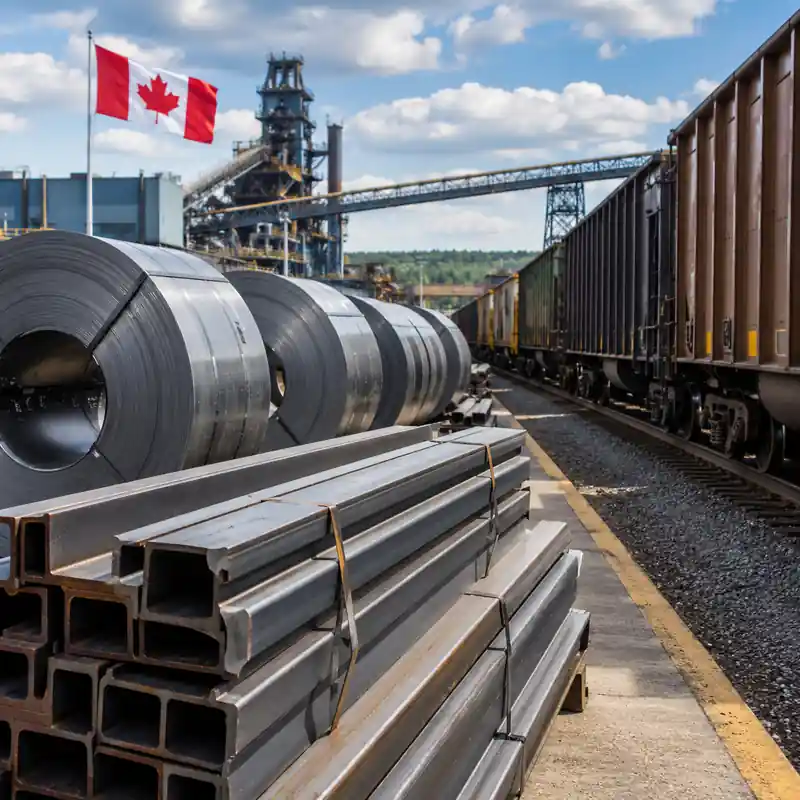

Canada has launched a $100 million steel shipping rebate that will cover 50% of eligible rail and marine transportation costs for Canadian steel moving between provinces and territories. The measure is aimed at making domestic steel more competitive at home as producers face steep U.S. tariffs and buyers in Western Canada struggle with the cost of moving heavy steel products from mills concentrated in Ontario and Quebec.
The Commodities Sectoral Support Program opened on August 10, 2026 and can run for up to one year, or end earlier if the available funding is fully allocated. A single eligible recipient can receive up to $50 million in cumulative rebates, while qualifying shipments must have a Canadian origin and destination.
How the 50% steel shipping rebate works
The rebate applies to eligible interprovincial steel shipments moved by rail or marine transportation. Rail support is limited to qualifying carload movements, while eligible marine shipments must be non-containerized cargo. Trucking is not included, making the program narrower than a general freight subsidy.
That exclusion has already drawn criticism from the Canadian Trucking Alliance, which argues that subsidizing rail and marine transport could shift some steel freight away from trucking companies. For steel buyers, however, the immediate calculation is simpler: where a shipment qualifies, Ottawa can reimburse half of the eligible transportation cost.
The policy addresses a long-standing geographic problem. Much of Canada’s steelmaking capacity sits in Ontario and Quebec, while construction companies, fabricators and other large users operate thousands of kilometres away. British Columbia buyers have repeatedly pointed to freight costs and delivery reliability as reasons imported steel can sometimes be easier or cheaper to source.
The pressure has been especially visible in rebar, the steel rods and mesh used to reinforce concrete. B.C. supplier Cobra Rebar Ltd. has said it has been using more Canadian steel since import restrictions tightened, but moving product from Eastern Canada remains expensive and can be difficult from a timing perspective.
Trade disruption has already affected Canadian producers directly. Algoma Steel’s layoff notices affecting about 1,000 workers highlighted how tariffs, weaker demand and changing market conditions can quickly reach plant operations and employment.
Why Ottawa is pushing Canadian steel at home
The rebate comes after the United States raised its Section 232 tariff on Canadian steel to 50% in June 2025, sharply reducing the attractiveness of a market that had historically absorbed most Canadian steel exports. Ottawa has since tightened its own steel import rules as it tries to redirect more demand toward domestic producers.
Canada’s current tariff-rate quotas generally limit steel from countries without a free-trade agreement to 20% of their 2024 import volumes. Free-trade partners outside the United States and Mexico generally face a threshold of 75% of 2024 volumes. Imports above those quota levels face a 50% surtax.
The federal government’s current steel and aluminum tariff guidance confirms those quota levels and the 50% over-quota surtax.
Those restrictions can protect Canadian mills from a flood of lower-priced foreign supply, but they also create a practical challenge: domestic steel has to reach customers at a competitive delivered price. The new freight rebate is designed to address that missing piece rather than relying on tariffs alone.
The broader tariff environment is affecting manufacturers as well as primary metal producers. BRP’s warning of more than $500 million in potential tariff costs showed how changes to U.S. metal duties can move through complex North American supply chains and alter corporate forecasts.
GM Stock Falls as Canada Pushes Plan to End U.S. Auto Tariffs
Canada Cuts EV Tariffs With China as Doug Ford Warns of a One-Sided Deal
What the $100 million program could change
For buyers far from Canada’s major mills, a 50% freight rebate can materially change the delivered cost of domestic steel without implying that steel itself becomes 50% cheaper. Product prices, specifications, supplier contracts, availability and delivery times will still determine the final bill.
The program also has clear limits. Its funding is finite, trucking is excluded, and the rebate is temporary. That means its longer-term value will depend on whether lower transport costs help producers establish stronger domestic customer relationships that remain commercially viable after the subsidy ends.
For Ottawa, the program fits a wider effort to strengthen interprovincial trade, reinforce Canadian supply chains and reduce vulnerability to U.S. trade shocks. For steel users in Western Canada, the more practical test is whether rail and marine savings make Canadian material easier to source without creating new delays or capacity constraints.
The rebate therefore acts as both short-term tariff relief and a test of Canada’s domestic steel market. If producers can reach distant customers more competitively, the policy could support a larger shift toward Canadian supply. If freight reliability, regional availability or other costs remain the bigger obstacle, the $100 million fund may expose where further supply-chain improvements are still needed.

Make Swikblog your go-to source on Google for reliable updates, smart insights, and daily trends.