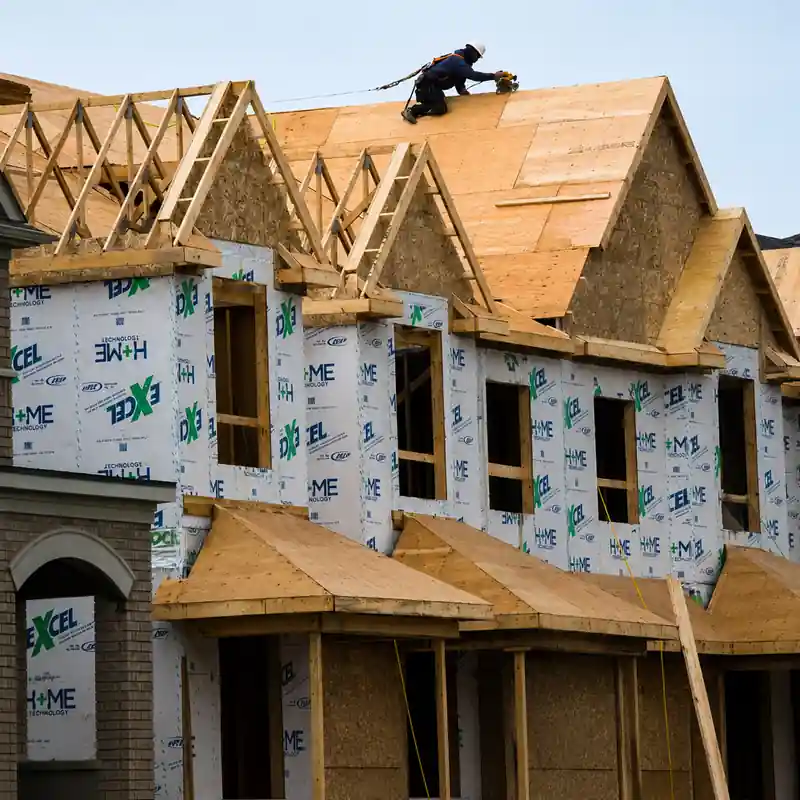

Ontario’s new-home market posted a sharp improvement in the second quarter of 2026, with 8,410 homes sold across the province — up 130% from 3,645 during the same period a year earlier — as buyers responded to a temporary HST relief program that can reduce the cost of an eligible new home by as much as $130,000.
The figures, compiled by the Building Industry and Land Development Association (BILD), the Ontario Home Builders’ Association (OHBA) and Altus Group, show 4,765 more new homes changed hands during the three months ending June 30 compared with the second quarter of 2025.
The industry groups attribute nearly all of that additional activity to the enhanced HST measure. That remains an industry assessment rather than proof that the tax change alone caused every extra purchase, but the timing suggests affordability incentives have encouraged some buyers who had been waiting on the sidelines.
How the Ontario HST rebate changes the cost of a new home
The temporary program applies to qualifying agreements for new or substantially renovated homes entered into from April 1, 2026 through March 31, 2027.
Combined federal and provincial relief can reach $130,000. Eligible homes valued up to $1 million can receive relief equivalent to the full 13% HST, while the maximum $130,000 benefit is maintained for qualifying homes between $1 million and $1.5 million. Relief is gradually reduced between $1.5 million and $1.85 million.
Ontario’s official enhanced HST relief guidance states that, for a qualifying home bought from a builder, construction generally must begin by December 31, 2028 and be substantially completed by December 31, 2031.
The program has also moved beyond its early administrative uncertainty. Federal regulations needed to implement Ontario’s enhanced rebate were made in June, and applications for the provincial enhanced new-housing rebate are now available. That gives buyers, builders and lenders more clarity than they had when the measure was first announced.
The change matters in a province where affordability and weak presales have been weighing on construction. Ontario had earlier lowered its 2026 housing-start forecast to 64,800 homes, highlighting the risk that weak sales today could translate into fewer completed homes in future years.
Low-rise demand improves while the condo market remains weak
The recovery has not been evenly distributed. In the GTA, low-rise new-home sales moved above their 10-year average in April for the first time in three years, according to BILD.
The wider market was still subdued. About 1,100 new homes were sold in the GTA that month, leaving total sales 55% below the 10-year average. Condominium sales were 88% below their historical benchmark.
May showed a similar divide, with 830 low-rise homes sold against only 193 condominium apartments. The weakness fits a broader pattern in which condo buyers are becoming more cautious about total ownership costs, including mortgage payments, maintenance fees and other recurring expenses.
Timing is another obstacle for high-rise developments. Large GTA condominium projects can take six or seven years — and sometimes longer — to move from planning and presales to completion. That makes the rebate’s 2028 construction-start and 2031 substantial-completion deadlines easier to accommodate for some low-rise projects than for major towers.
Industry sees wider economic impact from stronger sales
BILD and OHBA estimate the additional sales generated during the first three months of the program helped protect about 17,300 construction jobs, support roughly $2.8 billion in GDP and preserve approximately $1.4 billion in government revenue.
Those numbers are economic estimates, not directly observed job or revenue counts, and should be viewed separately from the confirmed sales totals.
Earlier modelling by economist Peter Norman estimated that deteriorating affordability between 2016 and 2026 had suppressed demand from about 35,000 additional Ontario households a year. His analysis suggested that combining HST relief with lower development charges could unlock roughly 18,000 to 23,000 additional new-home sales annually.
Development charges are now becoming the second part of that affordability strategy. Through the Canada-Ontario Partnership to Build, governments have committed up to $8.8 billion over 10 years for housing-enabling infrastructure, with participating municipalities expected to reduce development charges by 30% to 50% or more for three years.
Those reductions were largely too recent to influence the second-quarter sales figures, meaning the 130% year-over-year increase mainly reflects conditions before their broader effect could be measured.
Why the 130% increase still needs context
A 130% annual increase is eye-catching, but it comes against an exceptionally weak second quarter in 2025. Ontario’s new-home market is therefore recovering from a low base rather than moving straight into a broad housing boom.
There are some encouraging supply signals. Ontario reported 26,084 housing starts from January through May 2026, up 17.2% from the same period in 2025, while rental starts reached 13,599, an increase of 94.9%. Those figures predate much of the rebate’s sales impact, so they should not be presented as evidence that the HST measure caused the construction improvement.
The more important test is whether stronger purchases lead developers to launch and finance more projects. Presales are critical to many new developments, so sustained demand could improve the pipeline of future housing starts. If supply fails to respond, however, stronger demand could eventually put upward pressure on prices and reduce part of the affordability benefit.
For buyers, the headline $130,000 figure is also not an automatic saving on every property. Home value, purchase date, intended use, construction timing and other eligibility rules determine the amount available.
Ontario’s second-quarter numbers nevertheless show a meaningful change from the weakness seen through 2024 and 2025. The next measure of success is not simply whether sales remain higher, but whether that activity produces more viable projects and additional housing supply without pushing affordability back in the wrong direction.

Make Swikblog your go-to source on Google for reliable updates, smart insights, and daily trends.