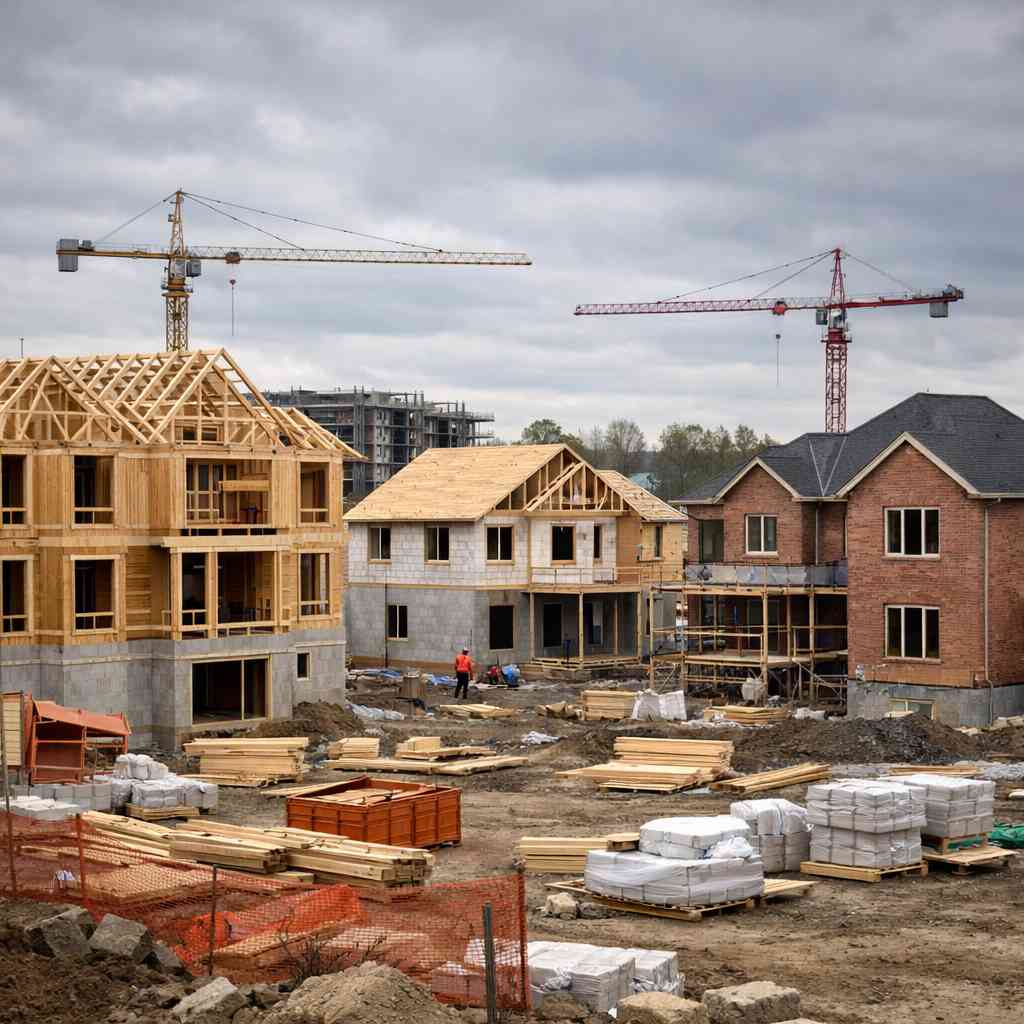

Ontario’s housing crisis is showing fresh signs of strain as the province cuts its housing start forecast once again. In its latest budget, Ontario now expects just 64,800 homes to be built in 2026, down sharply from the 74,800 projected last year — a drop of nearly 13%.
The downgrade highlights a growing gap between reality and the province’s ambitious plan to build 1.5 million homes by 2031. With each revision, the chances of hitting that target are fading, raising concerns about affordability, supply shortages, and long-term market stability.
Housing Starts Fall Further Behind Target
The latest forecast is not just a routine adjustment — it signals a major slowdown in construction momentum. When Ontario first introduced its 1.5 million homes plan, internal projections showed the province would need to build roughly 175,000 homes per year to stay on track.
Now, with the 2026 forecast sitting at just 64,800, the province is producing barely over one-third of the required pace. This widening gap suggests that even if construction activity improves later, catching up will become increasingly difficult.
The numbers clearly show the scale of the challenge. Instead of accelerating housing supply, Ontario is seeing projections move in the opposite direction — a trend that could worsen the housing shortage in the coming years.
Government Shifts Focus Away From 2031 Goal
Another key takeaway from the budget is the government’s changing tone on its flagship housing target. Finance Minister Peter Bethlenfalvy avoided emphasizing the 1.5 million homes goal, instead stating that his focus is on improving affordability rather than chasing a specific number.
Housing Minister Rob Flack echoed a similar sentiment, saying he does not focus on the 2031 target and instead prioritizes short-term progress over the next two to three months.
This marks a notable shift from earlier messaging, when the 1.5 million homes plan was positioned as a central policy objective. The reduced emphasis suggests the government recognizes the growing difficulty of meeting the target under current conditions.
HST Rebate Expansion Aims to Boost Supply
To support housing construction, the province announced an expanded HST rebate on new homes in its latest budget. The government believes this measure could help stimulate building activity and make new homes more affordable for buyers.
According to provincial estimates, the rebate could lead to the construction of around 8,000 additional housing units. While this is a positive step, it remains relatively small compared to the massive shortfall in required housing supply.
More details on the rebate policy can be found in the official government release: Ontario expands HST rebate to lower cost of new homes.
Why Housing Starts Are Slowing
Several key factors are contributing to the slowdown in housing construction across Ontario. High interest rates continue to make financing more expensive for developers, reducing the viability of many projects. At the same time, construction costs remain elevated, and labour shortages are limiting the pace at which new homes can be built.
Additionally, market uncertainty and affordability challenges are impacting buyer demand, particularly in pre-construction segments. When developers cannot secure enough early buyers, projects are often delayed or cancelled altogether.
Data from the Canada Mortgage and Housing Corporation (CMHC) continues to show volatility in housing starts across the country, reflecting these broader challenges: CMHC housing starts data.
Market Impact and Outlook
The continued decline in housing start projections is likely to have long-term implications for Ontario’s real estate market. Lower construction activity today means fewer homes will be available in the future, which could keep prices elevated and worsen affordability challenges.
For homebuyers, this signals that relief from high prices may take longer than expected. For developers and investors, it reflects a cautious environment where project launches remain sensitive to economic conditions.
More importantly, the growing gap between targets and actual construction raises questions about whether Ontario needs more aggressive policy changes to boost supply. While incentives like tax rebates can help, broader structural issues — including approval timelines, development costs, and financing conditions — will likely determine whether housing starts can recover.
The Bottom Line
Ontario’s latest budget paints a clear picture: the province is falling further behind on its housing goals. With housing starts dropping to 64,800 and required levels far higher, the 1.5 million homes target is becoming increasingly difficult to achieve.
While the expanded HST rebate may provide some support, it is unlikely to fully bridge the gap. Unless construction activity accelerates significantly in the coming years, Ontario’s housing shortage could deepen, keeping affordability a major concern for millions of residents.

Make Swikblog your go-to source on Google for reliable updates, smart insights, and daily trends.