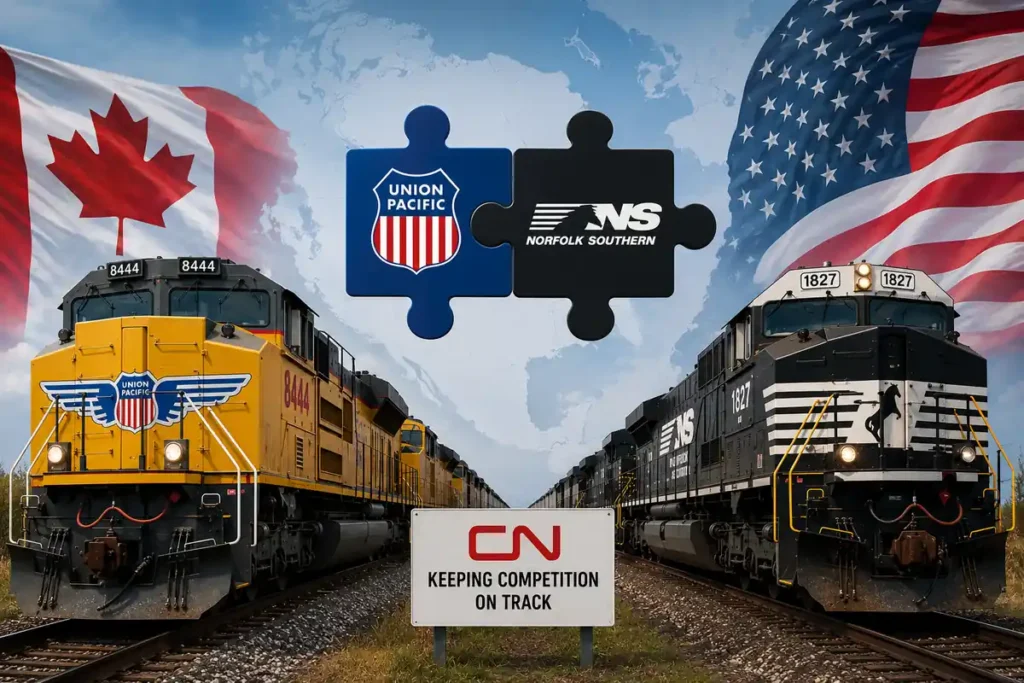

Canadian National Railway is intensifying its opposition to the proposed Union Pacific–Norfolk Southern merger, warning that the deal could reduce freight competition, weaken shipper choice and reshape how goods move across Canada and the United States.
The merger would combine Union Pacific, which operates primarily in the western United States, with Norfolk Southern’s eastern rail network. The companies say the transaction would create the first single-line transcontinental freight railroad in the United States, allowing cargo to move from coast to coast without being transferred between competing railways.
For Union Pacific and Norfolk Southern, the central argument is efficiency. They say a unified network could reduce interchange delays, improve shipment reliability and attract more freight away from highways. Their amended application estimates that customers could save approximately US$3.5 billion annually, although that figure is an estimate supplied by the merger applicants rather than a conclusion reached by regulators.
Why is CN fighting the UP–NS merger?
CN’s concern is that the proposed railway would become too powerful within the North American freight market. The Montreal-based company says the combined business could control more than 40% of the U.S. freight rail market, potentially leaving some manufacturers, farmers and exporters with fewer practical options.
That matters because railway competition is not limited to the number of tracks entering a facility. Shippers also depend on competitive routes, interchange agreements and the ability to negotiate with more than one carrier. CN argues that a larger UP–NS network could redirect traffic away from rival railroads while giving the merged company greater control over pricing and access at important gateways.
CN has launched a public campaign encouraging customers to participate in the regulatory process and explain how the transaction could affect their businesses. Its official Keeping Competition on Track campaign says safeguards are needed to prevent customers from losing meaningful railway choices.
The dispute also comes as Canadian exporters face wider uncertainty over changes that could reshape North American trade under the USMCA. Railways carry large volumes of grain, lumber, minerals, vehicles and manufactured products across the border, making freight access an important part of Canada’s broader trade position.
What is the latest regulatory update?
The merger has not been approved. Union Pacific and Norfolk Southern initially submitted an application in December 2025, but the U.S. Surface Transportation Board rejected it in January 2026 because the filing was incomplete.
The companies returned with an amended application on April 30. On May 28, the STB accepted it for consideration but placed the proceedings, including the environmental review, on hold. The regulator ordered the applicants to supply additional information by July 27, 2026 about competition, network capacity, service reliability, claimed public benefits and customers who could lose access to competing railroads.
The full regulatory record is available through the Surface Transportation Board’s UP–NS merger resource page.
On July 7, Union Pacific and Norfolk Southern submitted the first portion of their supplemental response. That filing dealt with issues involving the Terminal Railroad Association of St. Louis, Kansas City Terminal Railway and railcar-pooling company TTX. Additional responses are expected before the July deadline.
Why the merger matters in Canada
CN operates an extensive network connecting Canada with major U.S. industrial centres and ports. A coast-to-coast UP–NS system could compete more aggressively for cross-border shipments currently exchanged with CN or routed through its network.
The debate is therefore not simply about one railway protecting its market share. Canadian businesses could be affected if the merger changes freight rates, interchange arrangements or access to U.S. destinations. CN’s recent operations have already attracted attention following a CN derailment in Ontario that disrupted Niagara rail service, highlighting how heavily passenger and commercial transportation can depend on the same railway infrastructure.
Union Pacific and Norfolk Southern maintain that the transaction would increase competition with trucking and improve supply-chain performance. CN’s position is that those promised benefits must be weighed against the risk of fewer railway choices. The STB’s request for more evidence means that question remains unresolved, and the July 27 submissions could determine when the formal merger review is allowed to resume.

Make Swikblog your go-to source on Google for reliable updates, smart insights, and daily trends.