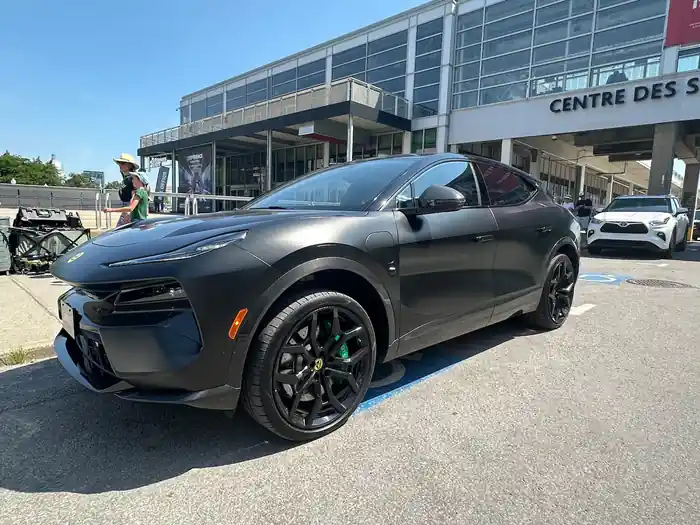

Canada’s EV market has crossed a new line: the first Chinese-owned and Chinese-built electric vehicle is now available to Canadian buyers, but it is arriving as a six-figure luxury SUV rather than a budget car. Lotus has begun bringing the China-made Eletre into Canada, with prices starting at $119,000 and rising to about $159,000 for a fully loaded model.
The launch is important because it marks the first visible result of Canada’s changed policy toward Chinese electric vehicles. After a 2024 tariff effectively shut the door on many China-built EVs, a new Canada-China arrangement now allows a limited number of vehicles to enter at a much lower tariff rate.
For Canadian drivers, this is not just a Lotus story. It is an early test of how Chinese automakers may enter the market, how much pressure they could put on EV prices, and how Ottawa will balance consumer choice with cybersecurity and privacy concerns.
A Luxury SUV Opens The Door
The first model to reach buyers is the Lotus Eletre, a premium electric SUV built in Wuhan, China. Lotus is owned by China’s Geely Group, making the Eletre both Chinese-owned and Chinese-built.
The vehicle’s specifications are aimed at high-end EV shoppers. Lotus says the Eletre can drive more than 600 kilometres on a single charge and can move from 20 per cent to 80 per cent charge in less than 20 minutes. Those numbers place it in the same conversation as other premium electric SUVs, especially for buyers who want long range and fast charging.
Lotus Cars Americas CEO Max Trantini said Canadian interest was strong even before the SUV became widely visible in showrooms. The company’s first shipment of nearly 20 vehicles has already arrived, with further imports expected as the model reaches dealerships and roads.
Lotus has only six dealerships in Canada, a network originally suited to a niche sports-car brand. The Eletre changes that equation. Company officials say they are discussing expansion with current dealers and receiving interest from potential investors who want to join the network.
The Trade Shift Behind The Launch
The timing of the Lotus launch is tied directly to Ottawa’s tariff change. Canada previously imposed a 100 per cent tariff on Chinese-made electric vehicles in 2024. That policy made it difficult for companies such as Lotus to bring China-built models into the country at competitive prices.
Under a January 2026 agreement between Prime Minister Mark Carney and Chinese President Xi Jinping, Canada now allows up to 49,000 Chinese EVs per year to enter the country at a 6.1 per cent tariff rate. The arrangement also came as China agreed to drop duties on certain Canadian agricultural products. More details on Canada’s EV import controls are available through Global Affairs Canada.
Trantini said Lotus had planned to launch the Eletre in Canada before the 100 per cent tariff was introduced. The vehicle had already launched in Europe three years earlier, and the company had developed plans for both the U.S. and Canadian markets before tariff pressure delayed Canadian imports.
Global Affairs Canada data shows 2,910 EVs from China entered Canada between March 1 and the end of May. The agency did not identify which companies imported them or where the vehicles were located. The same data indicated no new Chinese EVs had arrived since the end of May.
The policy shift comes as Canadian transportation and consumer markets face broader changes, including leadership movement at major mobility companies such as Air Canada naming Anko van der Werff as its next CEO.
Why Cheaper Chinese EVs May Not Arrive First
Many consumers associate Chinese EV makers with lower prices, but Canada’s first example is a luxury model. That is likely not an accident.
Automotive industry analysts expect the early phase to be led by higher-end vehicles because they give automakers more room to absorb the cost of market entry. Building a dealer network, creating service capacity, stocking parts, opening offices and meeting regulatory requirements all require money before a brand can scale.
That means premium models from better-known brands may take a large share of the early import quota. Lotus, Volvo, Tesla vehicles built in China where applicable, and Polestar are among the names expected to be more visible in the first wave because they already have some brand awareness or retail presence.
The mass-market impact could come later. Ottawa has said that by 2030, it wants half of imported Chinese EVs to cost less than $35,000. If that target is met, Chinese-made EVs could move from a luxury-market story to a mainstream affordability story.
BYD, Chery And Polestar Are The Names To Watch
The Lotus launch is expected to be followed by more activity from other Chinese-linked brands. Polestar, which is also connected to Geely, is already listed in Transport Canada’s Appendix G pre-clearance program for passenger cars produced in Chengdu and Taizhou, China, as well as vehicles made in the United States and South Korea.
BYD has also received Appendix G approval for an unspecified passenger car made in Shenzhen City and Xi’an, China. The timing of that approval has not been made clear, but BYD’s presence in the registry is notable because the company is one of the world’s most important EV manufacturers.
Chery is another Chinese automaker expected to target Canada in the coming months. If BYD and Chery eventually bring lower-priced models, they could place new pressure on established automakers already selling EVs in Canada.
That pressure may be felt even before Chinese brands become dominant. More competition can force existing automakers to improve standard features, adjust pricing, offer stronger incentives or speed up product updates.
Canada’s EV Market Is Growing, But Still Small
The new imports are entering a market that is expanding but still far from fully electric. Transport Canada data shows at least 726,126 light-duty battery electric vehicles are on Canadian roads, representing 2.7 per cent of market share.
There are also 304,823 light-duty plug-in hybrid vehicles, equal to about 1.1 per cent of market share. Those numbers show that EV adoption is real, but most Canadian drivers still use gasoline or diesel vehicles.
That gives Chinese automakers a potential opening, especially if they can eventually deliver vehicles with strong range, reliable winter performance, accessible service and lower prices. But trust will matter as much as cost.
Read More:
- Halifax Jazz Festival cancels Saturday night show after Broken Social Scene pulls out
- Obama Presidential Center museum tickets: Prices, dates and how to book
- Visit the Swikblog homepage for more latest news
The Data Privacy Issue Around Chinese EVs
Chinese-built EVs are entering Canada with a major warning attached: modern vehicles are connected devices. They use cameras, sensors, microphones, navigation systems, apps and phone pairing. That means they can collect information about where people go, how they drive and what devices they connect.
Former National Security and Intelligence Advisor Jody Thomas has warned that Chinese law may allow the state to access data collected by Chinese companies if requested. She described the risk as plausible, not guaranteed, but said consumers should understand the privacy implications before buying.
The concern is larger for people who work in the military, federal or provincial government, critical infrastructure, sensitive industries or national security roles. Routes, phone contacts, driving patterns, conversations and camera recordings may seem ordinary at an individual level, but aggregated data can become more sensitive.
Some security experts have suggested Canada should consider restricting Chinese-made EVs from military bases or certain government sites. Public Safety Minister Gary Anandasangaree has said Ottawa needs to ensure vehicles in Canada do not have the ability to transmit information back to other countries, including China.
Lotus says it has met Canadian requirements. Trantini said the company disclosed information related to its hardware and software and passed government examinations. He also said Lotus would comply with any future Canadian rules on vehicle data and cybersecurity.
What Buyers Should Check Before Ordering
For Canadian consumers, the arrival of Chinese-built EVs creates more choice but also more homework. Buyers should compare not only price, range and charging speed, but also warranty terms, local service access, parts availability, software update policies and data settings.
Anyone working in a sensitive job may also want to avoid connecting a work phone to a Chinese-made EV, review app permissions carefully, and ask dealers how vehicle data is stored, processed and shared.
Canada has repeatedly said Chinese automakers should eventually build where they sell. That means Ottawa may keep pushing for partnerships with Canadian companies, local investment, manufacturing commitments and tighter rules on data collected inside the country.
The Lotus Eletre is the first visible step. The larger story is whether Canada can use Chinese EV competition to lower prices while protecting privacy, national security and domestic industry interests.

Make Swikblog your go-to source on Google for reliable updates, smart insights, and daily trends.