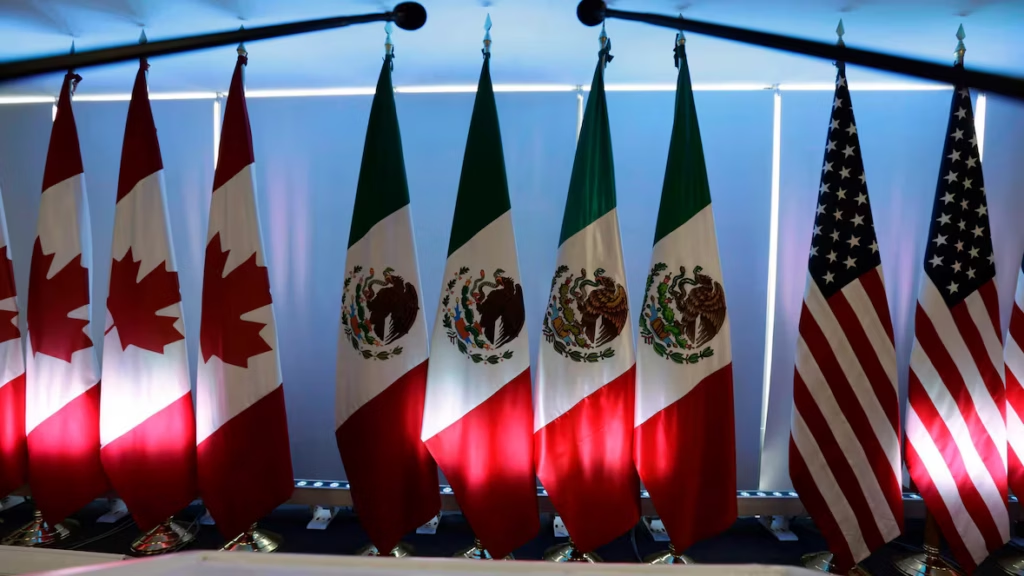

Canada has moved to extend the USMCA for another 16 years, but the review may become far more difficult than a routine renewal. Ottawa wants the North American trade pact preserved, while President Donald Trump’s administration is expected to push for tougher conditions that could change how goods move between Canada, the United States and Mexico.
The agreement, known as CUSMA in Canada, is due for its first joint review on July 1, 2026. Canada has formally notified Washington and Mexico City that it supports renewing the pact, a step meant to give exporters, manufacturers and investors more certainty after years of tariff disputes and trade tension.
Canada-U.S. Trade Minister Dominic LeBlanc has described the agreement as beneficial for all three economies and for the broader North American market. His position reflects Ottawa’s view that the pact has helped protect supply chains, reduce trade barriers and support businesses that rely on cross-border production.
The issue is that Washington may not be looking for a simple extension. The Trump administration is reportedly interested in major changes, especially in the auto sector. One proposal would require at least 50% of vehicle content to be made in the United States for cars and trucks to qualify for tariff-free access to the American market.
That would be a major shift for automakers. North America’s auto industry is built around shared production, with parts often moving between Canada, the United States and Mexico several times before a vehicle is completed. A U.S.-specific content rule could push manufacturers to rethink where they source parts, where they invest and how they price vehicles.
The risk is not limited to automakers. Steel, aluminum, forestry, agriculture, logistics and energy companies all depend on predictable trade rules. Canada has already raised concerns over U.S. tariffs on steel, aluminum, autos and forest products, arguing that such measures weaken the trade relationship the agreement was designed to protect.
Dairy could also return as a major point of friction. U.S. officials have repeatedly pushed for more access to Canada’s protected dairy market, while Canadian governments have traditionally defended the supply management system as important for domestic producers.
Prime Minister Mark Carney has played down concerns that Mexico is moving ahead faster in talks with Washington. He has said the United States has more unresolved CUSMA-related issues with Mexico than with Canada, though Ottawa still faces its own pressure over tariffs, autos and market access.
For investors, the review matters because trade policy can quickly affect company outlooks. Automakers and parts suppliers are especially sensitive to rule changes, as seen in the decline in GM stock following Canada’s auto tariff proposal. If the USMCA review leads to stricter rules, companies may face higher costs and more complicated supply chain decisions.
The agreement currently remains scheduled to run until 2036, even if the three countries do not immediately agree to renew it. However, any member can withdraw with six months’ notice, which means political uncertainty can still create pressure long before the pact formally expires.
Read More
The official Government of Canada CUSMA resources show that the agreement covers far more than tariffs, including labor rules, digital trade, dispute settlement, investment protections and market access.
Canada’s goal is stability. Trump’s goal appears to be leverage. That difference could turn the 2026 USMCA review into a defining test for North American trade, with the outcome shaping investment, manufacturing and export decisions across the continent for years.

Make Swikblog your go-to source on Google for reliable updates, smart insights, and daily trends.