
A short stop-sign enforcement operation on Toronto’s waterfront has turned into a much larger argument about policing, road safety and the way cyclists are treated on city streets.
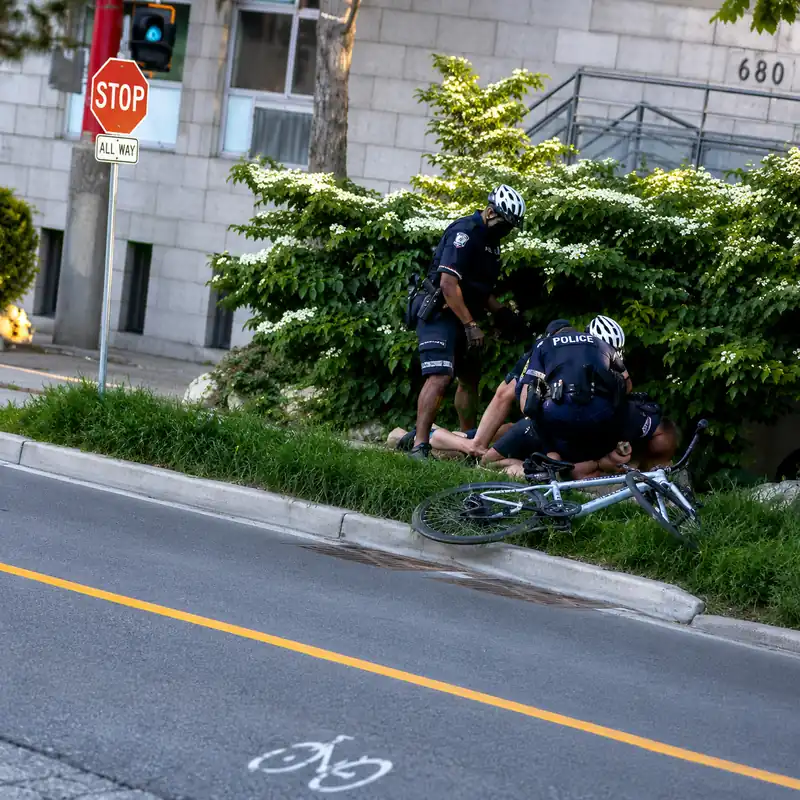
Video shared on Instagram appears to show Toronto police officers tackling and pinning down a cyclist on the Martin Goodman Trail after police say the rider failed to stop at a posted stop sign near Queens Quay West and Little Norway Crescent.
The video, shared on Instagram by The Biking Lawyer, shows the moment officers moved in during the stop-sign enforcement operation. Readers can watch the Instagram video here.
The footage, posted by The Biking Lawyer, shows an officer running across a bike lane before several uniformed officers surround a person on the ground. In the video, the cyclist can be heard asking, “What did I do wrong?” An officer is heard replying: “You didn’t stop.”
Toronto police have said the incident happened shortly before 6:30 p.m. on May 31, during cyclist stop-sign enforcement in the area. Police said officers were responding to community complaints about cyclists failing to obey the posted stop sign. According to police, the cyclist failed to stop, continued through the intersection at speed, shouted a profanity at officers and did not comply when another officer directed him to stop.
The cyclist, described by police as a man in his 20s, was arrested and later issued provincial offence notices. Public reporting said the tickets included failure to stop, failure to identify and disobeying a stop sign under Ontario’s Highway Traffic Act.
Video triggers criticism over police force
The reaction online was immediate because the alleged offence was not a criminal charge but a traffic-related infraction. David Shellnut, the lawyer behind The Biking Lawyer account, said the footage appeared to show an excessive response to a stop-sign offence on a busy cycling corridor.
In the Instagram post, The Biking Lawyer described the incident as “multiple @torontopolice officers tackling, pinning down, and arresting a cyclist during a TPS stop sign trap on the Martin Goodman Trail.” The post argued that, if the account of the incident was accurate, the response looked like “a grossly excessive use of force for a traffic infraction” and called on Mayor Olivia Chow and local councillor Ausma Malik to look into it.
The post also said the stop sign in the area is “poorly placed” and “should be a yield,” reflecting a long-running frustration among some Toronto cyclists who argue that certain trail intersections are designed in a way that does not clearly match how people actually move through them.
The wider concern raised by cycling advocates is not simply whether cyclists should stop at signs. It is whether a person accused of a traffic offence should be physically taken to the ground by multiple officers, especially on a bike trail where a fall could cause injury.
Shellnut told local media that the use of force by police must be reasonable, necessary and proportionate. He argued that tackling a cyclist over a stop-sign allegation did not appear to meet that standard, particularly when no criminal charges were laid.
Instagram comments show a divided public reaction
The comments under the Instagram video show how sharply divided the public response has become. Some viewers saw the arrest as an alarming example of excessive force. Others argued that cyclists must obey the same road rules as everyone else and that police were justified if the rider ignored commands.
One commenter wrote: “This seems like an insane use of force.”
Another said: “I wonder how many drivers in this city have been tracked and pinned to the ground by 3 officers for running a stop sign?”
A third commenter argued that police attention would be better directed elsewhere: “TPS needs to focus on reckless drivers, not harassing cyclists.”
Several commenters connected the incident to broader road-safety frustrations in Toronto. One person wrote that, as a pedestrian, they could remember “one close call with a reckless cyclist” but “hundreds of times a year” when they felt endangered by reckless drivers. Another commenter said officers could issue “real tickets for far worse traffic infractions” nearby but that it was “probably easier to tackle someone on a bike.”
There were also strong comments defending enforcement. One Instagram user wrote that “too many cyclists run far too many stop signs” in the area and said people “have to side with the police” if cyclists do not listen to commands. Another commenter said both cyclists and drivers need to stop at stop signs, adding: “Can’t pick and choose.”
One police-supportive comment said: “Not obeying traffic laws can put other people’s lives and property at serious risk.”
Another wrote: “Had the cyclist obeyed traffic rules, everyone would be safe and no tackling would have occurred.”
That split captures the central tension in the story. Many residents want stronger enforcement of traffic rules, especially where pedestrians, cyclists and vehicles interact. But many cyclists and road-safety advocates argue that enforcement should be proportionate and focused on the behaviours most likely to kill or seriously injure people.
The Martin Goodman Trail is one of Toronto’s most recognizable waterfront cycling routes, carrying commuters, recreational riders, pedestrians and tourists through busy parts of the city. The City of Toronto describes it as part of the waterfront trail system, a major east-west route along the lakefront. That makes any enforcement operation there highly visible, especially during warmer months when cycling volumes rise.
The incident also landed as Toronto police launched a two-wheel safety campaign focused on cyclists and motorcycle riders. Toronto police said the campaign is aimed at protecting vulnerable road users and addressing dangerous behaviours such as speeding, aggressive driving, distracted driving and impaired driving. More details on the campaign were posted by the Toronto Police Service.
For critics, however, the video raises a different question: whether a safety campaign can keep public trust if people see police resources being used to physically arrest cyclists over stop-sign infractions while dangerous driving remains a daily concern across the city.
Some Instagram commenters called for an “Idaho Stop” style law, which would allow cyclists to treat stop signs as yield signs in certain circumstances. Supporters argue that such rules can better reflect cycling movement and reduce conflict at intersections. Critics argue that changing stop-sign rules could create confusion and make streets less predictable for pedestrians and drivers.
The legal issue around the arrest may now depend on what happened before the recorded portion of the video, whether officers clearly directed the cyclist to stop, whether the cyclist refused to identify himself, and whether the force used was considered reasonable in the circumstances. The video alone has already shaped public perception, but official review or legal action would likely examine the full sequence of events.
For now, the arrest has become another flashpoint in Toronto’s cycling debate: a city trying to improve road safety while residents remain divided over enforcement, street design and police priorities. The viral video has made one thing clear — a stop sign on the waterfront is no longer just a local traffic issue. It has become a test of how Toronto balances safety, fairness and restraint on its streets.

Make Swikblog your go-to source on Google for reliable updates, smart insights, and daily trends.